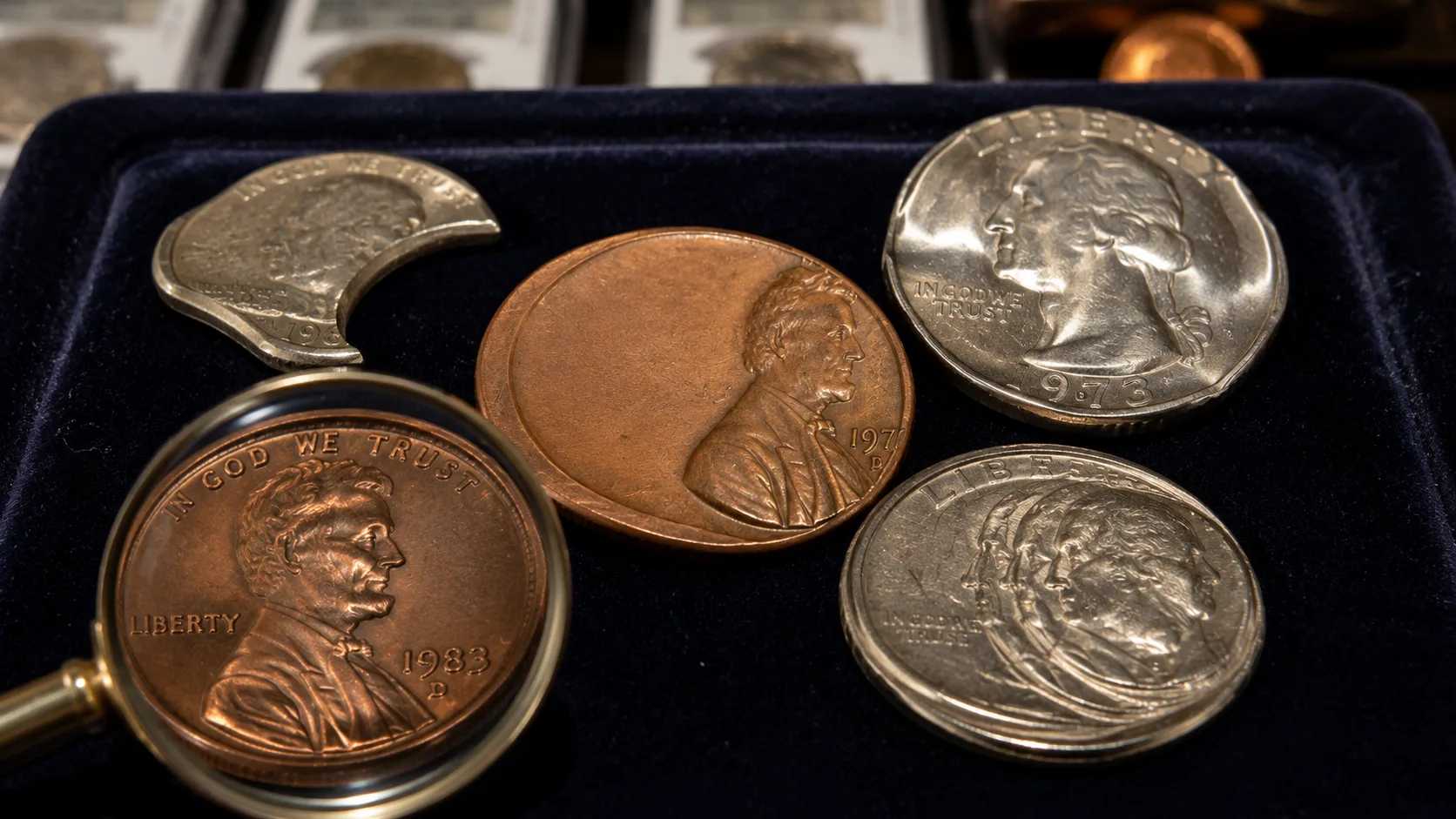
Finding a valuable coin in everyday pocket change sounds unlikely, but it happens more often than many people realize. While most coins are worth only their face value, certain mint errors can make otherwise ordinary coins highly desirable to collectors. Some of these errors have been discovered in circulation years after leaving the U.S. Mint, occasionally turning a few cents into a significant collectible.
For beginners, the challenge is knowing what to look for. Many valuable error coins are overlooked because people mistake them for damage, wear, or manufacturing defects that occurred after the coin entered circulation. Understanding the difference can help you avoid missing an important find.
Quick Answer
Some of the most valuable and collectible U.S. coin errors found in circulation include doubled dies, off-center strikes, broadstrikes, clipped planchets, wrong planchet errors, and dramatic die breaks. The value of any error coin depends on the type of error, the coin series, rarity, condition, collector demand, and whether the error has been authenticated by a reputable grading service.
What Makes a Coin Error Valuable?
A coin error occurs when something goes wrong during the minting process. Unlike post-mint damage, genuine mint errors happen before the coin leaves the mint.
Several factors influence value:
| Factor | Why It Matters |
|---|---|
| Rarity | Scarcer errors generally attract stronger collector demand. |
| Visibility | Dramatic, easily recognizable errors are often more desirable. |
| Coin Series | Errors on popular series can command stronger premiums. |
| Condition | Better-preserved examples usually bring higher prices. |
| Certification | Professional authentication helps verify legitimacy. |
| Demand | Collector interest varies across different error types. |
Before spending money on grading, collectors should compare their coin to verified examples from trusted numismatic references.
How to Tell a Real Mint Error From Damage
One of the most common mistakes beginners make is confusing damage with a legitimate mint error.
A genuine mint error is created during the manufacturing process. Damage occurs after the coin enters circulation.
Common examples of post-mint damage include:
- Scratches
- Tool marks
- Hammer damage
- Heat damage
- Altered dates
- Environmental corrosion
When evaluating a potential error coin, look for evidence that the abnormality occurred during striking rather than after the coin left the mint.
1. Doubled Die Errors
Doubled die errors are among the most famous and widely collected U.S. coin varieties.
These errors occur during die production when the design is improperly impressed onto the die multiple times at slightly different positions. Every coin struck by that die can display the same doubling.
What to Look For
Collectors should examine:
- Dates
- Mint marks (on older series where applicable)
- Lettering
- Mottoes
- Portrait details
The doubling appears as a distinct separation in design elements rather than a blurry or machine-doubled appearance.
Why Collectors Love Them
Many doubled die varieties are well documented and actively collected. Some have become key varieties within their respective series, making them highly sought after by specialists.
One of the most famous doubled die varieties ever discovered is featured in 1955 Doubled Die Lincoln Penny Value Guide: How to Identify This Famous Error Coin, a coin that remains a favorite among error specialists.
2. Off-Center Strike Errors
An off-center strike occurs when a coin blank is not properly positioned between the dies during striking.
As a result, part of the design is missing while the remaining design appears shifted toward one side.
Identification Tips
A genuine off-center strike will show:
- Missing design elements
- A blank crescent-shaped area
- Normal metal flow from striking
The percentage of the strike that is off-center plays a major role in desirability.
Value Factors
Collectors generally prefer examples that:
- Clearly display the date
- Show substantial displacement
- Remain visually dramatic
- Are found on popular coin series
Extremely minor off-center strikes often carry less collector interest than dramatic examples.
3. Clipped Planchet Errors
A clipped planchet error occurs before striking when part of the metal blank is improperly cut from the strip used to produce coin planchets.
The resulting coin has a curved or irregular missing section.
Types of Clips
Several clip varieties exist, including:
- Curved clips
- Straight clips
- Ragged clips
- Multiple clips
Curved clips are among the most commonly encountered.
How to Verify a Genuine Clip
Authentic clipped planchet errors often display characteristics associated with the minting process, including metal weakness opposite the clip area.
Because damaged coins can sometimes resemble clips, authentication becomes important for unusual examples.
4. Broadstrike Errors
Broadstrike errors occur when the retaining collar fails to properly contain the coin during striking.
Without the collar, the metal spreads outward more than normal.
What Broadstrikes Look Like
Typical characteristics include:
- Larger diameter
- Missing reeded or formed edge
- Fully struck design
- Expanded appearance
The coin often appears wider and thinner than a normal example of the same denomination.
Collector Appeal
Broadstrikes are popular because they are easy for beginners to recognize. While many broadstrikes are relatively affordable, dramatic examples on scarcer coin series can attract stronger collector interest.
5. Wrong Planchet Errors
Wrong planchet errors occur when a coin is struck on a blank intended for a different denomination or, in some cases, a different coinage composition.
These are among the most fascinating mint errors because they create coins with unusual sizes, weights, or metal compositions.
Signs of a Wrong Planchet Error
Potential indicators include:
- Unusual weight
- Incorrect diameter
- Different color or metal appearance
- Design extending beyond the planchet
Accurate identification often requires weighing the coin and comparing it to official specifications.
Why Authentication Matters
Many altered coins can resemble wrong planchet errors. Professional grading services frequently use precise measurements and advanced analysis to confirm authenticity.
Because of their complexity and rarity, authenticated wrong planchet errors are often among the most studied categories of U.S. mint errors.
Collectors researching major minting mistakes across different U.S. coin series should also review Jefferson Nickel Error Guide: Rare Errors, Valuable Varieties & Collector Tips, which covers some of the most sought-after error varieties in the Jefferson nickel series.
Common Beginner Mistakes When Searching for Error Coins
Before examining your spare change, avoid these common errors:
- Assuming every unusual coin is valuable.
- Confusing machine doubling with doubled dies.
- Mistaking damage for mint errors.
- Cleaning coins before evaluation.
- Ignoring weight and measurement specifications.
- Relying solely on social media claims.
Many coins promoted online as “rare errors” are actually damaged coins with little or no collector value.
Proper attribution is critical because many genuine varieties are frequently confused with damage, as explained in Rare Lincoln Wheat Penny Errors Worth Money: 12 Valuable Varieties Every Collector Should Know.
6. Strike-Through Errors
A strike-through error occurs when a foreign object comes between the die and the planchet during the striking process.
The object is struck into the coin and may leave an impression, indentation, or missing design area.
Common Strike-Through Materials
Foreign materials can include:
- Grease
- Cloth fibers
- Metal fragments
- Debris from the minting process
Grease-filled die errors are among the most frequently encountered examples, though they are generally less dramatic than strike-throughs involving solid objects.
How to Identify One
A genuine strike-through will typically show a recessed area where the foreign material prevented part of the design from being fully struck. Unlike damage, the affected area often blends naturally into the surrounding metal and reflects the minting process.
7. Die Crack and Die Break Errors
Minting dies endure tremendous pressure during production. Over time, cracks can develop in the die surface.
When a cracked die strikes a coin, metal flows into the crack, creating raised lines on the coin.
Die Cracks
Die cracks appear as raised lines because the crack exists in the die itself.
These lines may:
- Cross lettering
- Extend through the date
- Travel across portrait features
- Connect rim areas
Major Die Breaks
When a larger portion of the die breaks away, the resulting coin may display a raised blob of metal known among collectors as a cud.
Major die breaks are typically more desirable than minor cracks because they are easier to identify and often visually dramatic.
Collectors who enjoy studying visually dramatic minting mistakes may also want to explore Most Valuable Washington Quarter Errors Every Collector Should Know, which highlights some of the most famous quarter error varieties.
8. Die Rotation Errors
A properly struck U.S. coin should exhibit standard coin alignment.
If one side is rotated relative to the other, a die rotation error may have occurred.
How to Check
Hold the coin upright and rotate it vertically from top to bottom.
If the opposite side is not properly aligned, measure the degree of rotation.
Collector Interest
Minor rotations are relatively common and often carry limited premiums. Significant rotations, however, can attract collector attention, particularly when the rotation is substantial and easily visible.
Authentication is often recommended because precise measurement is important when evaluating these errors.
9. Mule Errors
Mule errors occur when dies intended for different coin types are mistakenly paired together.
These are among the rarest and most famous minting mistakes known in modern numismatics.
Why Mule Errors Are Important
A mule combines designs that were never intended to appear together on the same coin.
Because multiple production safeguards exist at modern mints, such mistakes are exceptionally uncommon.
What Collectors Should Know
Most collectors will never encounter a mule error in circulation. However, documented examples demonstrate that major minting mistakes can occasionally escape into the marketplace.
Because of their rarity and complexity, any suspected mule should be evaluated by a recognized grading and authentication service.
10. Double-Struck Errors
A double-struck coin receives more than one strike from the dies.
Depending on how the coin moves between strikes, the second impression may overlap the first or appear dramatically offset.
Characteristics of Double-Struck Coins
Collectors often look for:
- Multiple dates or lettering impressions
- Overlapping design elements
- Shifted portraits
- Visible secondary strikes
The more dramatic the displacement between strikes, the easier the error is to identify.
Why They Are Popular
Double-struck coins provide a clear visual illustration of what went wrong during the minting process. Their appearance often makes them popular among both beginning and advanced collectors.
Which Error Types Are Usually the Most Valuable?
No error category automatically guarantees high value. However, collectors generally place strong interest on:
| Error Type | Typical Collector Interest |
|---|---|
| Wrong Planchet | Often very strong |
| Mule Errors | Extremely strong |
| Major Doubled Dies | Very strong |
| Dramatic Double Strikes | Strong |
| Major Off-Center Strikes | Strong |
| Significant Die Breaks | Moderate to strong |
| Broadstrikes | Moderate |
| Clipped Planchets | Moderate |
| Strike-Through Errors | Varies widely |
| Die Rotations | Depends on degree |
Actual market value depends on rarity, condition, certification status, and collector demand at the time of sale.
How Coin Grading Affects Error Coin Values
Two coins with the same error can have dramatically different market values depending on condition.
Professional grading services evaluate factors such as:
- Wear
- Surface preservation
- Strike quality
- Eye appeal
- Authenticity
Why Certification Matters
Certification can:
- Verify the error type
- Confirm authenticity
- Increase buyer confidence
- Improve marketability
For significant errors, third-party authentication is often considered an important step before selling.
Where Should You Sell a Valuable Error Coin?
Collectors have several options when selling authenticated error coins.
Coin Dealers
Experienced dealers can provide quick evaluations and immediate offers.
Coin Shows
Coin shows allow sellers to compare offers from multiple professionals.
Major Auction Houses
Exceptional errors may perform best through established numismatic auction firms, particularly when the coin is rare, certified, and in strong demand.
Historic auction results often help illustrate the importance of rarity and collector demand, as seen in The 1893-S Morgan Dollar That Sold for Over $2 Million: Why It’s the King of Morgan Dollars.
Online Marketplaces
Online selling can reach a large audience, but proper attribution and authentication are especially important when listing error coins.
Tips for Searching Circulation Coins
Many collectors build valuable collections simply by examining coins they receive in everyday transactions.
A few practical habits can improve your chances:
- Check dates carefully.
- Examine lettering under magnification.
- Learn the appearance of known varieties.
- Weigh suspicious coins when possible.
- Compare findings with trusted references.
- Store potential discoveries safely.
- Never clean coins.
Patience is often the most important tool in circulation searching.
Frequently Asked Questions
Are coin errors the same as coin varieties?
No. A mint error results from a mistake during production, while a variety typically results from a difference in the die itself. Some categories, such as doubled dies, are often classified as varieties rather than one-time minting errors.
Can valuable error coins still be found in circulation?
Yes. Although major discoveries are uncommon, collectors continue to find legitimate mint errors in circulation, bank rolls, estate holdings, and inherited collections.
Should I clean an error coin before having it evaluated?
No. Cleaning can permanently damage a coin’s surface and may reduce collector interest. Most professionals recommend leaving the coin in its original condition.
How can I tell if my coin is a real mint error?
Compare the coin with verified examples from trusted numismatic references. If the coin appears significant, professional authentication can help confirm whether it is a genuine mint error or post-mint damage.
For an example of a widely recognized variety that requires careful attribution, see 1955 Doubled Die Lincoln Penny Value Guide: How to Identify This Famous Error Coin.
Are all error coins valuable?
No. Some errors are common and carry only modest premiums, while others are exceptionally rare. Value depends on rarity, visibility, condition, demand, and authentication.
Do modern coins have mint errors?
Yes. Mint errors can occur on both modern and older coinage. Improvements in quality control have reduced many error types, but mistakes still occasionally reach circulation.
Conclusion
Rare coin errors remain one of the most fascinating areas of numismatics because they reveal the manufacturing process behind America’s coinage. From doubled dies and off-center strikes to wrong planchet errors and dramatic double strikes, these mistakes offer collectors an opportunity to discover something unusual in ordinary pocket change.
The key to successful error collecting is education. Learning how genuine mint errors form, understanding the difference between errors and damage, and relying on trusted numismatic references can help collectors make informed decisions. While most circulation finds will not be life-changing discoveries, a careful eye and a little knowledge can occasionally uncover a coin that stands far above face value.
Collectors interested in discovering more famous error coins should also read Top 10 Lincoln Penny Errors Worth Big Money, which showcases some of the most sought-after Lincoln cent varieties.
References
- United States Mint
- Professional Coin Grading Service (PCGS)
- Numismatic Guaranty Company (NGC)
- American Numismatic Association (ANA)
- Heritage Auctions Archives
- Stack’s Bowers Galleries Auction Archives
- Newman Numismatic Portal

Narayan Kumar is the Founder and Author of Worth My Coins. She specializes in U.S. coin collecting, with a focus on coin identification, mint errors, grading, rare varieties, and collector education. Her goal is to publish accurate, well-researched, and easy-to-understand guides that help both new and experienced collectors make informed decisions. Every article is created using trusted numismatic references and is written with a commitment to accuracy, transparency, and long-term educational value.