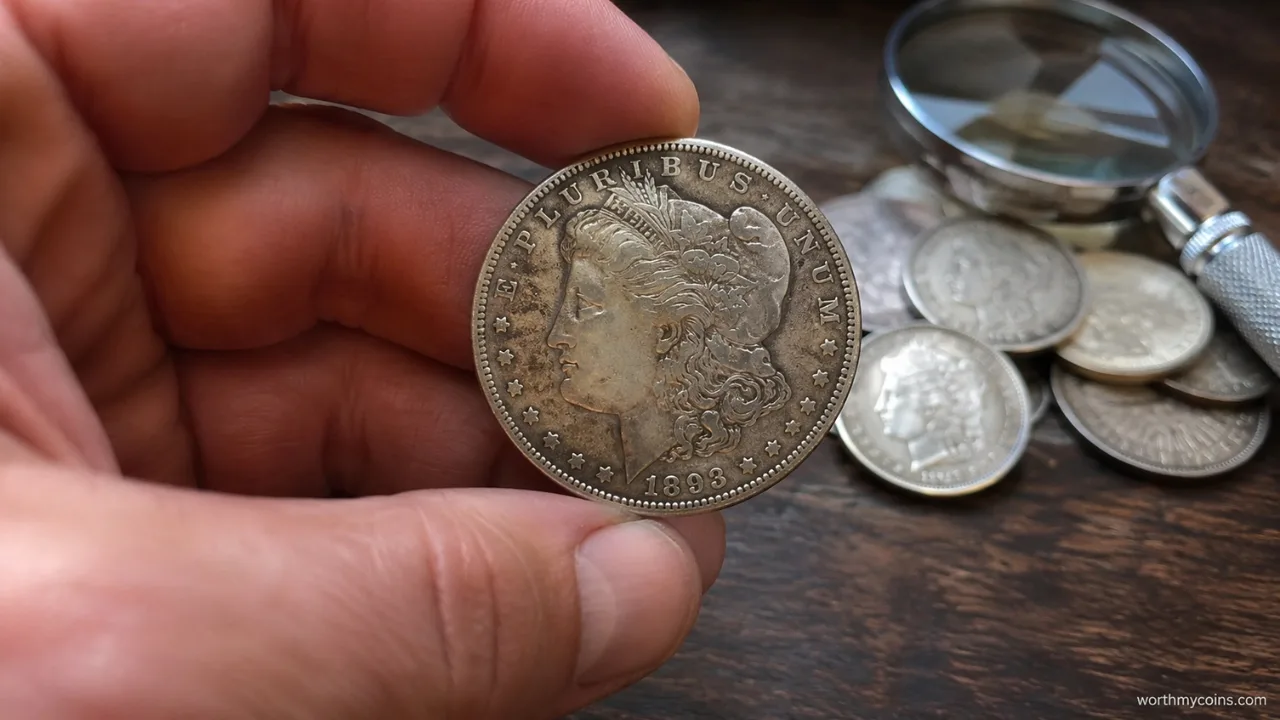
The 1893-S Morgan Dollar is often called the “King of Morgan Dollars,” and for good reason. With the lowest business-strike mintage in the series and very few surviving examples, it has become one of the most sought-after U.S. coins ever produced.
Although record-breaking auction sales often capture the headlines, the 1893-S earned its legendary reputation through exceptional rarity, historical significance, and generations of steady collector demand. Those qualities—not just its price—have made it the undisputed key date of the Morgan Dollar series.
This guide explains why the 1893-S is so special, how to identify an authentic example, and what collectors should know before considering one for their collection.
Coin Specifications
| Specification | Details |
|---|---|
| Coin | Morgan Dollar |
| Year | 1893 |
| Mint | San Francisco |
| Mint Mark | S |
| Designer | George T. Morgan |
| Composition | 90% Silver, 10% Copper |
| Weight | 26.73 grams |
| Diameter | 38.1 mm |
| Edge | Reeded |
| Face Value | One Dollar |
Historical Background
The Morgan Dollar was introduced in 1878 following the passage of the Bland-Allison Act, which required the U.S. government to purchase large amounts of silver for coinage. Designed by George T. Morgan, the coin quickly became one of the most recognizable pieces in American numismatic history.
Collectors who want to understand how the 1893-S compares with other dates and mint marks can start with our Morgan Dollar Value Guide: Rare Dates, Mint Errors & Collector Tips, which provides a broader look at the series.
By the early 1890s, silver coin production had slowed significantly. The year 1893 became especially notable because several Morgan Dollar issues from that year were produced in relatively small numbers compared to earlier dates.
Among them, the San Francisco Mint produced only 100,000 business-strike Morgan Dollars in 1893, the lowest business-strike mintage of the entire Morgan Dollar series. Although low mintage alone does not always create rarity, the 1893-S became exceptionally scarce because relatively few examples survived decades of circulation, melting, and normal wear.
Unlike many other Morgan Dollar dates that were stored in Treasury vaults and later released in the twentieth century, few bags of 1893-S dollars were preserved. As a result, surviving examples are scarce, and collectors seeking a complete Morgan Dollar set face one of the series’ most difficult key dates.
Why Is the 1893-S Morgan Dollar Called the King of Morgan Dollars?
Many rare Morgan Dollars command impressive prices, but the 1893-S occupies a unique position in the series.
Several factors contribute to its legendary status:
- Lowest business-strike mintage of the Morgan Dollar series.
- Very few surviving Mint State examples.
- Heavy collector demand for complete Morgan Dollar sets.
- Strong historical importance.
- Consistent popularity across generations of collectors.
Even well-worn examples are considered major key-date coins. High-grade pieces become exponentially rarer, which explains why certified gem-quality examples have achieved multimillion-dollar auction prices.
Unlike many collectible coins that become valuable only in Mint State, the 1893-S Morgan Dollar is considered a key date across all grades because surviving examples are so limited.
A famous high-grade 1893-S Morgan Dollar has brought more than $2 million at auction, showing how dramatically the market can change when an exceptional, authenticated specimen comes to market. That result applies to an elite example and should not be treated as a typical value for every 1893-S.
How to Identify a Genuine 1893-S Morgan Dollar
Quick Authentication Checklist
| Check | Genuine 1893-S Morgan Dollar |
|---|---|
| Date | 1893 |
| Mint Mark | S (reverse above “DO” in DOLLAR) |
| Weight | 26.73 grams |
| Diameter | 38.1 mm |
| Composition | 90% silver, 10% copper |
| Authentication | Professional certification strongly recommended |
Because of its tremendous value, the 1893-S Morgan Dollar is one of the most frequently counterfeited coins in U.S. numismatics.
Collectors should know the basic identification features before considering any purchase.
Obverse Features
Look for:
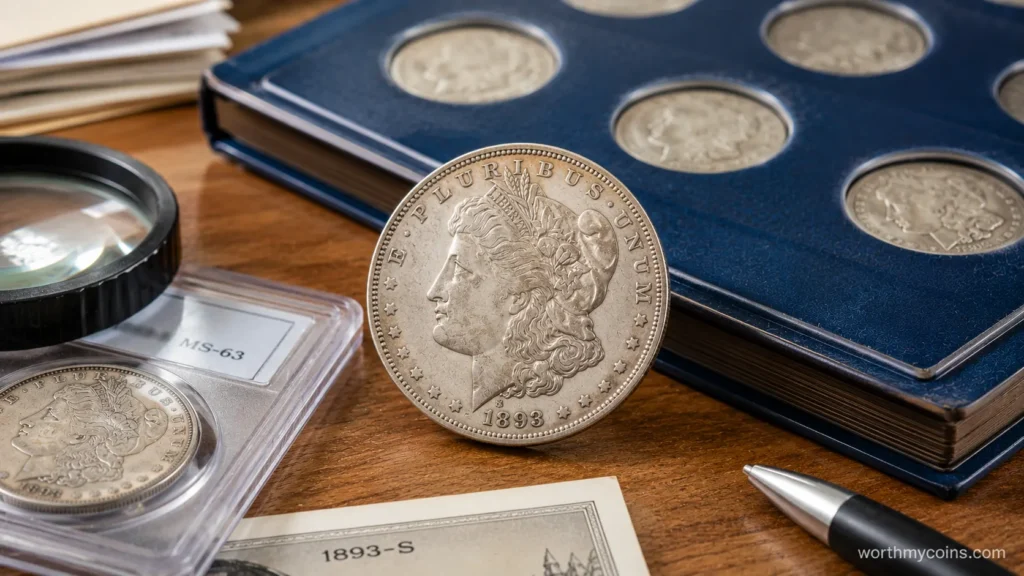
- Lady Liberty facing left.
- “E PLURIBUS UNUM” above the portrait.
- Seven stars on the left.
- Six stars on the right.
- Date “1893” below Liberty.
George T. Morgan’s detailed portrait includes cotton blossoms, wheat, and a Phrygian cap within Liberty’s crown.
Reverse Features
The reverse displays:
- Heraldic eagle with wings spread.
- Olive branch and arrows.
- “UNITED STATES OF AMERICA.”
- “ONE DOLLAR.”
- “IN GOD WE TRUST.”
Mint Mark Location
The identifying “S” mint mark appears on the reverse beneath the wreath and above the letters “DO” in “DOLLAR.”
Collectors should never rely on the mint mark alone. A counterfeit or altered Morgan Dollar can have a convincing-looking date or mint mark while still failing other diagnostic checks.
Weight, diameter, design details, surfaces, and die characteristics can help identify suspicious pieces, but these checks are screening tools rather than proof of authenticity. For an 1893-S, professional authentication and certification are especially appropriate because of the coin’s rarity and value.
Professional authentication is strongly recommended for any suspected genuine example.
Mint Mark Comparison
| Mint | Mint Mark | Notes |
| Philadelphia | None | No mint mark |
| New Orleans | O | Produced in New Orleans |
| Carson City | CC | Highly collectible western mint |
| San Francisco | S | Mint that struck the famous 1893-S issue |
| Denver | D | Not used for Morgan Dollars until the series resumed in 1921 |
Why Is the 1893-S Morgan Dollar Worth More Than $2 Million?
Age is only one part of the story. For an 1893-S Morgan Dollar, rarity, grade, originality, authentication, eye appeal, and current market demand can all have a major effect on what a particular example brings.
1. Extremely Low Mintage
The official production of only 100,000 coins remains the lowest regular-issue Morgan Dollar mintage.
2. Low Survival Rate
Many original coins entered circulation and experienced decades of use. Others were likely melted under later silver legislation. Consequently, surviving examples are far fewer than the original production figure.
3. Condition
Condition has an enormous impact on value.
Circulated examples are scarce.
About Uncirculated examples are much rarer.
Mint State coins become dramatically scarcer as grade increases.
Gem-quality certified examples represent only a tiny fraction of surviving coins.
4. Authentication
Professional grading by respected third-party grading services gives buyers confidence that the coin is genuine and accurately graded.
For a key-date rarity like the 1893-S, certification also provides an independently verified record of authenticity and preservation, making the coin easier to evaluate when buying, selling, or insuring it.
5. Collector Demand
Morgan Dollars remain one of the most actively collected U.S. coin series. Every collector attempting a complete date-and-mint collection eventually encounters the 1893-S as the greatest challenge.
Collectors building a date-and-mint Morgan Dollar collection can also compare the 1893-S with the later 1921 Morgan Silver Dollar Value Guide: Rare Mint Marks, Errors & Current Prices, another important issue to understand when studying the series.
Coin Grading Overview
Understanding grading helps explain why prices vary so dramatically.
| Grade | General Description |
| Good (G) | Heavy wear with major design visible |
| Very Good (VG) | More lettering and major details remain |
| Fine (F) | Moderate wear with stronger details |
| Very Fine (VF) | Moderate to light wear with noticeable detail |
| Extremely Fine (XF) | Light wear on highest points |
| About Uncirculated (AU) | Slight wear with most mint luster remaining |
| Mint State (MS60-MS70) | No circulation wear; quality varies by numerical grade |
Because differences of just one or two grading points can significantly affect collector demand, buyers should rely on certified examples whenever possible.
Auction Records and Market Performance
The 1893-S Morgan Dollar has consistently ranked among the most valuable regular-issue Morgan Dollars sold at major public auctions.
Exceptional certified Mint State examples have commanded multimillion-dollar auction prices. These results reflect the specific grade, preservation, eye appeal, provenance, certification, and market conditions of those individual coins rather than a standard value for the entire issue.
It’s important to remember that these record-setting sales involve extraordinary specimens. Prices for other examples vary considerably based on condition, originality, certification, and current collector demand. Rather than relying on generalized price estimates, collectors should consult recent auction archives from established firms and current price guides from reputable grading organizations.
Verified Error Varieties
Unlike some other Morgan Dollar dates, the 1893-S is not primarily collected for dramatic mint errors.
Collectors instead focus on originality, preservation, and certified authenticity.
| Variety | Status |
| Major doubled dies | No widely recognized major collectible variety |
| Repunched mint marks | No major standard variety widely collected |
| Die cracks | Minor examples may exist on individual dies |
| Die polishing | Can occur on individual specimens |
| Counterfeit or altered coins | Extremely common; authentication is essential |
Most advanced collectors prioritize obtaining an authentic example rather than searching for unusual die varieties.
Why Authentication Is Essential for an 1893-S Morgan Dollar
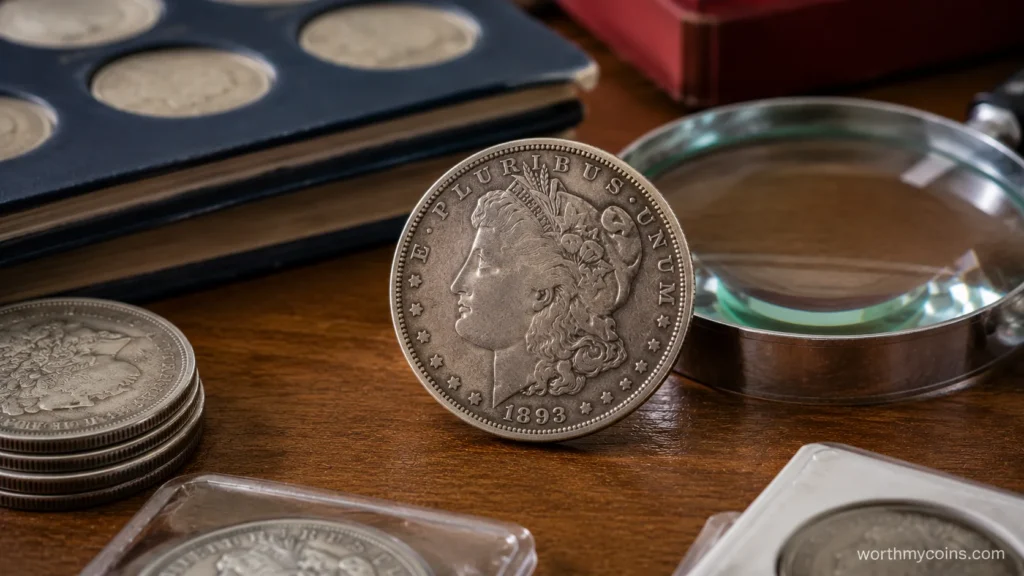
Due to its rarity and value, the 1893-S Morgan Dollar has been heavily counterfeited for decades.
Common problems include:
- Added “S” mint marks.
- Altered dates.
- Cast counterfeits.
- Modern struck counterfeits.
- Artificial toning.
- Cleaned or repaired coins sold as original.
For these reasons, purchasing only certified examples from reputable dealers or established auction companies is considered best practice.
Collectors should be especially cautious of unusually low-priced examples offered without certification. Because authentic 1893-S Morgan Dollars are exceptionally scarce, prices that appear too good to be true often deserve additional scrutiny.
Tips for Collectors
If you’re interested in adding a 1893-S Morgan Dollar to your collection, patience is essential.
Consider these recommendations:
- Learn the grading standards before buying.
- Purchase coins authenticated by respected third-party grading services.
- Compare multiple certified examples rather than rushing into a purchase.
- Study auction archives to understand market trends.
- Buy from reputable dealers with established reputations.
- Keep documentation, certification numbers, and purchase records.
Pay attention to the coin itself, not just the grade on the holder. Surface quality, originality, eye appeal, and the quality of the strike can make two coins with the same numerical grade look very different.
Many collectors would rather own a genuine lower-grade example than spend years waiting for a high-grade coin that may never fit their budget.
Common Mistakes to Avoid
Even experienced collectors can make costly mistakes when pursuing rare coins.
Avoid these common pitfalls:
Buying Uncertified Examples
Given the number of counterfeits in the marketplace, uncertified examples present substantial risk.
Focusing Only on Price
A lower price isn’t always a bargain. Original surfaces, authenticity, and proper grading matter far more.
Ignoring Cleaning
Improper cleaning can significantly reduce collector appeal and market value.
Trusting Online Photos Alone
Photographs rarely reveal every important detail. Certification and seller reputation remain essential.
Assuming Every 1893-S Is Worth Millions
Only exceptional, elite-grade examples have achieved multimillion-dollar auction results. Values vary significantly depending on condition, certification, originality, and market demand.
Why the 1893-S Continues to Fascinate Collectors
Few U.S. coins combine historical significance, rarity, and collector demand as effectively as the 1893-S Morgan Dollar.
Its story reflects more than a low production number. It represents the challenges of survival, the importance of authentication, and the passion of generations of collectors seeking to complete one of America’s most beloved coin series.
Whether viewed as an investment-grade rarity or simply admired as a landmark in American numismatic history, the 1893-S remains one of the defining coins of U.S. coin collecting.
Conclusion
The 1893-S Morgan Dollar remains the key date that every serious Morgan Dollar collector knows. Its tiny mintage, extremely low survival rate, and lasting collector demand have made it one of the most respected coins in American numismatics.
While multimillion-dollar auction results grab attention, the real value of this coin lies in its rarity and historical significance. Anyone considering the purchase of a 1893-S should focus on authenticity, condition, and certification before anything else.
Even if owning one isn’t realistic for most collectors, learning about the 1893-S offers a better understanding of why certain coins become true legends in the hobby.
If you’re interested in exploring another iconic American coin series, our Lincoln Wheat Penny Value Guide (1909–1958): Prices, Errors & Rare Coins explains the key dates, valuable varieties, and collecting history that have made Lincoln cents favorites among collectors for generations.
Frequently Asked Questions
Why is the 1893-S Morgan Dollar so rare?
It has the lowest business-strike mintage in the Morgan Dollar series, and relatively few examples survived after years of circulation, melting, and normal attrition.
Is every 1893-S Morgan Dollar worth millions?
No. Only exceptional, high-grade certified examples have sold for more than $2 million at auction. The value of any individual coin depends on its authenticity, grade, condition, originality, and current market demand.
Where is the mint mark located?
The “S” mint mark appears on the reverse below the wreath and above the word “DOLLAR.”
Should I buy a raw 1893-S Morgan Dollar?
Because the coin is widely counterfeited, collectors generally recommend purchasing professionally authenticated and graded examples from reputable dealers or established auction firms.
Why is the 1893-S Morgan Dollar considered a key date?
A key date is a coin that is especially difficult to obtain compared with others in the same series. The 1893-S is widely recognized as the key date of the Morgan Dollar series because of its extremely low mintage and limited number of surviving examples.
Which grading services are most trusted?
The Professional Coin Grading Service (PCGS) and Numismatic Guaranty Company (NGC) are among the most widely respected third-party grading services in the United States.
Can I authenticate a 1893-S Morgan Dollar at home?
Basic checks such as verifying the weight, diameter, and design details may help identify obvious problems, but they cannot confirm authenticity. Because of the coin’s value and the number of sophisticated counterfeits, professional authentication remains essential.
References
This guide is based on published United States Mint information, recognized third-party grading standards, auction archives, and established numismatic references. Because of the rarity and value of the 1893-S Morgan Dollar, professional authentication should always take precedence over online claims or visual inspection alone.
- United States Mint –
- Professional Coin Grading Service (PCGS) –
- Numismatic Guaranty Company (NGC) –
- American Numismatic Association (ANA) –
- Heritage Auctions Auction Archives –
- Stack’s Bowers Galleries Auction Archives –
- Newman Numismatic Portal –

Narayan Kumar is the Founder and Author of Worth My Coins. She specializes in U.S. coin collecting, with a focus on coin identification, mint errors, grading, rare varieties, and collector education. Her goal is to publish accurate, well-researched, and easy-to-understand guides that help both new and experienced collectors make informed decisions. Every article is created using trusted numismatic references and is written with a commitment to accuracy, transparency, and long-term educational value.