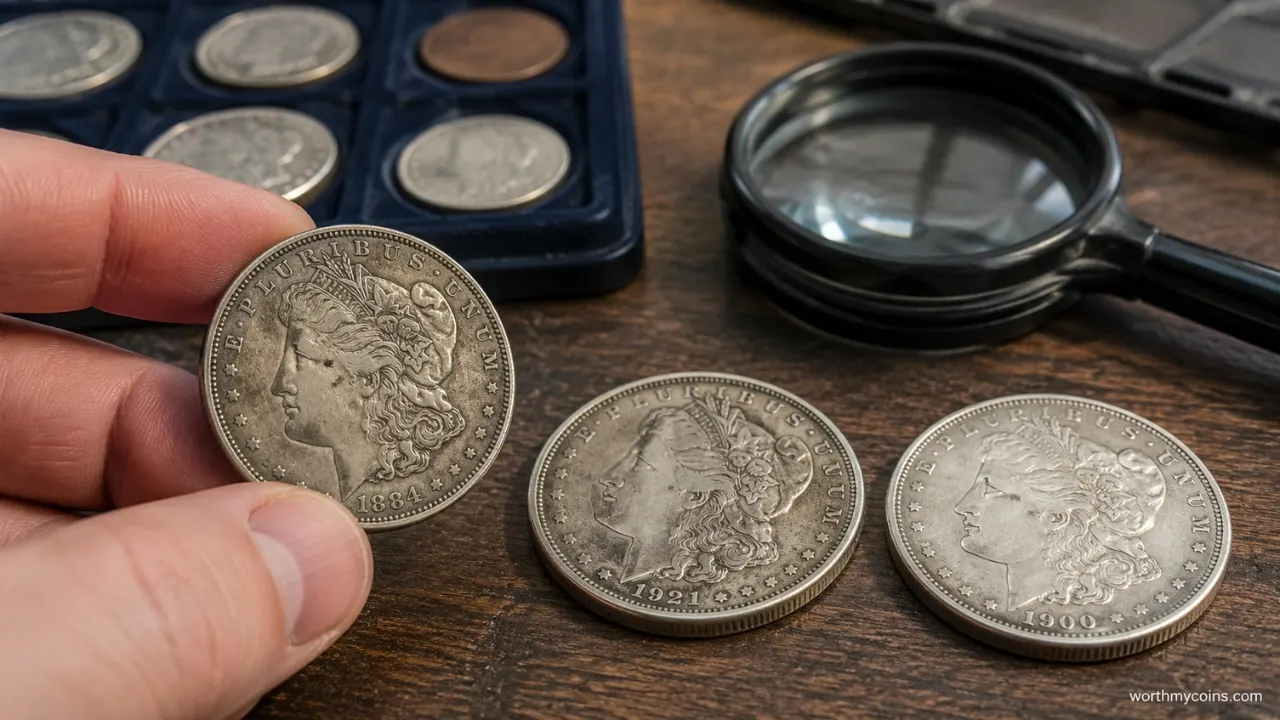
The Morgan Dollar is one of the most recognizable and widely collected coins in American numismatics. First struck in 1878, it represents an important period in U.S. history when vast quantities of silver from western mines were transformed into circulating coinage. More than a century later, Morgan Dollars remain favorites among beginners and advanced collectors alike because of their rich history, beautiful design, and the possibility of discovering valuable dates, mint marks, and varieties.
If you’re researching a Morgan Dollar’s value, it’s important to understand that no single price applies to every coin. The value depends on several factors, including the date, mint mark, condition, originality, rarity, authentication, and current collector demand. While some common Morgan Dollars trade primarily for their silver content when heavily worn, scarcer dates and high-grade examples can command significant premiums.
Whether you inherited a Morgan Dollar or recently added one to your collection, the first step is learning how to identify it correctly. This guide covers the key dates, mint marks, grading basics, and the factors collectors use when deciding what a Morgan Dollar might be worth.
History of the Morgan Dollar
The Morgan Dollar was introduced in 1878 following passage of the Bland-Allison Act, which required the U.S. government to purchase large quantities of domestically mined silver and convert much of it into silver dollars. The coin was designed by English-born engraver George T. Morgan, who served as an assistant engraver at the United States Mint before eventually becoming its Chief Engraver.
Unlike earlier Liberty designs that were based largely on classical artwork, Morgan used an American model for Liberty’s portrait. The reverse features a bald eagle with outstretched wings holding arrows and an olive branch, symbolizing both military strength and peace.
Production continued from 1878 through 1904 before ending due to a shortage of silver bullion available under existing legislation. Morgan Dollar production resumed briefly in 1921 before the design was replaced later that same year by the Peace Dollar, which commemorated the end of World War I.
Today, Morgan Dollars remain one of the most collected U.S. coin series because they combine historical significance, large silver content, and an impressive variety of collectible dates, mint marks, and die varieties.
Morgan Dollar Specifications
| Specification | Details |
|---|---|
| Designer | George T. Morgan |
| Years Issued | 1878–1904, 1921 |
| Country | United States |
| Denomination | One Dollar |
| Composition | 90% Silver, 10% Copper |
| Weight | 26.73 grams |
| Diameter | 38.1 mm |
| Edge | Reeded |
| Mint Authority | United States Mint |
Because every Morgan Dollar contains 90% silver, bullion prices can influence the minimum value of heavily circulated examples. However, collectible value often exceeds silver value for many dates and mint marks.
How to Identify a Morgan Dollar
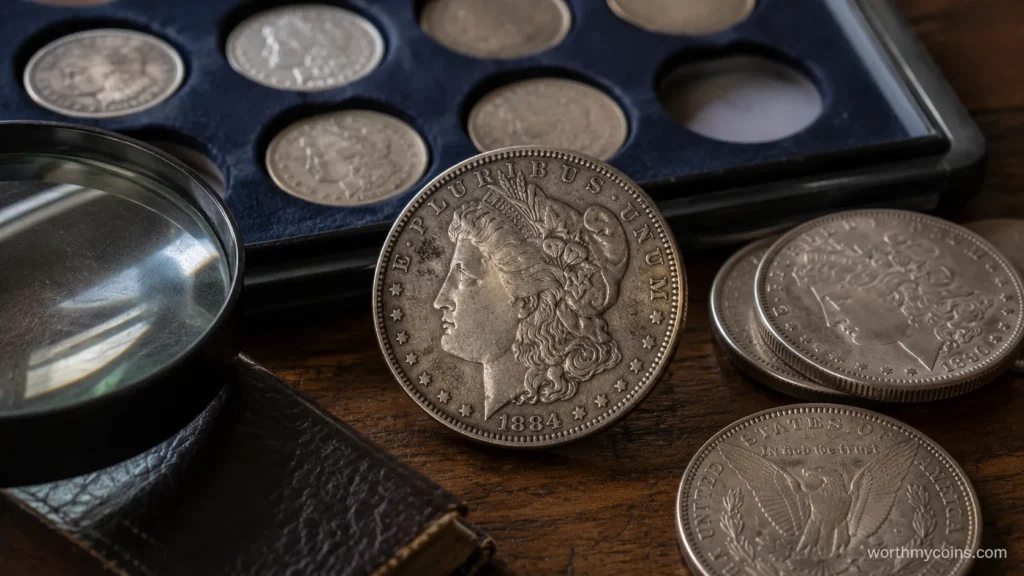
Before researching value, always verify the coin’s date, mint mark, and overall condition. These details provide the foundation for accurate identification and pricing.
Correct identification is the first step toward determining whether a Morgan Dollar may have collectible value.
Obverse Design
The front of the coin features Liberty wearing a Phrygian cap decorated with wheat and cotton, representing America’s agricultural heritage. Around the edge appears the inscription “E PLURIBUS UNUM,” while the date is centered at the bottom.
Reverse Design
The reverse depicts a heraldic eagle with extended wings surrounded by a wreath. Above the eagle appears “UNITED STATES OF AMERICA,” while the denomination “ONE DOLLAR” is displayed along the lower rim.
The designer’s initial “M” appears on both sides of the coin as a subtle tribute to George T. Morgan’s work.
Morgan Dollar Mint Marks
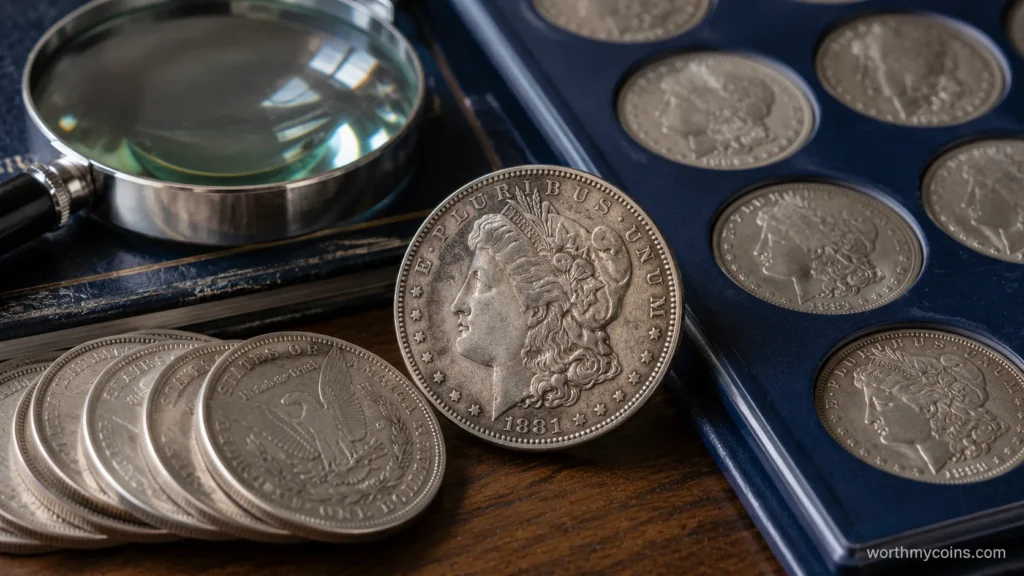
Morgan Dollars were struck at several United States Mint facilities. Identifying the mint mark is essential because the same date can have dramatically different collector demand depending on where it was produced.
The mint mark appears on the reverse beneath the wreath and above the letters “DO” in “DOLLAR.”
| Mint | Mint Mark | Location |
| Philadelphia | None | No mint mark |
| Carson City | CC | Reverse beneath wreath |
| New Orleans | O | Reverse beneath wreath |
| San Francisco | S | Reverse beneath wreath |
| Denver | D | 1921 only |
| New Orleans (historic issues) | O | Reverse beneath wreath |
Among these, Carson City Morgan Dollars are especially popular because the mint operated for a relatively short period and is closely associated with the silver mining boom of the American West. However, not every Carson City coin is automatically rare, and rarity varies considerably by individual date and surviving population.
What Determines Morgan Dollar Value?
Many new collectors assume that age alone determines a coin’s worth. In reality, several factors work together to establish market value.
Date and Mintage
Certain production years had lower mintages than others, while some dates experienced heavy circulation that reduced the number of surviving high-quality examples. A coin’s date should always be considered alongside its mint mark rather than by itself.
Mint Mark
The mint where a Morgan Dollar was struck can significantly influence collector demand. Coins from Carson City, San Francisco, New Orleans, Philadelphia, and Denver each have their own collecting patterns and availability.
Condition
Condition is often one of the most important factors affecting value. A well-preserved Morgan Dollar with sharp detail, minimal wear, and original surfaces will generally be more desirable than a heavily circulated example of the same date.
Professional grading services evaluate preservation using standardized grading scales, helping buyers and sellers communicate consistently about a coin’s condition.
Original Surfaces
Collectors generally prefer coins that retain original surfaces and natural toning. Improper cleaning, polishing, harsh chemical treatments, or abrasive handling can permanently reduce collector appeal even when the coin appears shiny.
Authentication
Because Morgan Dollars are widely collected, counterfeit examples do appear in the marketplace. If you own a valuable date, an unusual variety, or a high-grade coin, professional authentication is one of the best ways to confirm that it’s genuine before buying, selling, or adding it to a collection.
These same collecting principles apply across many classic U.S. coins. Our Lincoln Wheat Penny Value Guide (1909–1958): Prices, Errors & Rare Coins explains how rarity, condition, and mint varieties influence values in another of America’s most popular coin series.
Understanding Morgan Dollar Grades
Coin grading measures the amount of wear and overall preservation. Even two Morgan Dollars with the same date and mint mark can have dramatically different values depending on grade.
| Grade | Description |
| Good (G) | Heavy wear with major design visible |
| Very Good (VG) | Moderate to heavy wear with stronger details |
| Fine (F) | Moderate wear; major features remain clear |
| Very Fine (VF) | Light to moderate wear across high points |
| Extremely Fine (XF) | Only slight wear with most details remaining sharp |
| About Uncirculated (AU) | Very slight friction on highest points |
| Mint State (MS) | No circulation wear; graded from MS60 through MS70 |
Beyond wear, experienced collectors also examine strike quality, luster, surface preservation, eye appeal, and contact marks when evaluating Mint State Morgan Dollars.
For expensive or potentially rare coins, certification by leading grading companies provides standardized grading and authentication that many collectors and dealers rely upon during buying and selling.
Verified Morgan Dollar Errors and Important Varieties
Morgan Dollars are well known for their numerous die varieties, but it’s important to separate true mint-made errors from post-mint damage. Coins that have been scratched, drilled, polished, or altered after leaving the Mint are generally not considered mint errors and often carry lower collector value.
Below are several well-documented Morgan Dollar varieties recognized by major numismatic references.
| Variety | Description | Notes |
|---|---|---|
| 1878 8 Tail Feathers | Early reverse design featuring eight tail feathers | Historic first-year variety |
| 1878 7 Tail Feathers | Modified reverse after design correction | Commonly collected alongside the 8TF variety |
| 1878 7/8 Tail Feathers | Transitional variety showing remnants of both designs | Popular with variety collectors |
| 1878 Reverse of 1878 | Early reverse hub style | Recognized by specialists |
| 1879 Reverse of 1878 | Transitional hub variety | Scarcer than standard issues |
| Doubled Die Varieties | Doubling caused during die creation | Must be authenticated individually |
| Repunched Mint Marks (RPMs) | Mint mark punched more than once into the die | Found on selected dates and mints |
Some Morgan Dollar varieties can be valuable, while others carry only modest premiums. Their desirability depends on the specific variety, rarity, grade, and current collector demand. Always compare your coin with photographs published by trusted grading organizations before assuming you have a rare discovery.
Collectors who enjoy studying famous mint-produced rarities may also appreciate the 1943 Bronze Lincoln Wheat Penny Value Guide, which covers one of the most celebrated accidental error coins in U.S. Mint history.
Rare Morgan Dollar Dates Every Collector Should Know
Certain Morgan Dollar dates have become key coins because of lower mintages, lower survival rates, or strong collector demand.
Examples include:
- 1889-CC
- 1893-S
- 1893-CC
- 1894
- 1895 (Proof issue)
- 1895-O
- 1901
These dates are among the better-known keys in the series, but even common dates can become desirable when preserved in exceptional Mint State grades or when displaying attractive original toning.
It’s worth remembering that rarity alone does not determine value. A common Morgan Dollar in outstanding condition may sell for considerably more than a scarce date in heavily worn condition.
Why Morgan Dollar Values Vary So Much
Many collectors are surprised to learn that two Morgan Dollars with the same date can differ greatly in market value.
Several factors contribute to these differences:
Grade
A small increase in grade—especially among Mint State coins—can significantly affect collector demand. Coins with fewer contact marks, stronger luster, and better eye appeal often command higher prices.
Certified Authenticity
Coins authenticated and graded by respected third-party grading services are generally easier to buy and sell because collectors have greater confidence in their authenticity and assigned grade.
Original Toning
Natural toning formed over decades can be highly desirable when it enhances a coin’s appearance. Brilliant rainbow toning or attractive peripheral color may increase collector interest, while artificial toning often decreases confidence.
Strike Quality
Some Morgan Dollars were struck with stronger details than others. Sharp hair detail above Liberty’s ear and strong breast feathers on the eagle are often indicators of a better strike.
Collector Demand
Even when rarity remains unchanged, collector demand can fluctuate over time. Popular dates, historic mint marks, and beautifully preserved examples often receive more attention at auctions and coin shows.
Because market conditions change, there is no permanent value guide that applies to every Morgan Dollar. Current auction records and recent sales are often better indicators than outdated printed price lists.
Should You Clean a Morgan Dollar?
In nearly every case, the answer is no.
Cleaning is one of the most common mistakes made by new collectors. While a cleaned coin may initially appear brighter, experienced collectors and grading services can usually identify evidence of cleaning.
Common forms of damage include:
- Hairline scratches from polishing
- Loss of natural mint luster
- Chemical discoloration
- Artificial brightness
- Altered surface texture
Once original surfaces are damaged, the coin’s collector appeal may be permanently reduced.
If a Morgan Dollar appears dirty or tarnished, it’s generally best to leave it untouched until it can be evaluated by an experienced numismatist.
Tips for Collecting Morgan Dollars
Morgan Dollars offer countless collecting possibilities, making them enjoyable for both beginners and advanced hobbyists.
Here are several practical tips:
- Learn to identify mint marks before purchasing.
- Buy the best condition your budget allows.
- Study grading standards using reputable references.
- Purchase from established coin dealers whenever possible.
- Store coins in archival-quality holders designed for long-term preservation.
- Keep detailed records of purchases and certifications.
- Compare multiple recent auction results before making major purchases.
- Consider certified examples for expensive or key dates.
Many collectors build complete date-and-mint collections, while others specialize in Carson City issues, toned dollars, VAM varieties, or high-grade Mint State examples.
Common Mistakes New Collectors Make
Even experienced collectors occasionally make mistakes, but beginners can avoid many problems by slowing down and researching before buying.
Some of the most common mistakes include:
Assuming Every Old Morgan Dollar Is Rare
Although Morgan Dollars are historic coins, millions were produced. Age alone does not guarantee rarity or high value.
Ignoring Mint Marks
A small mint mark can dramatically change collector demand. Always examine the reverse carefully before researching value.
Buying Unauthenticated Key Dates
Because counterfeit Morgan Dollars exist, valuable dates should be authenticated whenever possible before significant money changes hands.
Trusting Internet Price Claims
Social media posts and online videos sometimes exaggerate coin values. Always verify information using trusted numismatic references and recent auction records.
Improper Storage
Exposure to humidity, PVC-containing holders, fingerprints, or harsh environments can permanently damage silver coins.
The answers below cover several of the questions collectors most frequently ask when researching Morgan Dollars.
Frequently Asked Questions
Are all Morgan Dollars made of silver?
Yes. Morgan Dollars were struck in a composition of 90% silver and 10% copper.
Where is the mint mark located?
The mint mark appears on the reverse beneath the wreath and above the “DO” in “DOLLAR.” Philadelphia issues have no mint mark.
Is every Carson City Morgan Dollar valuable?
Carson City Morgan Dollars are highly collectible, but value varies by date, condition, rarity, and collector demand. Not every CC issue has the same market value.
What is the rarest Morgan Dollar?
The 1895 Proof Morgan Dollar is widely regarded as one of the most famous and elusive issues in the series because no circulation-strike examples are known to have been produced.
Should I have my Morgan Dollar professionally graded?
Professional grading is often worthwhile for coins that appear to be key dates, high-grade examples, unusual varieties, or potentially valuable pieces.
The same advice applies to famous key-date coins such as the 1909-S VDB Lincoln Wheat Penny, where authentication and professional grading play a major role in establishing collector confidence.
Can cleaned Morgan Dollars still have value?
Yes. Cleaned coins still retain silver value and may have collector value, but improper cleaning often reduces their desirability compared with original, unaltered examples.
How can I tell if my Morgan Dollar is genuine?
Compare the coin’s weight, diameter, design details, edge, and mint characteristics with official specifications. For valuable coins, authentication by a respected third-party grading service is recommended.
Where can I research recent Morgan Dollar sales?
Major auction houses and professional grading companies regularly publish auction archives that collectors use to compare recent market activity.
Conclusion
The Morgan Dollar remains one of the most popular U.S. coins because of its history, silver content, and wide range of collectible dates and varieties. Whether you’re just starting a collection or searching for a key-date example, understanding mint marks, grading, authenticity, and condition will help you make more informed decisions. Taking the time to research each coin carefully is the best way to appreciate both its history and its potential collector value.
Every Morgan Dollar has its own story to tell. Taking the time to identify the date, mint mark, condition, and originality before estimating its value will help you make better collecting decisions. Whether you’re keeping a family heirloom or building a collection from scratch, understanding these fundamentals makes the hobby both more rewarding and more enjoyable.
References
- United States Mint
- Professional Coin Grading Service (PCGS)
- Numismatic Guaranty Company (NGC)
- American Numismatic Association (ANA)
- Heritage Auctions
- Stack’s Bowers Galleries
- Newman Numismatic Portal
- The Official Red Book: A Guide Book of United States Coins

Narayan Kumar is the Founder and Author of Worth My Coins. She specializes in U.S. coin collecting, with a focus on coin identification, mint errors, grading, rare varieties, and collector education. Her goal is to publish accurate, well-researched, and easy-to-understand guides that help both new and experienced collectors make informed decisions. Every article is created using trusted numismatic references and is written with a commitment to accuracy, transparency, and long-term educational value.