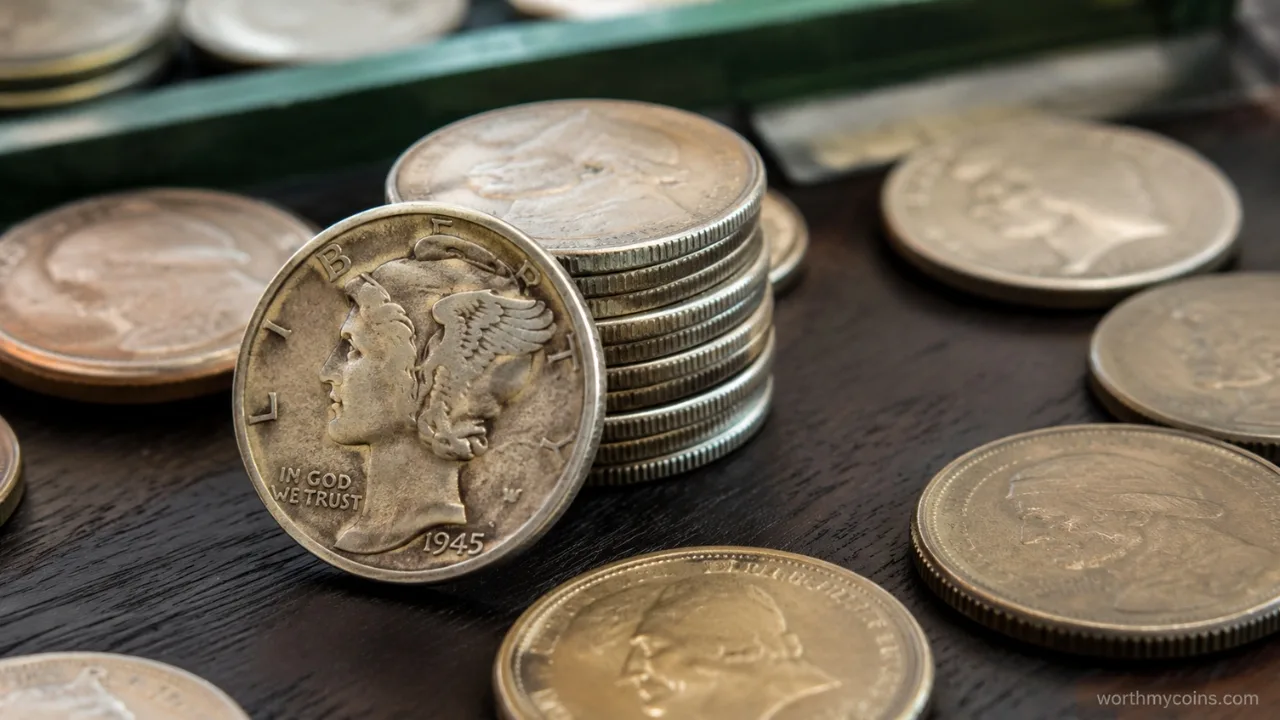
The Mercury Dime is one of the most beloved and recognizable coins in American numismatics. Although its official name is the Winged Liberty Head Dime, generations of collectors have referred to it as the “Mercury Dime” because Liberty’s winged cap resembles the Roman god Mercury. Produced from 1916 through 1945, the series combines artistic beauty, historical significance, and the excitement of discovering scarce dates and valuable varieties.
If you’re trying to determine the value of a Mercury Dime, it’s important to understand that there is no fixed price for every coin. A Mercury Dime’s worth depends on several factors, including its date, mint mark, condition, strike quality, originality, authentication, and current collector demand. While many circulated examples are collected primarily for their silver content, key dates and well-preserved specimens can be significantly more desirable among collectors.
Whether you recently found a Mercury Dime or have owned one for years, learning how to identify it is the best place to start. This guide explains the key dates, mint marks, grading basics, and the factors collectors use when deciding what a Mercury Dime may be worth.
History of the Mercury Dime
The Mercury Dime debuted in 1916, replacing the Barber Dime as part of the United States Mint’s effort to modernize American coinage. The coin was designed by renowned sculptor Adolph A. Weinman, whose work is also featured on the Walking Liberty Half Dollar.
Contrary to its popular nickname, the coin does not depict Mercury. Instead, the obverse features Liberty wearing a winged cap, symbolizing freedom of thought. The elegant design quickly became one of the most admired in American coinage and remains a favorite among collectors today.
The reverse features a fasces—a bundle of rods with an axe blade—paired with an olive branch. Together, these symbols represent America’s strength and readiness to defend peace.
The Mercury Dime remained in production until 1945 before being replaced by the Roosevelt Dime in 1946, bringing one of the most admired silver coin series in U.S. history to an end.
Mercury Dime Specifications
| Specification | Details |
|---|---|
| Designer | Adolph A. Weinman |
| Years Issued | 1916–1945 |
| Denomination | Ten Cents |
| Country | United States |
| Composition | 90% Silver, 10% Copper |
| Weight | 2.50 grams |
| Diameter | 17.9 mm |
| Edge | Reeded |
| Mint Authority | United States Mint |
Because every Mercury Dime was struck in 90% silver, precious metal prices establish a baseline value for heavily circulated examples. However, collector demand frequently pushes values well beyond silver content for scarcer dates and higher-grade coins.
How to Identify a Mercury Dime
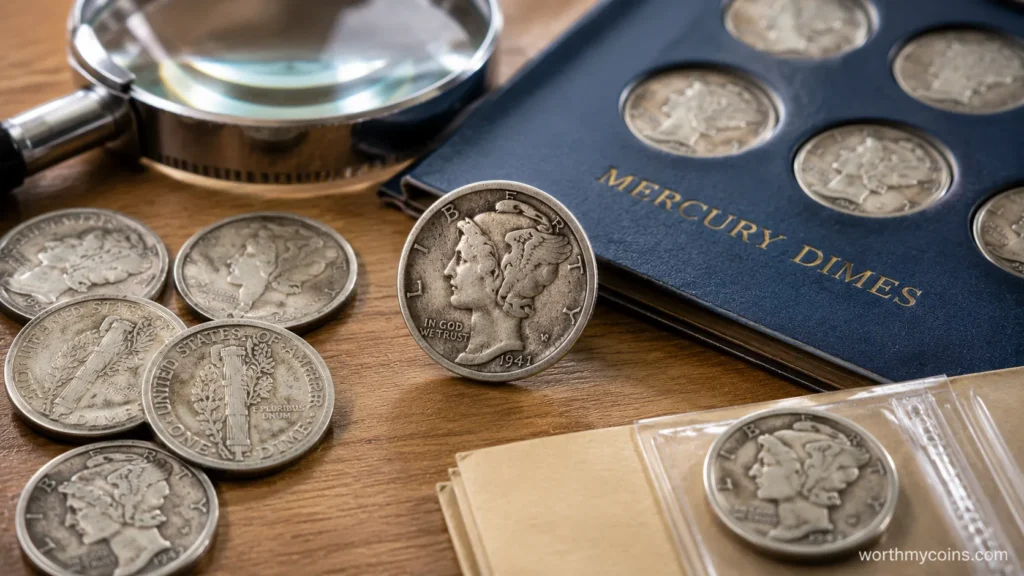
Before estimating value, verify the coin’s date, mint mark, and overall condition. These three details provide the foundation for accurate identification and pricing.
Correct identification is the first step toward understanding whether your coin may have collectible value.
Obverse Design
The obverse features Liberty facing left while wearing a winged cap. The word “LIBERTY” appears around the upper edge, with the motto “IN GOD WE TRUST” placed to the left and the date located near the bottom.
Many beginners mistakenly believe the portrait represents Mercury, but it actually depicts Liberty with wings symbolizing freedom of thought.
Reverse Design
The reverse displays a fasces wrapped with horizontal bands alongside an olive branch. Around the edge appear the inscriptions “UNITED STATES OF AMERICA,” “ONE DIME,” and “E PLURIBUS UNUM.”
The combination of military strength and peace reflects themes that were especially meaningful during the early twentieth century.
Mercury Dime Mint Marks
Mercury Dimes were produced at three United States Mint facilities. The mint mark plays a major role in determining collector demand, particularly for key dates.
The mint mark appears on the reverse near the lower left side of the fasces.
| Mint | Mint Mark | Location |
| Philadelphia | None | No mint mark |
| Denver | D | Reverse beside the fasces |
| San Francisco | S | Reverse beside the fasces |
Although Philadelphia coins carry no mint mark, they include many important dates that remain highly collectible today.
What Determines Mercury Dime Value?
Several factors influence the value of a Mercury Dime. Understanding these characteristics helps collectors evaluate coins more accurately.
Date
Certain production years are more difficult to locate than others due to lower mintages or fewer surviving examples. The date should always be considered together with the mint mark.
Mint Mark
The same year may have been struck at multiple mint facilities, yet each version can have very different collector demand depending on surviving populations and historical production.
Condition
Condition is one of the most significant value factors. Coins with sharp details, minimal wear, strong luster, and original surfaces generally attract greater interest than heavily circulated examples.
Professional grading services evaluate preservation using standardized grading criteria, making it easier for collectors and dealers to communicate about quality.
Original Surfaces
Collectors strongly prefer Mercury Dimes that retain original mint surfaces. Harsh cleaning, polishing, or chemical treatments can permanently reduce collector appeal and may lower market value.
Natural toning that develops over decades is often considered desirable, especially when it enhances eye appeal without masking important details.
Authentication
Valuable Mercury Dimes are sometimes counterfeited or altered. If you believe you’ve found a better date or an important variety, professional authentication is one of the safest ways to confirm it’s genuine before buying, selling, or adding it to your collection.
These same principles apply across many classic U.S. coin series. The Lincoln Wheat Penny Value Guide (1909–1958): Prices, Errors & Rare Coins explains how rarity, mint marks, and condition influence collector values beyond silver coinage.
Coin Grading Overview
Grading is one of the most important concepts every Mercury Dime collector should understand. Two coins with the same date and mint mark may differ greatly in value simply because of their condition.
| Grade | Description |
| Good (G) | Heavy wear with major design visible |
| Very Good (VG) | Moderate wear with stronger details |
| Fine (F) | Moderate wear while major features remain clear |
| Very Fine (VF) | Light to moderate wear with strong overall detail |
| Extremely Fine (XF) | Slight wear limited to the highest design elements |
| About Uncirculated (AU) | Minimal friction with nearly full mint detail |
| Mint State (MS) | No circulation wear; graded from MS60 through MS70 |
One important characteristic unique to Mercury Dimes is the horizontal bands on the fasces. Coins displaying fully separated horizontal bands often receive the “Full Bands” (FB) designation from major grading services when they meet specific strike standards. This designation is especially important for advanced collectors because it reflects exceptional strike quality rather than simply the absence of wear.
When evaluating valuable Mercury Dimes, collectors also examine luster, strike sharpness, contact marks, eye appeal, and overall originality in addition to the numerical grade.
For higher-value coins, certification by respected third-party grading companies provides added confidence in both authenticity and condition, making certified examples easier to buy and sell within the numismatic market.
Rare Mercury Dime Dates Every Collector Should Know
While every Mercury Dime has historical appeal, some dates are especially sought after because of lower mintages, lower survival rates, or exceptional collector demand.
Some of the best-known key dates include:
- 1916-D
- 1921
- 1921-D
- 1926-S
- 1931-D
- 1942/1 (Philadelphia Overdate)
- 1942/1-D (Denver Overdate)
These coins are among the most recognized key dates in the series, but condition plays a major role in determining desirability. A common-date Mercury Dime in outstanding Mint State condition may be worth considerably more than a scarce date that is heavily worn.
Collectors interested in famous U.S. key dates may also enjoy the 1909-S VDB Lincoln Wheat Penny Value Guide, another classic example of how low mintage and collector demand can dramatically affect value.
Rather than focusing only on the date, collectors should evaluate each coin individually by considering its grade, originality, strike quality, and authentication.
Verified Mercury Dime Errors and Important Varieties
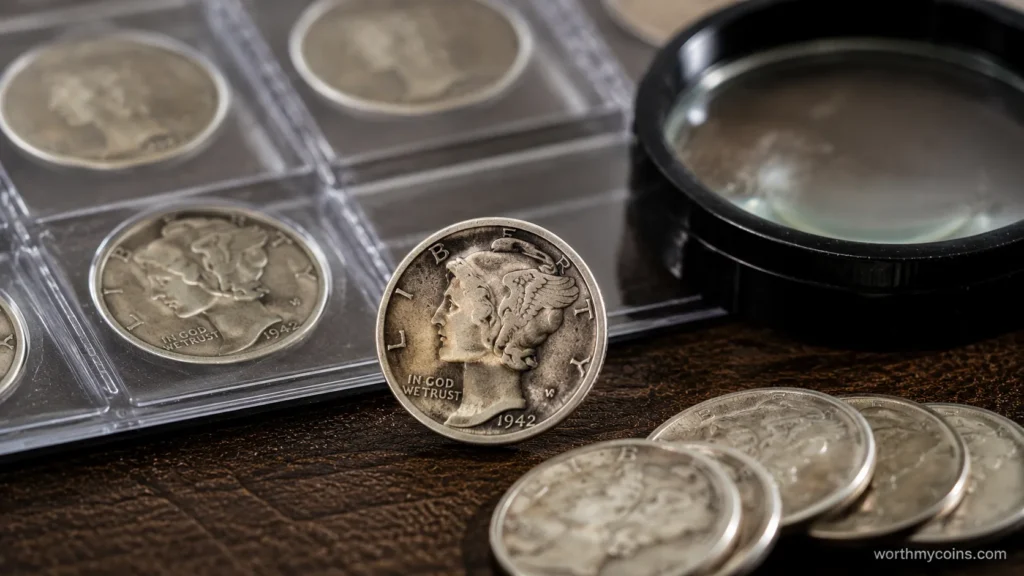
Mercury Dimes are popular among variety collectors because several genuine mint-made varieties have been thoroughly documented by professional grading services and numismatic researchers.
Below are some of the best-known examples.
| Variety | Description | Notes |
|---|---|---|
| 1942/1 Overdate | 1942 punched over a 1941 die | Major recognized variety |
| 1942/1-D Overdate | Denver overdate variety | One of the series’ most famous errors |
| Doubled Die Varieties | Noticeable doubling created during die production | Authentication recommended |
| Repunched Mint Marks (RPMs) | Mint mark punched into the die more than once | Found on selected issues |
| Off-Center Strikes | Coin struck outside normal alignment | Premium depends on degree of off-center strike |
| Die Cracks and Cuds | Raised metal caused by damaged dies | Collected by error specialists |
Not every unusual-looking Mercury Dime is a genuine mint error. Damage caused after the coin entered circulation—including scratches, dents, cleaning, or environmental corrosion—is not considered a mint error and generally does not increase collector value.
Another well-known example of a genuine U.S. Mint rarity is featured in the 1943 Bronze Lincoln Wheat Penny Value Guide, which explains why authentic minting mistakes are among the hobby’s most valuable discoveries.
The Importance of Full Bands
One feature that makes Mercury Dimes unique is the “Full Bands” designation.
The horizontal bands wrapped around the fasces on the reverse are often weakly struck, especially on certain dates and mint combinations. When these bands are fully separated and clearly defined, major grading services may assign the “FB” (Full Bands) designation.
A Full Bands designation does not necessarily mean the coin is rare, but it does indicate an exceptionally sharp strike. Collectors often pay significant premiums for certified Full Bands examples because they are more difficult to find than standard strikes.
Because grading standards are strict, collectors should rely on certified examples rather than attempting to assign the designation themselves.
Why Mercury Dime Values Can Vary So Much
Two Mercury Dimes with the same date and mint mark can have very different market values.
Several important factors explain these differences.
Grade
Higher-grade coins are generally scarcer because fewer examples survive with minimal wear. Small improvements in grade can make a noticeable difference in collector demand.
Strike Quality
Some Mercury Dimes were struck with sharper details than others. Strong design elements, particularly on Liberty’s hair and the fasces, often make a coin more attractive to collectors.
Full Bands Designation
For Mint State examples, the Full Bands designation may increase collector demand because it reflects superior strike quality.
Original Surfaces
Coins that retain natural luster and original surfaces are generally more desirable than examples that have been cleaned or altered.
Authentication
Certified coins are often easier to buy and sell because professional grading services have verified both authenticity and condition.
Collector Demand
Demand changes over time as collectors pursue complete sets, registry collections, or specific varieties. As a result, prices can fluctuate even when rarity remains unchanged.
Instead of relying solely on printed price guides, many collectors compare recent auction results to better understand current market activity.
Should You Clean a Mercury Dime?
The short answer is no.
Cleaning is one of the fastest ways to reduce a Mercury Dime’s collector appeal. Even gentle polishing can leave hairline scratches or remove the original mint surface that experienced collectors value.
Common signs of cleaning include:
- Fine hairline scratches
- Artificial shine
- Dull or altered luster
- Chemical discoloration
- Uneven surface appearance
Although cleaned Mercury Dimes still contain silver, they often sell for less than comparable coins with untouched original surfaces.
If your coin appears dark or naturally toned, it is usually best to leave it as it is until an experienced collector or grading service can evaluate it.
Tips for Collecting Mercury Dimes
Mercury Dimes remain one of the most enjoyable U.S. coin series to collect because they offer something for every budget.
Consider these practical tips:
- Learn to identify mint marks before purchasing.
- Study grading standards using trusted references.
- Buy the highest quality coin your budget allows.
- Focus on originality rather than bright, cleaned surfaces.
- Purchase key dates from reputable dealers.
- Store coins in archival-quality holders.
- Keep records of certified coins and purchase history.
- Compare multiple recent auction sales before making major purchases.
Many collectors build complete date-and-mint collections, while others specialize in Full Bands examples, overdates, or certified high-grade coins.
Collectors who enjoy building classic U.S. coin sets often expand into the Buffalo Nickel Value Guide: Rare Dates, Mint Errors & Collector Tips, another historic series known for its collectible dates and important varieties.
Common Mistakes New Collectors Make
Beginning collectors often make avoidable mistakes when purchasing Mercury Dimes.
Assuming Every Silver Dime Is Rare
Although all Mercury Dimes are made of silver, many dates were produced in large numbers. Silver content alone does not determine collector value.
Ignoring Mint Marks
The mint mark is often just as important as the date. Always examine the reverse carefully before researching a coin.
Overlooking Full Bands
Strike quality can significantly influence desirability, especially among Mint State coins.
Buying Expensive Coins Without Authentication
Key-date Mercury Dimes are sometimes counterfeited. Certification from a respected grading service provides additional confidence when purchasing valuable examples.
Cleaning Coins Before Selling
Many collectors unknowingly reduce value by attempting to improve appearance through polishing or chemical cleaning.
The following questions cover the topics collectors most frequently ask when identifying and valuing Mercury Dimes.
Frequently Asked Questions
Why is it called the Mercury Dime?
The coin’s official name is the Winged Liberty Head Dime. Its nickname comes from Liberty’s winged cap, which resembles the Roman god Mercury.
Are all Mercury Dimes made of silver?
Yes. Every Mercury Dime struck between 1916 and 1945 is composed of 90% silver and 10% copper.
Where is the mint mark located?
The mint mark appears on the reverse, near the lower left side of the fasces. Philadelphia coins have no mint mark.
What is the rarest Mercury Dime?
The 1916-D is widely recognized as the key date of the regular Mercury Dime series because of its low mintage and strong collector demand.
What does Full Bands mean?
Full Bands indicates that the horizontal bands on the fasces are fully separated by a strong strike. Major grading services award this designation only to coins that meet strict standards.
Should I have my Mercury Dime professionally graded?
Professional grading is often recommended for key dates, high-grade coins, important varieties, and pieces that may have significant collector value.
Can cleaned Mercury Dimes still be collectible?
Yes, but cleaning generally reduces collector demand because original surfaces are preferred by most buyers.
How can I verify if my Mercury Dime is genuine?
Compare its weight, diameter, design details, and mint characteristics with official specifications. Valuable coins should be authenticated by a respected third-party grading service.
Conclusion
The Mercury Dime remains one of the most admired U.S. coin series thanks to its timeless design, silver content, and collectible key dates. Whether you’re searching for a famous 1916-D or simply building a complete set, understanding mint marks, grading, and authenticity will help you make smarter collecting decisions. With a little research and careful evaluation, you’ll be better prepared to recognize Mercury Dimes that deserve a closer look.
Whether you’re searching for a famous 1916-D, studying Full Bands examples, or simply building a complete date-and-mint collection, careful research will always be your greatest advantage. Learn to identify mint marks, understand grading standards, avoid cleaned coins, and rely on trusted references when evaluating potential purchases.
Every Mercury Dime has its own story. By learning how to evaluate dates, mint marks, condition, and originality, you’ll be better prepared to recognize truly collectible examples and build a collection with confidence.
References
- United States Mint
- Professional Coin Grading Service (PCGS)
- Numismatic Guaranty Company (NGC)
- American Numismatic Association (ANA)
- Heritage Auctions
- Stack’s Bowers Galleries
- Newman Numismatic Portal
- A Guide Book of United States Coins (The Official Red Book)

Narayan Kumar is the Founder and Author of Worth My Coins. She specializes in U.S. coin collecting, with a focus on coin identification, mint errors, grading, rare varieties, and collector education. Her goal is to publish accurate, well-researched, and easy-to-understand guides that help both new and experienced collectors make informed decisions. Every article is created using trusted numismatic references and is written with a commitment to accuracy, transparency, and long-term educational value.