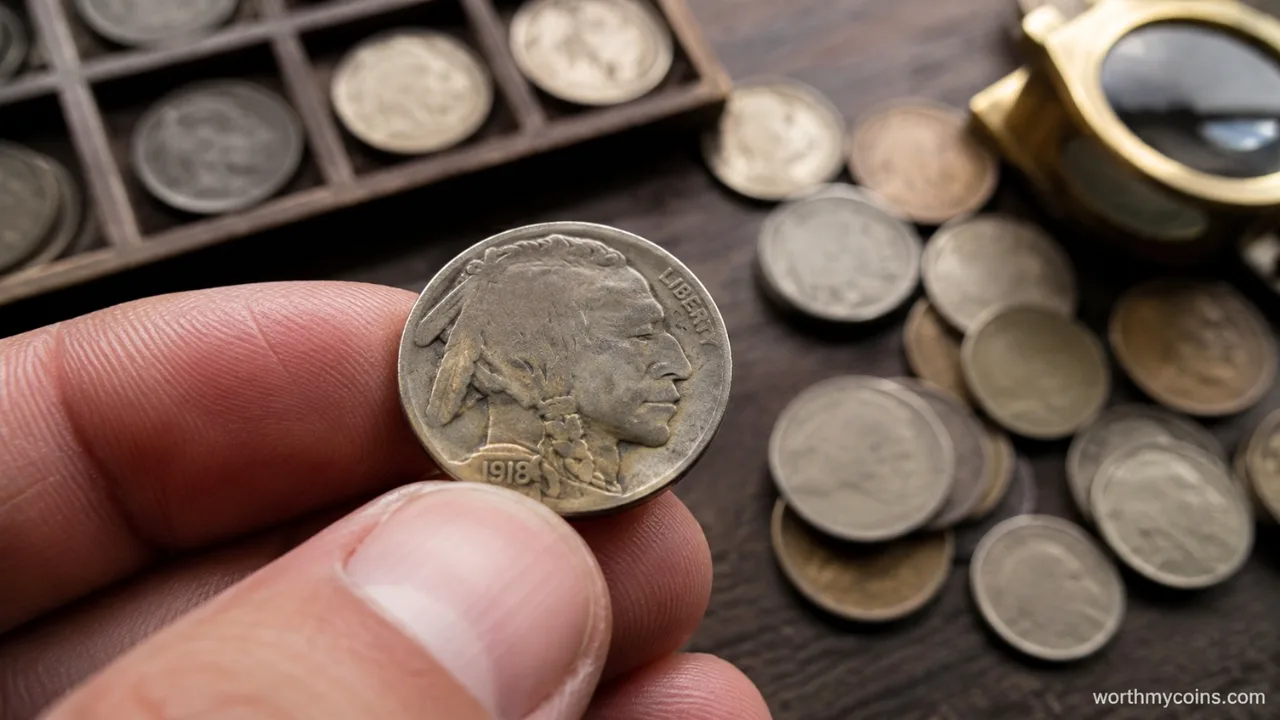
The Buffalo Nickel is one of the most iconic and beloved coins in American numismatic history. Officially known as the Indian Head Nickel, it combines classic American symbolism with a rugged design that continues to attract collectors more than a century after its introduction. Whether you’ve discovered one in an old coin jar, inherited a family collection, or recently started collecting U.S. coins, understanding Buffalo Nickel values begins with proper identification and an appreciation of the factors that influence rarity.
Unlike many modern coins, Buffalo Nickels can vary dramatically in value based on date, mint mark, condition, and the presence of recognized mint errors or varieties. While many circulated examples are affordable collector pieces, certain rare dates and authenticated varieties have become highly desirable in the numismatic market.
Whether you recently found a Buffalo Nickel or you’re thinking about adding one to your collection, this guide will help you understand what makes certain dates more valuable, how to identify important varieties, and what experienced collectors look for.
History of the Buffalo Nickel
The Buffalo Nickel was minted from 1913 through 1938 after replacing the Liberty Head Nickel. The design was created by sculptor James Earle Fraser, who wanted the coin to represent the spirit of the American West.
The obverse features a Native American portrait created from several real-life Native American models rather than a single individual. The reverse displays an American bison, commonly referred to as a buffalo, inspired by “Black Diamond,” a bison that lived in New York’s Bronx Zoo, although historians continue to debate the exact identity of the animal.
Production ended in 1938 when the Jefferson Nickel replaced the Buffalo Nickel, bringing one of the most recognizable designs in American coinage to a close.
Many numismatists also enjoy reading about the 1943 Bronze Lincoln Wheat Penny Value Guide, one of the most famous and valuable mint errors in U.S. coin collecting.
Buffalo Nickel Specifications
| Feature | Specification |
|---|---|
| Face Value | Five Cents |
| Years Minted | 1913–1938 |
| Composition | 75% Copper, 25% Nickel |
| Weight | 5.00 grams |
| Diameter | 21.2 mm |
| Edge | Plain |
| Designer | James Earle Fraser |
How to Identify a Buffalo Nickel
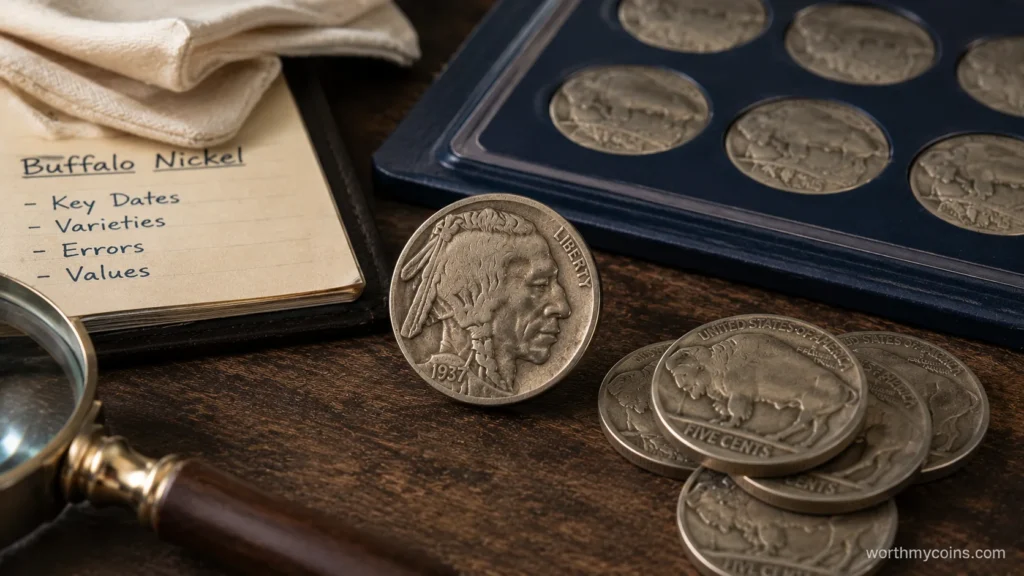
Before checking a Buffalo Nickel’s value, first confirm the date, mint mark, and overall condition. These three details have the greatest influence on collector demand.
Identifying a Buffalo Nickel is usually straightforward, but several design details deserve close attention.
Obverse
The front of the coin shows:
- A Native American profile facing right
- “LIBERTY” near the upper-right edge
- The date near the shoulder
Because the date sits on one of the highest points of the design, it often wears away completely on circulated coins.
Reverse
The reverse displays:
- An American bison
- “UNITED STATES OF AMERICA”
- “E PLURIBUS UNUM”
- “FIVE CENTS”
Collectors should also examine the area beneath “FIVE CENTS” for the mint mark on coins struck outside Philadelphia.
Buffalo Nickel Mint Marks
Buffalo Nickels were produced at three U.S. Mint facilities.
| Mint | Mint Mark | Location |
| Philadelphia | No Mint Mark | None |
| Denver | D | Reverse below FIVE CENTS |
| San Francisco | S | Reverse below FIVE CENTS |
Mint marks alone do not determine value. Some Philadelphia issues are scarcer than Denver or San Francisco examples, depending on the year.
Readers interested in identifying valuable modern U.S. coins may also want to explore the Top Modern Quarters Worth Money, featuring rare state and Washington quarter varieties that collectors continue to search for.
What Determines Buffalo Nickel Value?
Several important factors influence Buffalo Nickel values.
Date and Mintage
Certain production years had lower mintages than others. Scarcity often increases collector demand, particularly for coins that survive in higher grades.
Condition
Condition remains one of the biggest value drivers.
Collectors generally evaluate:
- Amount of wear
- Visible hair detail
- Horn detail on the buffalo
- Full date visibility
- Surface preservation
- Luster
- Strike quality
A coin with a readable date and strong details will usually attract greater interest than one with heavy wear.
Eye Appeal
Natural toning, original surfaces, and attractive overall appearance often increase collector interest, even when two coins share the same numerical grade.
Authentication
Rare Buffalo Nickels should always be authenticated by respected third-party grading services before major buying or selling decisions.
Professional authentication can confirm that a coin is genuine while also identifying altered pieces and important varieties before you buy or sell it.
Buffalo Nickel Grading Overview
Understanding grading helps collectors estimate where their coin fits within the market.
| Grade | Description |
| Good (G) | Heavy wear, major design visible |
| Very Good (VG) | More detail remains but significant wear |
| Fine (F) | Moderate wear with stronger lettering |
| Very Fine (VF) | Moderate detail throughout |
| Extremely Fine (XF) | Light wear on high points |
| About Uncirculated (AU) | Slight friction with most mint luster remaining |
| Mint State (MS) | No circulation wear |
Professional grading is particularly important for scarce dates and valuable varieties.
Collectors interested in famous U.S. coin rarities may also enjoy the 1909-S VDB Lincoln Wheat Penny Value Guide, which covers one of the most sought-after key-date coins in American numismatics.
Rare Buffalo Nickel Dates
Some Buffalo Nickel dates are well known among collectors because of lower survival rates, collector demand, or historical significance.
Examples include:
- 1913 Type 1
- 1913 Type 2
- 1914-D
- 1921-S
- 1924-S
- 1926-S
- 1931-S
- 1937-D Three-Legged Buffalo
These coins range from moderately scarce to exceptionally collectible depending on their condition and authenticity.
It’s important to remember that even common dates can become valuable in high Mint State grades.
Verified Buffalo Nickel Errors and Major Varieties
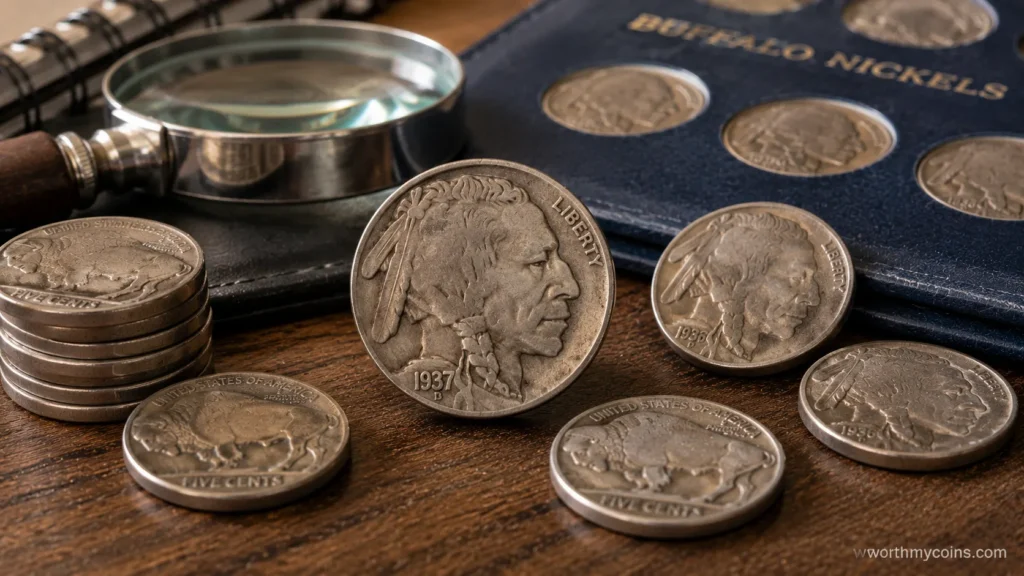
Buffalo Nickels are famous for several legitimate and well-documented mint varieties.
1913 Type 1 and Type 2
During the first year of production, the reverse design was modified.
Type 1 features the buffalo standing on a raised mound.
Type 2 changed the ground beneath the buffalo to reduce excessive wear on the denomination.
Both are collectible, with Type 1 representing the original design.
1916 Doubled Die Obverse
One of the best-known Buffalo Nickel varieties displays noticeable doubling on portions of the obverse lettering and date.
Authentication is recommended because many forms of machine doubling can resemble genuine doubled dies.
1918/7-D Overdate
This famous overdate occurred when a 1918 die was struck over a 1917 die.
Authentic examples are among the most sought-after Buffalo Nickels and should always be examined by professional grading services.
1935 Doubled Die Reverse
Some 1935 Buffalo Nickels exhibit doubling on reverse lettering.
Specialists examine these carefully since numerous forms of minor doubling exist.
1937-D Three-Legged Buffalo
Arguably the most famous Buffalo Nickel error, this variety resulted after excessive die polishing removed much of one front leg.
Collectors should be cautious, as damaged coins are sometimes altered to imitate this variety.
Verified Buffalo Nickel Varieties
| Variety | Description |
| 1913 Type 1 | Raised mound reverse |
| 1913 Type 2 | Modified ground beneath buffalo |
| 1916 Doubled Die Obverse | Genuine hub doubling |
| 1918/7-D Overdate | Overpunched date |
| 1935 Doubled Die Reverse | Reverse doubling |
| 1937-D Three-Legged Buffalo | Missing front leg caused by die polishing |
Buffalo Nickel Values
There is no single value that applies to every Buffalo Nickel.
Prices vary depending on:
- Date
- Mint mark
- Grade
- Surface quality
- Originality
- Authentication
- Current collector demand
Because market prices change over time, collectors should rely on regularly updated pricing resources from professional grading companies and major auction archives instead of outdated printed estimates.
If you believe you have a rare example, obtaining professional authentication before selling is strongly recommended.
Collectors researching similar historic coins often read the Lincoln Wheat Penny Value Guide for another classic American series with significant date and variety differences.
Tips for Collecting Buffalo Nickels
Building a Buffalo Nickel collection can be both enjoyable and educational.
Consider these best practices:
- Learn the key dates before making expensive purchases.
- Buy authenticated examples for rare varieties.
- Use proper coin holders to prevent damage.
- Avoid cleaning coins.
- Study grading standards regularly.
- Purchase from reputable coin dealers or established auction firms.
- Compare certified examples before investing in higher-grade coins.
Many collectors begin with circulated examples before gradually upgrading individual dates over time.
Common Mistakes to Avoid
New collectors frequently make avoidable mistakes.
Cleaning Coins
Cleaning removes original surfaces and often reduces collector value.
Even gentle polishing can leave permanent hairline scratches.
Assuming Every Old Nickel Is Rare
Age alone does not determine value.
Many Buffalo Nickels remain relatively common in circulated grades.
Ignoring Authentication
Counterfeits and altered coins exist, especially for famous varieties like the 1918/7-D and 1937-D Three-Legged Buffalo.
Professional certification provides confidence for both buyers and sellers.
Misidentifying Damage as Errors
Scratches, corrosion, environmental damage, and post-mint alterations are often mistaken for mint errors.
Learning how genuine mint errors occur helps avoid costly mistakes.
Overlooking Condition
Two Buffalo Nickels with the same date can differ substantially in market value depending on preservation.
How to Store Buffalo Nickels
Proper storage helps preserve long-term condition.
Recommended storage methods include:
- Mylar coin flips
- Archival-quality cardboard holders
- Hard plastic coin capsules
- Certified grading service holders
Store coins in a cool, dry location away from excessive humidity and direct sunlight.
Handle coins only by their edges whenever possible.
Conclusion
The Buffalo Nickel remains one of the most rewarding U.S. coin series to collect because it combines history, distinctive design, and several fascinating key dates and varieties. Whether you’re searching through old collections or building a complete set, learning how to identify genuine coins, understand grading, and recognize important varieties will help you make better collecting decisions and enjoy the hobby even more.
The most rewarding collections are built through patience and knowledge. Learning how to identify key dates, recognize genuine varieties, and understand grading standards will help you make more confident collecting decisions for years to come. That approach not only reduces costly mistakes but also makes collecting far more rewarding over the long term.
The following questions answer some of the most common topics collectors ask when evaluating Buffalo Nickels.
Frequently Asked Questions
Are Buffalo Nickels made of silver?
No. Buffalo Nickels contain 75% copper and 25% nickel. They contain no silver.
Why is the date missing on many Buffalo Nickels?
The date was placed on one of the highest points of the design, making it especially vulnerable to wear during circulation.
What is the rarest Buffalo Nickel?
Several issues are considered major rarities, including authenticated examples of the 1918/7-D Overdate and the 1937-D Three-Legged Buffalo. Rarity depends on the specific variety and grade.
Should I clean a Buffalo Nickel?
No. Cleaning generally reduces collector value and may permanently damage the coin’s original surface.
Where is the mint mark located?
Denver (“D”) and San Francisco (“S”) mint marks appear on the reverse beneath “FIVE CENTS.” Philadelphia coins do not carry a mint mark.
How can I tell if my Buffalo Nickel is valuable?
Start by identifying the date, mint mark, condition, and whether the coin matches any recognized varieties. If you believe you have a scarce example, seek professional authentication from a respected grading service.
References
- United States Mint
- Professional Coin Grading Service (PCGS)
- Numismatic Guaranty Company (NGC)
- American Numismatic Association (ANA)
- Heritage Auctions
- Stack’s Bowers Galleries
- Newman Numismatic Portal

Narayan Kumar is the Founder and Author of Worth My Coins. She specializes in U.S. coin collecting, with a focus on coin identification, mint errors, grading, rare varieties, and collector education. Her goal is to publish accurate, well-researched, and easy-to-understand guides that help both new and experienced collectors make informed decisions. Every article is created using trusted numismatic references and is written with a commitment to accuracy, transparency, and long-term educational value.