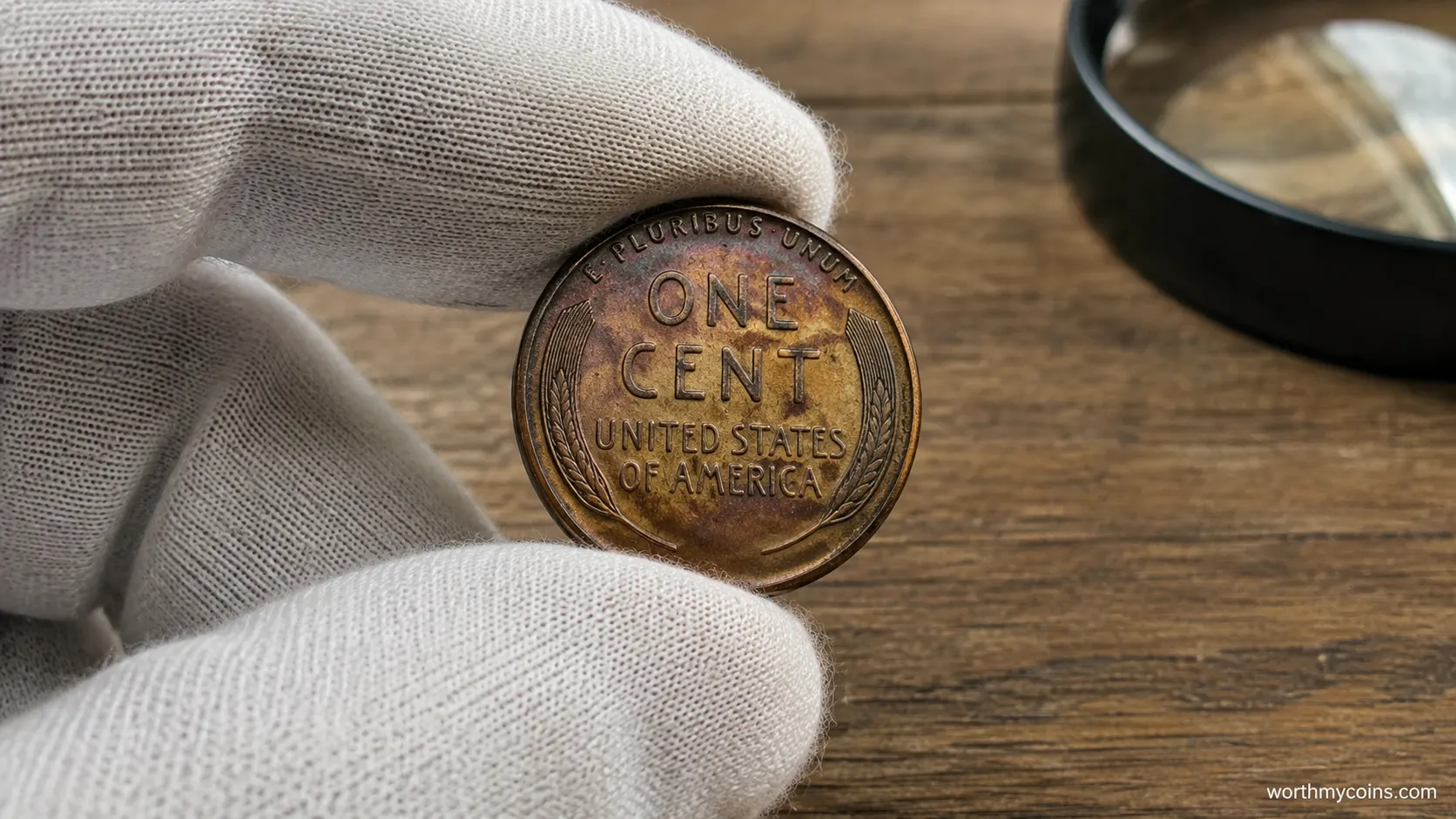
A Lincoln Wheat Penny’s copper surface can gradually change in appearance as it reacts with air and its surrounding environment.Lincoln Wheat Cents were introduced in 1909, and the Wheat reverse remained in use through 1958.
A coin that was originally bright reddish copper may gradually become red-brown or brown as its surface reacts with the environment. Some pieces can also develop multicolored or iridescent toning as the copper surface changes over time.For collectors, these color changes are more than cosmetic. On Mint State copper cents, color can be an important grading designation, while color, luster, surface quality, and eye appeal can all influence how a coin is evaluated.
Quick Answer
Lincoln Wheat Pennies are commonly described as Red (RD), Red-Brown (RB), or Brown (BN) when they are graded by major third-party services. These designations describe how much of the coin’s original red copper color remains.
- Red (RD): Most of the original red color remains.
- Red-Brown (RB): The coin retains a mixture of original red and brown coloration.
- Brown (BN): Little of the original mint red remains.
- Rainbow or iridescent toning: A multicolored surface appearance that can develop as the coin reacts with its environment.
The exact percentage standards vary somewhat between grading services. PCGS defines RD as more than 95% original red color, RB as between 5% and 95%, and BN as less than 5% original red color. These are PCGS color designations applied to qualifying copper coins.
NGC uses different general guidelines for Lincoln cents, describing RD as roughly 85% to 90% or more original color and RB as at least 15% to 20% red. Because the services use different published guidelines, RD, RB, and BN should be treated as grading-service designations rather than universal scientific measurements.
Why Lincoln Wheat Pennies Change Color
Lincoln cents were introduced in 1909, and the reverse featuring two wheat sheaves remained in use through 1958. The United States Mint notes that the two wheat ears appeared on the reverse from 1909 through 1958.
The copper surface does not remain visually unchanged forever. Copper begins reacting with the air and can gradually mellow from its original bright red or brassy appearance toward red-brown and brown. Newly struck copper can have a bright reddish or orange-red appearance, while older examples commonly mellow toward brown.
This means a brown Wheat Penny is not automatically damaged, and a red Wheat Penny is not automatically a better coin in every collecting situation. Color has to be considered together with the coin’s grade, surface quality, originality, date, mintmark, and overall appearance.
For a broader look at the dates, mintmarks, errors, and other factors that can affect these coins, see the Lincoln Wheat Penny Value Guide (1909–1958): Prices, Errors & Rare Coins.
What Red, Red-Brown and Brown Really Mean
The letters RD, RB, and BN are especially important when looking at certified copper coins.
Red (RD)
A Red Lincoln Wheat Penny has retained a very large percentage of its original red coloration.
PCGS defines RD as more than 95% original red color on qualifying copper coins. NGC’s published general guideline for Lincoln cents describes RD examples as retaining roughly 85% to 90% or more of their original color.
The important point for collectors is that RD indicates substantial original red color, not simply that the coin looks reddish under certain lighting.
A fully red Wheat Penny can be especially desirable in high grades because original copper color becomes increasingly difficult to preserve as a coin ages.
Collectors focusing on one of the most famous early Wheat Penny issues can also learn more about the 1909-S VDB Lincoln Wheat Penny Value Guide: Why This Rare Cent Is So Important to Collectors, where the specific coin’s collecting importance can be examined in greater detail.
Red-Brown (RB)
Red-Brown coins occupy the middle ground.
They have lost some of their original red appearance but still retain a meaningful amount of red mixed with brown. PCGS defines RB copper as having between 5% and 95% original red color. NGC’s published general guideline describes RB Lincoln cents as retaining at least about 15% to 20% red.
RB coins can have very attractive surfaces. Some show an even mixture of red and brown, while others have patches of remaining red surrounded by darker copper coloration.
Brown (BN)
Brown indicates that very little of the original mint red remains.
Under the PCGS designation system, BN means that less than 5% of the coin’s original red color remains.
Brown should not automatically be interpreted as unattractive or undesirable. A naturally toned Wheat Penny with smooth brown surfaces can also be appealing, particularly when it has strong luster, clean surfaces, and attractive overall eye appeal. NGC notes that beautifully toned cents can benefit from strong eye appeal even when they are not fully red.
For circulated copper, brown coloration is also completely normal because circulation and environmental exposure commonly remove the visual appearance of the original mint red.
Why Red Wheat Pennies Can Be More Valuable
Color can have a substantial effect on the market appeal of high-grade copper coins, particularly when comparing otherwise similar examples. PCGS notes a general marketplace preference for Red copper, although collector preferences vary.
The reason is straightforward: maintaining original red color for decades is difficult. Copper naturally changes as it reacts with its surroundings, so an old Wheat Penny that retains nearly all of its original red appearance can be considerably more desirable than an otherwise comparable coin that has turned brown.
But color does not replace grade.
A Wheat Penny with RD designation can still have distracting contact marks, weak luster, poor eye appeal, or other problems. NGC specifically points to surface quality, luster, and color as important considerations when grading Mint State Lincoln cents.
That is why comparing two coins simply by saying “this one is Red, so it must be worth more” is not enough. The date, mintmark, numerical grade, strike, surfaces, and overall eye appeal still matter.
Does Brown Mean a Wheat Penny Is Damaged?
No.
Natural brown coloration is often simply the result of the copper’s normal aging process. NGC describes the mellowing of a cent’s original bright-red or brassy color toward red-brown and brown as a natural process for copper and bronze coins.
The key distinction is between natural color change and artificially altered color.
A naturally toned brown cent can be completely acceptable to collectors and grading services. A coin that has been chemically treated or otherwise manipulated to change its appearance is a different matter.
Collectors interested in unusual Wheat Penny issues can also compare natural color and surface appearance with the documented characteristics discussed in the 1943 Bronze Lincoln Wheat Penny Value Guide: Identification, Rarity & Collector’s Guide.
This distinction becomes particularly important when a collector encounters a Wheat Penny with unusually bright or dramatic coloration.
What Is Rainbow Toning on a Lincoln Wheat Penny?
“Rainbow toning” is a collector term used for coins displaying multiple colors across the surface, sometimes including shades of gold, orange, red, blue, green, purple, or magenta.
On copper coins, iridescent coloration can occur as the metal reacts with its environment. PCGS has documented Lincoln cents and other copper coins displaying colorful, sometimes iridescent toning.
Rainbow toning is not a separate official grade category like RD, RB, or BN. Instead, it describes the appearance of the surface.
A copper cent can display multicolored toning while also receiving an RD, RB, or BN color designation when applicable. The designation reflects the amount of original red color remaining, while toning describes the coin’s surface appearance.
Is Rainbow Toning Natural?
It can be, but color alone cannot prove that it is natural.
Natural toning develops through interaction between a coin’s surface and its surrounding environment. Storage materials, atmospheric exposure, and other environmental conditions can influence the appearance that develops over time.
Artificial toning is also possible. People have deliberately accelerated chemical reactions or otherwise altered coins to create colors that may resemble natural toning.
This is one reason experienced collectors do not judge a toned Wheat Penny solely by how spectacular its colors look.
PCGS notes that artificially created or accelerated toning can lead to a questionable color determination, while NGC states that coins with altered color may be ineligible for normal numerical grading.
Attractive Toning vs. Artificial Color
A colorful Wheat Penny can be appealing without being artificially altered. The challenge is determining whether the appearance is consistent with natural toning.
There is no single visual test that can prove every toned coin is natural. Collectors should be cautious when a coin displays extremely vivid colors that appear unnatural, especially when the color seems inconsistent with the coin’s age, storage history, or surface.
PCGS has discussed artificially created toning as a potential problem for collectors, making it important to consider whether unusual coloration appears consistent with the coin’s surfaces and overall appearance.
That does not mean every brightly colored coin is artificial. It means that spectacular color deserves careful examination rather than an automatic premium.
For collectors who want to examine documented Lincoln Penny errors separately from color and toning issues, the Rare Lincoln Wheat Penny Errors Worth Money: 12 Valuable Varieties Every Collector Should Know provides a focused guide to recognized error varieties.
How Color Affects a Wheat Penny’s Grade
Color and grade are related, but they are not the same thing.
A numerical grade describes the coin’s overall condition, while RD, RB, and BN provide additional information about the color of qualifying copper coins.
For example, two Wheat Pennies could have the same numerical Mint State grade while carrying different color designations. Their market appeal may still differ substantially because collectors may place different values on original red color and attractive surfaces. NGC specifically places RD above RB and RB above BN in its hierarchy for coins that use these designations.
At the same time, personal preference matters. Some collectors strongly prefer brilliant red copper, while others appreciate naturally toned RB or BN coins for their character.
Why Surface Quality Matters With Color
Color should always be viewed together with the actual condition of the coin.
A red cent with numerous marks is not necessarily more desirable than a beautifully preserved RB cent. Likewise, attractive toning cannot erase scratches, cleaning, corrosion, or other surface problems.
NGC notes that surface quality and luster are particularly important when grading Lincoln cents because even relatively small marks can affect the grade of a Mint State example.
For that reason, examine a Wheat Penny under good lighting and look beyond the color itself.
Don’t Clean a Wheat Penny to Make It Red Again
One of the biggest mistakes a collector can make is trying to restore an old brown or red-brown Wheat Penny to a bright red appearance.
Cleaning or chemical treatment does not recreate original mint color. Instead, it can alter the coin’s surface and potentially make the piece less desirable to serious collectors.
NGC explains that the natural change from red to red-brown to brown is irreversible and that attempts to alter a copper coin’s color can result in an altered-color determination.
If a Wheat Penny has attractive original color, the safest approach is generally to preserve the coin rather than attempt to improve its appearance.
What Collectors Should Look For
When evaluating the color of a Lincoln Wheat Penny, consider the whole coin rather than focusing on one attractive feature.
Look at:
- Original color: How much red appears to remain?
- Color distribution: Is the color even or heavily spotted?
- Luster: Does the surface still show natural mint luster?
- Surface quality: Are there scratches, marks, corrosion, or other problems?
- Toning: Does the coloration appear natural and consistent?
- Eye appeal: Does the coin look attractive under normal lighting?
- Grade: What is the coin’s actual condition?
- Certification: If the coin is valuable, has a recognized grading service evaluated it?
This approach helps prevent the common mistake of treating color as the only factor that matters.
Red vs. Brown: Which Is Better?
For uncirculated copper coins, Among the standard RD-RB-BN color designations, RD represents the greatest amount of original red color, followed by RB and then BN. NGC explicitly places RD above RB and RB above BN.
But “better” depends on what you are collecting.
A collector building a high-grade Red Lincoln Wheat Cent set may specifically seek RD examples. Another collector may prefer naturally toned brown cents because of their originality and appearance.
The important distinction is between market convention and personal preference. Red generally receives stronger preference in the marketplace for comparable high-grade copper coins, but attractive RB and BN pieces can still be highly collectible.
How to Store a Lincoln Wheat Penny
Proper storage is especially important if you want to preserve a coin’s existing appearance.
Avoid unnecessary handling of the surfaces. Finger oils and contaminants can affect a copper coin, and inappropriate storage materials or environmental exposure can contribute to additional toning.
For particularly valuable Wheat Pennies, professional certification can provide authentication, a third-party grade and color designation, and protective encapsulation. A certified holder can also help protect the coin from routine handling and environmental exposure.
Raw coins require more care because their surfaces remain directly exposed to their storage environment.
Common Lincoln Wheat Penny Color Mistakes
Assuming every red coin is valuable
Red color can increase desirability, but it does not automatically make a Wheat Penny rare or expensive. Date, mintmark, grade, variety, and surface quality still matter.
When checking individual dates and mintmarks, collectors can use the 1914-D Lincoln Wheat Penny Value Guide: Key Date, Mint Marks & Current Prices as a focused reference for one of the notable Lincoln Wheat Penny issues.
Assuming every brown coin is damaged
Natural brown coloration is normal for aged copper. Brown alone does not prove that a coin has been cleaned or damaged.
Treating rainbow color as proof of rarity
Colorful toning can be attractive, but dramatic coloration does not automatically mean the coin is rare or naturally toned.
Cleaning a brown cent
Trying to make a Wheat Penny brighter can damage its surfaces or produce an altered-color appearance. Original surfaces are generally preferable to artificially brightened ones.
Comparing different grades only by color
An RD designation tells you about color, not the entire condition of the coin. Always compare coins at an appropriate grade level. offers another focused look at Wheat Penny issues worth checking.
FAQ
What does RD mean on a Lincoln Wheat Penny?
RD means Red. It is a color designation used for qualifying copper coins that retain a high percentage of their original red coloration. The precise threshold depends on the grading service.
What does RB mean on a Wheat Penny?
RB means Red-Brown. It indicates that the coin retains a mixture of original red and brown coloration. PCGS and NGC use somewhat different percentage guidelines for this designation.
What does BN mean on a Lincoln Wheat Cent?
BN means Brown. It generally indicates that little of the coin’s original red color remains. A BN designation does not automatically mean the coin is damaged.
Is rainbow toning good on a Wheat Penny?
It can be attractive and desirable to some collectors when the coloration is natural and complements the coin. However, artificially created or accelerated color can negatively affect a coin’s collectibility and grading status.
Can a brown Wheat Penny turn red again naturally?
No. The natural change from red toward red-brown and brown is considered irreversible. Attempts to restore red color through chemical or other treatments can alter the coin’s surfaces.
Should I clean a Wheat Penny that has turned brown?
No. Cleaning can damage the original surface and may result in an altered appearance. If the coin has collector value, preserving its original surfaces is generally more important than trying to change its color.
Final Thoughts
The color of a Lincoln Wheat Penny tells part of its story. Red, Red-Brown, and Brown describe how much original copper color remains, while rainbow or iridescent toning describes additional coloration that may develop as the surface reacts with its environment.
For collectors, the best approach is to judge color alongside grade, luster, surface quality, originality, and eye appeal. A brilliant RD cent can be desirable, but a naturally toned RB or BN Wheat Penny can also be an excellent collectible. The real skill is learning to recognize the difference between natural aging, attractive toning, and artificial color manipulation.
References
- United States Mint — Penny
- PCGS — What Do RD, RB & BN Grading Designations Mean on Copper Coins?
- PCGS — PCGS Grading Standards
- NGC — Learn Grading: What are BN, RB and RD?
- NGC — Grading Lincoln Cents
- PCGS — Toning: Does It Help, or Hurt the Value of a Coin?

Narayan Kumar is the Founder and Author of Worth My Coins. She specializes in U.S. coin collecting, with a focus on coin identification, mint errors, grading, rare varieties, and collector education. Her goal is to publish accurate, well-researched, and easy-to-understand guides that help both new and experienced collectors make informed decisions. Every article is created using trusted numismatic references and is written with a commitment to accuracy, transparency, and long-term educational value.