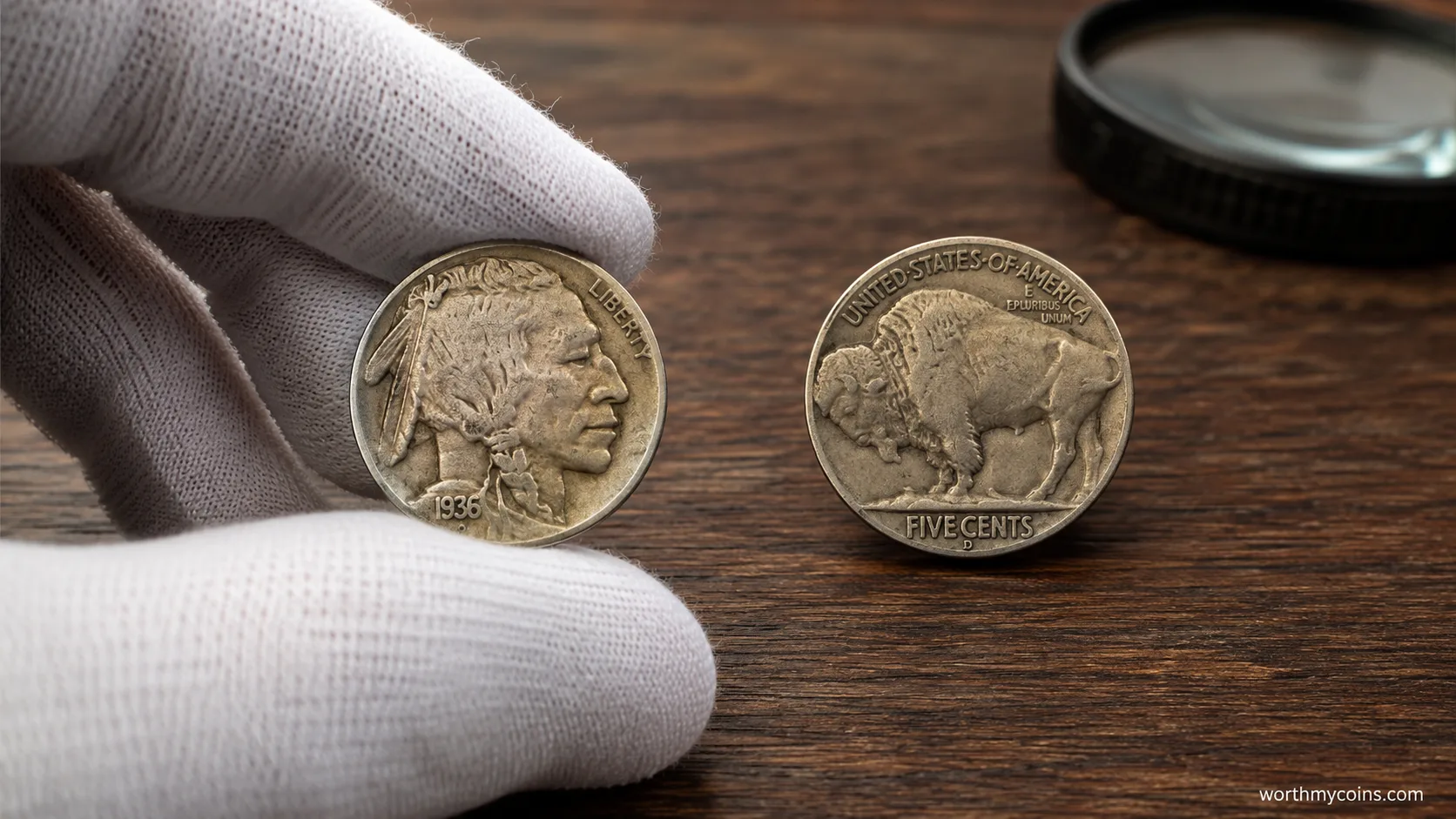
Buffalo Nickel mint marks tell you where a coin was struck, and for some dates they can make a major difference in collectibility and value. The key is knowing where to look: on Buffalo Nickels, the mintmark appears on the reverse, directly beneath the denomination “FIVE CENTS.” Philadelphia issues have no mintmark, while Denver and San Francisco coins carry a D or S.
For a broader look at the dates, errors, mintmarks, and other factors that can affect a Buffalo Nickel’s value, see the Buffalo Nickel Value Guide: Rare Dates, Mint Errors & Collector Tips.
Quick Answer
Buffalo Nickels were struck from 1913 through 1938 at Philadelphia, Denver, and San Francisco. Philadelphia coins have no mintmark, Denver coins have a D, and San Francisco coins have an S.
The mintmark is located on the reverse below “FIVE CENTS.” It is easy to miss on worn coins, so check the area carefully before assuming a Buffalo Nickel is a Philadelphia issue.
The mintmark matters because some dates from Denver and San Francisco are considerably scarcer than their Philadelphia counterparts. However, a mintmark alone does not automatically make a Buffalo Nickel rare or valuable. Date, condition, variety, and authenticity also matter.
Where Is the Mintmark on a Buffalo Nickel?
The easiest way to find a Buffalo Nickel mintmark is to turn the coin over to its reverse, the side showing the American bison.
Look directly below the words FIVE CENTS at the bottom of the reverse. If the coin was struck at Denver, you should see a D. If it was struck at San Francisco, you should see an S. Philadelphia Buffalo Nickels do not have a mintmark.
| Mint | Mintmark | Where to look |
|---|---|---|
| Philadelphia | None | No mintmark beneath FIVE CENTS |
| Denver | D | Beneath FIVE CENTS on the reverse |
| San Francisco | S | Beneath FIVE CENTS on the reverse |
This location is consistent across the Buffalo Nickel series, making the reverse the first place to check when identifying the striking mint.
What Do the D, S, and No-Mintmark Buffalo Nickels Mean?
The letter on the coin identifies the Mint facility responsible for striking it.
D — Denver
A D beneath FIVE CENTS means the Buffalo Nickel was struck at the Denver Mint.
Denver produced many Buffalo Nickel issues, including dates that are important to collectors because of their scarcity or recognized varieties. The mintmark itself does not determine rarity, though. You need to consider the specific date and condition of the coin.
S — San Francisco
An S indicates that the coin was struck at the San Francisco Mint.
Some early Buffalo Nickels from San Francisco are particularly sought after because certain dates are much scarcer than comparable Philadelphia issues. The 1926-S, for example, is identified by its S mintmark and is recognized by NGC as the rarest regular-issue Buffalo Nickel by original mintage.
Collectors who want to go beyond the mintmark and identify the dates that deserve the closest attention can use the Buffalo Nickel Key Dates and Values: The Coins Every Collector Should Know as a focused reference.
No Mintmark — Philadelphia
A Buffalo Nickel without a mintmark was struck at Philadelphia.
This can sometimes confuse beginning collectors because they may assume a missing letter means the coin is damaged or incomplete. On a Buffalo Nickel, however, no mintmark is normal for Philadelphia issues. NGC specifically identifies Philadelphia Buffalo Nickels as having no mintmark.
Why Does the Mintmark Matter?
The mintmark matters because different Mints produced different quantities of particular dates, and surviving coins can vary greatly in availability.
For example, the difference between a Philadelphia and San Francisco Buffalo Nickel can be substantial for certain dates. NGC notes that the 1926-S had an original mintage of only 970,000 pieces, while the 1926 Philadelphia issue had more than 44 million.
That does not mean every S-mint Buffalo Nickel is valuable or every Philadelphia coin is common. The date must always be considered alongside the mintmark.
Collectors commonly organize Buffalo Nickel sets by date and mintmark, rather than simply collecting one example of each year. This creates a more detailed picture of which issues were struck at each Mint and allows scarce issues to be distinguished from more available ones.
Buffalo Nickel Mintmark Location on Worn Coins
Worn Buffalo Nickels can make mintmark identification difficult.
The mintmark is relatively small and located in an area that can suffer from wear, scratches, corrosion, or other surface problems. If the letters beneath FIVE CENTS are difficult to see, use good lighting and inspect the reverse without rubbing the surface.
Do not assume that a faint mark is automatically a particular mintmark. A worn D or S can be difficult to distinguish, and damage around the area can create misleading shapes.
A magnifying glass can help, but avoid cleaning or scraping the coin to make the mintmark easier to see. Surface alteration can reduce a coin’s desirability and can make authentication more difficult.
Don’t Confuse the “F” With a Mintmark
One of the most common Buffalo Nickel identification mistakes involves the small F on the obverse.
The F is not a mintmark.
It is the initial of James Earle Fraser, the designer of the Buffalo Nickel. The F appears below the date on the obverse and is part of Fraser’s signature or designer’s initial. PCGS specifically notes that the F appears on Buffalo Nickels and should not be mistaken for an F Mint mark.
The actual mintmark is on the reverse beneath FIVE CENTS.
This distinction is especially useful when examining a heavily worn Buffalo Nickel, because the F may remain visible even when much of the date and other design detail has disappeared.
Why Some Mintmarks Are More Important Than Others
A mintmark becomes significant when it separates one issue from another with a different level of availability or collector importance.
For instance, the 1926-S is a good example of how the mintmark can dramatically change the identity of a coin. The Philadelphia version of the same year had a much larger mintage, while the San Francisco issue had an original mintage of 970,000.
Other Buffalo Nickel dates from Denver and San Francisco can also be more challenging to locate, particularly in higher grades. PCGS notes that many Buffalo Nickels from the teens and early 1920s struck at Denver and San Francisco are scarcer than many Philadelphia issues.
Still, collectors should avoid using a simple rule such as “D and S are always valuable.” The specific date, preservation, strike quality, and variety all need to be evaluated.
Mintmarks and Buffalo Nickel Varieties
Mintmarks can also help identify certain recognized varieties.
A well-known example is the 1938-D/S Buffalo Nickel, an overmintmark variety in which a D was placed over an underlying S. PCGS identifies recognized 1938-D/S varieties and notes that remnants of the underlying S can be visible around and inside the D.
This is different from simply finding an unusual-looking D or S. A genuine overmintmark variety has specific diagnostic characteristics, and authentication matters when a coin may represent a significant variety.
Another famous Buffalo Nickel variety is the 1918/7-D overdate, which combines a specific date, Denver mintmark, and overdate attribution. PCGS identifies genuine examples as an important Buffalo Nickel rarity.
These examples show why the mintmark should be considered together with the date rather than treated as an isolated feature.
Mintmarks and the 1937-D Three-Legged Buffalo
The mintmark can also be important when examining famous Buffalo Nickel varieties such as the 1937-D Three-Legged Buffalo.
The variety is associated specifically with the 1937-D issue. NGC notes that collectors should examine both the buffalo’s legs and the mintmark when looking for recognized varieties in the series.
For a detailed examination of the famous variety, the 1937-D For an expensive key-date Buffalo Nickel, professional authentication is a sensible precaution.3-Legged Buffalo Nickel Value Guide: How to Identify This Rare Error Coin provides a dedicated reference for checking the diagnostics and distinguishing the variety from ordinary wear or damage.
However, not every Buffalo Nickel with an unusual-looking leg is automatically a genuine Three-Legged variety. Wear, weak strikes, and surface damage can affect the appearance of the bison’s legs.
For potentially valuable varieties, comparison with trusted reference material or professional authentication is much safer than relying on a quick visual assumption.
Can a Buffalo Nickel Lose Its Mintmark?
Yes, a worn coin can have a mintmark that is extremely difficult to see.
The correct response is not to assume that the coin was struck in Philadelphia. Instead, examine the reverse carefully under good lighting.
If the mintmark area has been heavily worn, damaged, corroded, or altered, determining the original mint can become difficult. A missing visible letter on a worn coin is not necessarily proof that the coin was originally a Philadelphia issue.
This is especially important when a particular date has a major difference in desirability between a Philadelphia issue and a Denver or San Francisco issue.
Beware of Added Buffalo Nickel Mintmarks
Collectors should be cautious when a Buffalo Nickel appears to have an unusually valuable mintmark.
Added mintmarks are a documented counterfeit problem in the series. NGC has published examinations of altered Buffalo Nickels in which mintmarks were added to Philadelphia coins to make them appear to be scarcer Denver or San Francisco issues.
This matters because the difference between a no-mintmark Philadelphia coin and a scarce D or S issue can be significant for certain dates.
A suspicious mintmark may show unusual metal texture, disturbed surfaces, or other signs of alteration. Collectors should not attempt to create or repair a mintmark themselves.
For an expensive key-date Buffalo Nickel, professional authentication is a sensible precaution.
If you are sorting through Buffalo Nickels and want a broader checklist of characteristics that can signal collector interest, the How to Tell If Your Buffalo Nickel Is Valuable: 9 Signs Collectors Look For can help you evaluate the coin beyond its mintmark alone.
How to Check a Buffalo Nickel Mintmark
Use this simple process:
- Identify the date on the obverse.
- Turn the coin over to the bison reverse.
- Look below FIVE CENTS.
- Check for a D, S, or no mintmark.
- Examine the mintmark under good lighting if it is worn.
- Compare the complete date-and-mintmark combination with reliable numismatic references.
- If the coin appears to be a scarce issue or valuable variety, consider professional authentication.
Do not clean the coin to make the mintmark easier to read. Cleaning can permanently change the surface and does not make an uncertain attribution more reliable.
Does a Mintmark Make a Buffalo Nickel Valuable?
A mintmark can affect value, but it does not determine value by itself.
The same date can exist as a Philadelphia, Denver, or San Francisco issue, with substantially different availability and collector interest. Condition can then create another major difference between otherwise identical date-and-mintmark combinations.
PCGS’s current Buffalo Nickel price guide, for example, separates its listings by specific issues and grades rather than treating all Buffalo Nickels as having one universal value.
For that reason, the best way to evaluate a Buffalo Nickel is to identify the date + mintmark + variety + condition rather than relying on the mintmark alone.
Common Buffalo Nickel Mintmark Mistakes
A few mistakes can lead collectors to the wrong conclusion:
- Looking on the obverse: The actual mintmark is on the reverse.
- Calling the F a mintmark: The F is James Earle Fraser’s initial.
- Assuming no mintmark means a damaged coin: Philadelphia Buffalo Nickels normally have no mintmark.
- Assuming every D or S is rare: Rarity depends on the specific issue and condition.
- Calling damage a variety: Genuine varieties have identifiable characteristics.
- Trusting an added mintmark: Altered Buffalo Nickels are a documented problem.
- Cleaning the coin: Cleaning can damage the original surface and hurt collector appeal.
FAQ
Where is the mintmark on a Buffalo Nickel?
The mintmark is on the reverse, directly beneath the words FIVE CENTS. Denver coins have a D, San Francisco coins have an S, and Philadelphia coins have no mintmark.
What does the D mean on a Buffalo Nickel?
A D means the Buffalo Nickel was struck at the Denver Mint. The D appears beneath FIVE CENTS on the reverse.
What does an S mean on a Buffalo Nickel?
An S means the coin was struck at the San Francisco Mint. It is located beneath FIVE CENTS on the reverse.
Are Buffalo Nickels without a mintmark rare?
Not automatically. A Buffalo Nickel without a mintmark was struck at Philadelphia. Whether it is scarce depends on the particular date, condition, and variety.
Is the F on a Buffalo Nickel a mintmark?
No. The F is James Earle Fraser’s initial, not a Mint mark. The actual mintmark, when present, is on the reverse beneath FIVE CENTS.
Should I be concerned about an unusual Buffalo Nickel mintmark?
If a mintmark looks added, unusually shaped, or inconsistent with the rest of the coin, it deserves closer examination. Added mintmarks have been documented on altered Buffalo Nickels, particularly when an altered Philadelphia coin is made to resemble a scarcer issue.
References
- United States Mint — Nickel
- PCGS — Buffalo Nickels Guide
- PCGS — Buffalo Nickel CoinFacts
- NGC — Buffalo Five Cents (1913–1938)
- PCGS — What’s the “F” Mark on Buffalo Nickels Mean?
- NGC — Counterfeit Detection: Altered 1926-D Buffalo Nickel

Narayan Kumar is the Founder and Author of Worth My Coins. She specializes in U.S. coin collecting, with a focus on coin identification, mint errors, grading, rare varieties, and collector education. Her goal is to publish accurate, well-researched, and easy-to-understand guides that help both new and experienced collectors make informed decisions. Every article is created using trusted numismatic references and is written with a commitment to accuracy, transparency, and long-term educational value.