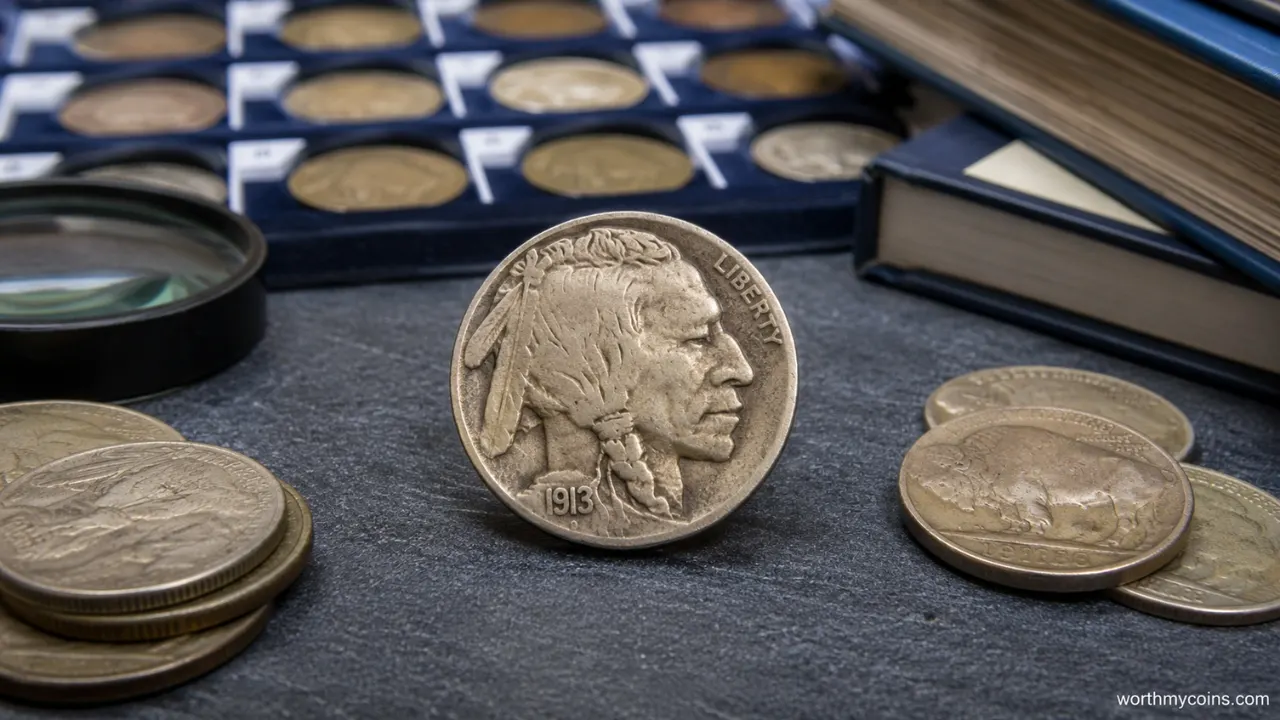
The Buffalo Nickel, also known as the Indian Head Nickel, is one of the most iconic coins ever produced by the United States Mint. Struck from 1913 through 1938, it is admired for its distinctly American design featuring a Native American portrait on the obverse and an American bison on the reverse. While millions of Buffalo Nickels were minted, certain dates, mint marks, and varieties have become highly desirable among collectors.
If you’re researching Buffalo Nickel key dates and values, it’s important to know that not every old nickel is rare or valuable. A coin’s worth depends on several factors, including its date, mint mark, condition, originality, authentication, and collector demand. Some well-worn examples are valued mainly for their collectible appeal, while scarce dates in high grades can attract significant interest from advanced collectors.
This guide explains how to identify Buffalo Nickels, spot important mint marks and key dates, recognize major varieties, and understand what experienced collectors look for when evaluating these coins. Whether you’re checking an inherited collection or an old coin album, these basics will help you identify Buffalo Nickels with more confidence.
History of the Buffalo Nickel
The Buffalo Nickel debuted in 1913 as part of a broader effort to improve the artistic quality of American coinage during the early twentieth century. The coin replaced the Liberty Head Nickel, which had been in circulation since 1883.
The design was created by sculptor James Earle Fraser, who wanted the coin to reflect America’s frontier heritage. The obverse features a composite portrait inspired by several Native American leaders, while the reverse depicts an American bison, commonly referred to as a buffalo, standing on a raised mound or a flat plain depending on the variety.
Buffalo Nickels were struck until 1938, when they were replaced by the Jefferson Nickel. Despite their relatively short production run, they remain one of the most collected U.S. coin series because of their historical significance, artistic design, and numerous collectible varieties.
Collectors interested in classic twentieth-century U.S. coinage often compare the Buffalo Nickel series with the Lincoln Wheat Penny Value Guide (1909–1958) because both series include famous key dates, sought-after varieties, and decades of established collector interest.
Although Buffalo Nickels are one of America’s most recognizable five-cent coins, collector demand varies considerably from one date and mint mark to another. Understanding those differences is often the first step toward identifying coins that deserve closer examination.
Buffalo Nickel Specifications
| Specification | Details |
|---|---|
| Designer | James Earle Fraser |
| Years Issued | 1913–1938 |
| Denomination | Five Cents |
| Country | United States |
| Composition | 75% Copper, 25% Nickel |
| Weight | 5.00 grams |
| Diameter | 21.2 mm |
| Edge | Plain |
| Mint Authority | United States Mint |
Unlike silver coins from the same era, Buffalo Nickels contain no silver. Their collectible value is determined primarily by rarity, condition, and demand rather than precious metal content.
How to Identify a Buffalo Nickel
Correct identification is essential before researching any Buffalo Nickel’s value. Several design characteristics make this series easy to recognize.
Obverse Design
The obverse features a right-facing portrait of a Native American. Above the portrait appears the word “LIBERTY,” while the date is positioned near the lower left shoulder. Because the date sits on one of the coin’s highest points, it often wears away after years of circulation.
Reverse Design
The reverse displays an American bison standing proudly with the denomination “FIVE CENTS” beneath it. Around the upper edge appears “UNITED STATES OF AMERICA,” while the national motto “E PLURIBUS UNUM” is placed above the animal.
Two different reverse designs were produced during 1913:
- Type 1: The bison stands on a raised mound.
- Type 2: The bison stands on a flatter ground with the denomination recessed to improve durability.
These two designs are collected separately by many enthusiasts.
Buffalo Nickel Mint Marks
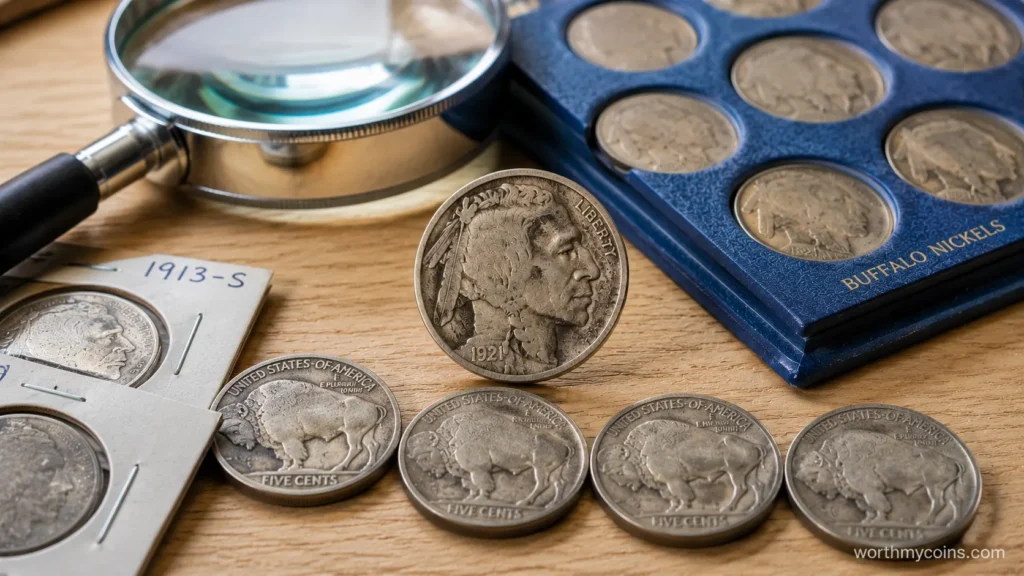
Buffalo Nickels were produced at three United States Mint facilities.
The mint mark appears on the reverse beneath the denomination “FIVE CENTS.”
| Mint | Mint Mark | Notes |
| Philadelphia | None | No mint mark |
| Denver | D | Reverse below denomination |
| San Francisco | S | Reverse below denomination |
The absence of a mint mark indicates the coin was struck in Philadelphia. However, a missing mint mark should not be confused with a worn coin where important details have faded over time.
Some dates are considerably scarcer from one mint than another, making the mint mark an important factor when determining collector demand.
Before estimating value, always verify three details first: the date, the mint mark, and whether the coin has an original readable surface. These factors form the foundation of accurate identification and are used by nearly every experienced collector.
What Determines Buffalo Nickel Value?
Several characteristics work together to determine how desirable a Buffalo Nickel is to collectors.
These same principles apply across many classic U.S. coin series. If you’d like to learn how rarity, condition, and collector demand influence another iconic coin, our 1909-S VDB Lincoln Wheat Penny Value Guide provides a detailed comparison.
Date
Certain years saw lower production totals or lower surviving populations than others. Collectors generally evaluate the date together with the mint mark instead of considering the year alone.
Mint Mark
Buffalo Nickels struck at Philadelphia, Denver, and San Francisco can vary greatly in availability. Coins from different mints often have different levels of collector demand even when they share the same date.
Condition
Condition is one of the most important factors affecting value. A Buffalo Nickel with strong design details, a visible date, and minimal wear will generally be more desirable than a heavily circulated example.
Since the date is one of the first features to wear away, coins with fully readable dates often receive greater attention from collectors.
Original Surfaces
Collectors usually prefer coins that retain their original surfaces. Cleaning, polishing, or other surface alterations can permanently reduce a coin’s appeal and may lower its market value.
Authentication
Although counterfeit Buffalo Nickels are relatively uncommon, altered dates and added mint marks do exist. If you think you’ve found a valuable example, professional authentication is the safest way to confirm that it’s genuine.
Coin Grading Overview
Coin grading measures how much wear a Buffalo Nickel has experienced and how well its original details have been preserved.
| Grade | Description |
| Good (G) | Heavy wear; major outlines remain visible |
| Very Good (VG) | Moderate to heavy wear with stronger details |
| Fine (F) | Moderate wear while major design elements remain clear |
| Very Fine (VF) | Light to moderate wear with good detail |
| Extremely Fine (XF) | Slight wear limited to high points |
| About Uncirculated (AU) | Minimal friction with nearly full detail |
| Mint State (MS) | No circulation wear; graded from MS60 through MS70 |
When grading Buffalo Nickels, collectors pay close attention to several important areas, including the Native American’s braid, cheekbone, hair details, and the bison’s horn, shoulder, and tail. Coins with stronger detail in these areas generally receive higher grades.
Professional grading services also evaluate strike quality, luster, eye appeal, and surface preservation. Because small differences in grade can significantly affect collector demand, certification is often recommended for scarce dates, major varieties, or exceptionally well-preserved examples.
Buffalo Nickel Key Dates Every Collector Should Know
While every Buffalo Nickel has historical appeal, a handful of dates and mint mark combinations are considered especially important to collectors because of their limited availability, lower mintages, or strong demand.
Some of the best-known key and semi-key dates include:
| Date | Mint Mark | Why It’s Important |
|---|---|---|
| 1913 Type 1 | Various | First-year design featuring the raised mound reverse |
| 1913 Type 2 | Various | Revised reverse design introduced during the first year |
| 1914-D | D | Better date with strong collector demand |
| 1915-S | S | Lower mintage than many common issues |
| 1918-D 8 over 7 | D | Famous overdate variety recognized by major grading services |
| 1921-S | S | Scarcer issue with fewer surviving high-grade examples |
| 1924-S | S | Difficult to locate in higher grades |
| 1926-S | S | One of the lowest regular-issue mintages in the series |
| 1931-S | S | Better date for collectors assembling complete sets |
| 1937-D Three-Legged | D | One of the most famous Buffalo Nickel varieties |
These dates are widely recognized by professional grading services and major numismatic references. However, a common-date Buffalo Nickel in exceptional Mint State condition can sometimes be more desirable than a scarcer coin with heavy wear.
Verified Buffalo Nickel Errors and Varieties
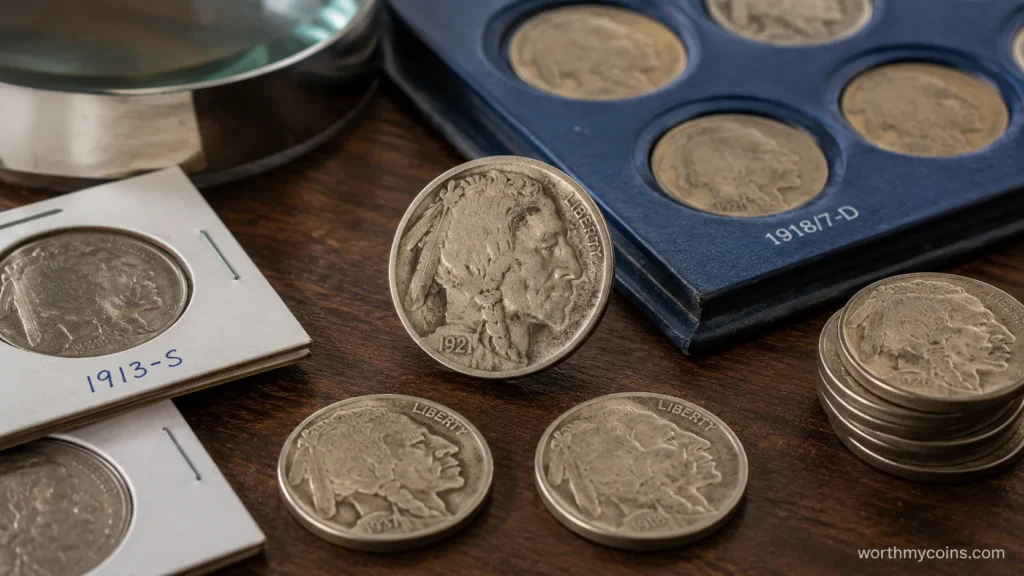
Buffalo Nickels are known for several important die varieties and mint-made errors that have become favorites among collectors. It’s essential to distinguish these from post-mint damage, which usually does not add collector value.
If you’re interested in learning how genuine mint errors differ from ordinary circulation damage, our Washington Quarter Error Guide explains many of the same error-identification principles used by experienced collectors.
| Variety | Description | Recognition |
|---|---|---|
| 1913 Type 1 | Raised mound reverse | First-year design |
| 1913 Type 2 | Modified recessed denomination | First-year redesign |
| 1916 Doubled Die Obverse | Noticeable doubling on lettering and date | Recognized by major grading services |
| 1918-D 8 Over 7 | Overdate created during die preparation | Major collectible variety |
| 1935 Doubled Die Reverse | Doubling on reverse lettering | Verified variety |
| 1937-D Three-Legged Buffalo | Missing front leg due to excessive die polishing | One of the series’ most famous errors |
| Repunched Mint Marks | Multiple impressions of mint mark on selected issues | Popular with variety specialists |
Because valuable varieties are frequently counterfeited or altered, authentication by reputable third-party grading companies is recommended before purchasing expensive examples.
Why Buffalo Nickel Values Vary
No two Buffalo Nickels are exactly alike from a collector’s perspective. Even coins with the same date and mint mark may differ substantially in value because of several important factors.
Grade
Condition remains one of the biggest influences on value. Buffalo Nickels often circulated extensively, making sharply detailed examples much harder to find.
Full Date
One of the most desirable characteristics is a fully visible date. Because the date is located on a high point of the design, it frequently wears away in circulation. Coins with complete, readable dates are generally more attractive to collectors than dateless examples.
Strike Quality
Certain dates were struck more sharply than others. Collectors often examine the details of the Native American’s braid, hair, and cheekbone along with the buffalo’s horn and shoulder when evaluating strike quality.
Original Surfaces
Natural surfaces with original color are generally preferred over coins that have been cleaned or polished. Harsh cleaning may permanently reduce collector appeal.
Authentication
Professional authentication provides additional confidence for buyers and sellers, especially when dealing with valuable key dates or major varieties.
Since market conditions change over time, there is no fixed value that applies to every Buffalo Nickel. Current prices depend on rarity, condition, certification, and collector demand.
Should You Clean a Buffalo Nickel?
The safest answer is almost always no.
Cleaning may seem like a good way to improve a coin’s appearance, but experienced collectors can usually recognize cleaned surfaces immediately. Once the original finish has been disturbed, the coin’s desirability may decline.
Common problems caused by cleaning include:
- Hairline scratches
- Loss of original luster
- Artificial shine
- Chemical discoloration
- Surface damage
If a Buffalo Nickel appears dirty or toned, leaving it untouched is usually the best decision until it can be evaluated by a knowledgeable collector or grading professional.
Tips for Collecting Buffalo Nickels
Whether you’re starting your first collection or expanding an existing set, these practical tips can help you make informed decisions.
- Learn to identify both 1913 reverse types.
- Always check the mint mark before researching value.
- Buy the highest grade your budget comfortably allows.
- Compare coins with certified examples whenever possible.
- Store coins in archival-quality holders designed for long-term preservation.
- Keep records of purchases, certifications, and provenance.
- Purchase key dates from reputable dealers or established auction houses.
- Continue studying grading standards as your collection grows.
Building experience across multiple classic U.S. coin series helps collectors recognize originality, grading differences, and market demand more confidently. For those interested in another historic series, our Morgan Dollar Value Guide is a helpful next resource.
Many collectors build complete date-and-mint collections, while others focus on major varieties such as the Three-Legged Buffalo or the 1918-D 8 Over 7 overdate.
Many collectors eventually organize Buffalo Nickels by date and mint mark rather than estimated value. This approach makes it easier to spot missing key dates while building a complete collection over time.
Common Mistakes New Collectors Make
New collectors often make avoidable mistakes that can lead to disappointment or unnecessary expense.
Assuming Every Buffalo Nickel Is Valuable
Although Buffalo Nickels are collectible, many common dates remain readily available. A coin’s age alone does not determine its value.
Ignoring the Date
Some Buffalo Nickels have worn dates that are difficult or impossible to read. Since the date is essential for identification, a missing date can significantly affect collector interest.
Confusing Damage With Mint Errors
Scratches, dents, corrosion, and environmental damage occurred after the coin left the Mint. Genuine mint errors occur during production and should be verified before assuming they are valuable.
Buying Rare Dates Without Authentication
High-demand Buffalo Nickels are sometimes altered by changing dates or adding mint marks. Professional authentication is recommended for expensive purchases.
The same precautions apply when purchasing scarce early U.S. coins. Our 1943 Bronze Lincoln Wheat Penny Value Guide explains why professional authentication becomes especially important whenever a coin is believed to be exceptionally rare.
Improper Storage
Exposure to moisture, fingerprints, PVC-containing holders, and harsh environments can permanently damage older coins.
Frequently Asked Questions
Why is the Buffalo Nickel also called the Indian Head Nickel?
The coin features a Native American portrait on the obverse and an American bison on the reverse. Because of the obverse design, many collectors refer to it as the Indian Head Nickel.
Where is the mint mark located?
The mint mark appears on the reverse beneath the denomination “FIVE CENTS.” Philadelphia coins have no mint mark.
What are the two 1913 Buffalo Nickel types?
Type 1 features the buffalo standing on a raised mound, while Type 2 has a redesigned reverse with the denomination recessed into the ground.
Why do so many Buffalo Nickels have missing dates?
The date was placed on one of the highest points of the design, making it especially vulnerable to wear during circulation.
Is the 1937-D Three-Legged Buffalo a real mint error?
Yes. It is a well-documented variety created after excessive die polishing removed much of the buffalo’s front leg, and it is recognized by major grading services.
Should I have my Buffalo Nickel professionally graded?
Professional grading is often worthwhile for key dates, major varieties, high-grade examples, or coins that may have significant collector value.
Can cleaned Buffalo Nickels still be collectible?
Yes, but cleaning generally reduces collector appeal compared with coins that retain their original surfaces.
Where can I verify Buffalo Nickel varieties?
Trusted resources include PCGS, NGC, the American Numismatic Association, and the Newman Numismatic Portal, along with recent auction archives.
Conclusion
The Buffalo Nickel remains one of the most rewarding U.S. coin series to collect because of its classic design, fascinating history, and memorable key dates. Whether you’re searching for a 1913 Type 1, a 1918-D 8 Over 7 overdate, or the famous 1937-D Three-Legged Buffalo, understanding mint marks, grading, and authenticity will help you make smarter collecting decisions. With careful research and patience, you’ll be better prepared to recognize coins that deserve a closer look.
If you’re planning to expand your collection beyond Buffalo Nickels, our Kennedy Half Dollar Value Guide is another helpful resource covering key dates, important varieties, and collecting fundamentals from one of America’s most widely collected modern coin series.
Understanding key dates, mint marks, grading standards, and verified varieties will help you make informed collecting decisions while avoiding common mistakes. Rather than relying on sensational online claims, evaluate each coin based on its authenticity, condition, originality, and current collector demand. With careful research and patience, collecting Buffalo Nickels can be both rewarding and historically enriching.
References
- United States Mint (Official U.S. Government)
- Professional Coin Grading Service (PCGS)
- Numismatic Guaranty Company (NGC)
- American Numismatic Association (ANA)
- Heritage Auctions
- Stack’s Bowers Galleries
- Newman Numismatic Portal

Narayan Kumar is the Founder and Author of Worth My Coins. She specializes in U.S. coin collecting, with a focus on coin identification, mint errors, grading, rare varieties, and collector education. Her goal is to publish accurate, well-researched, and easy-to-understand guides that help both new and experienced collectors make informed decisions. Every article is created using trusted numismatic references and is written with a commitment to accuracy, transparency, and long-term educational value.