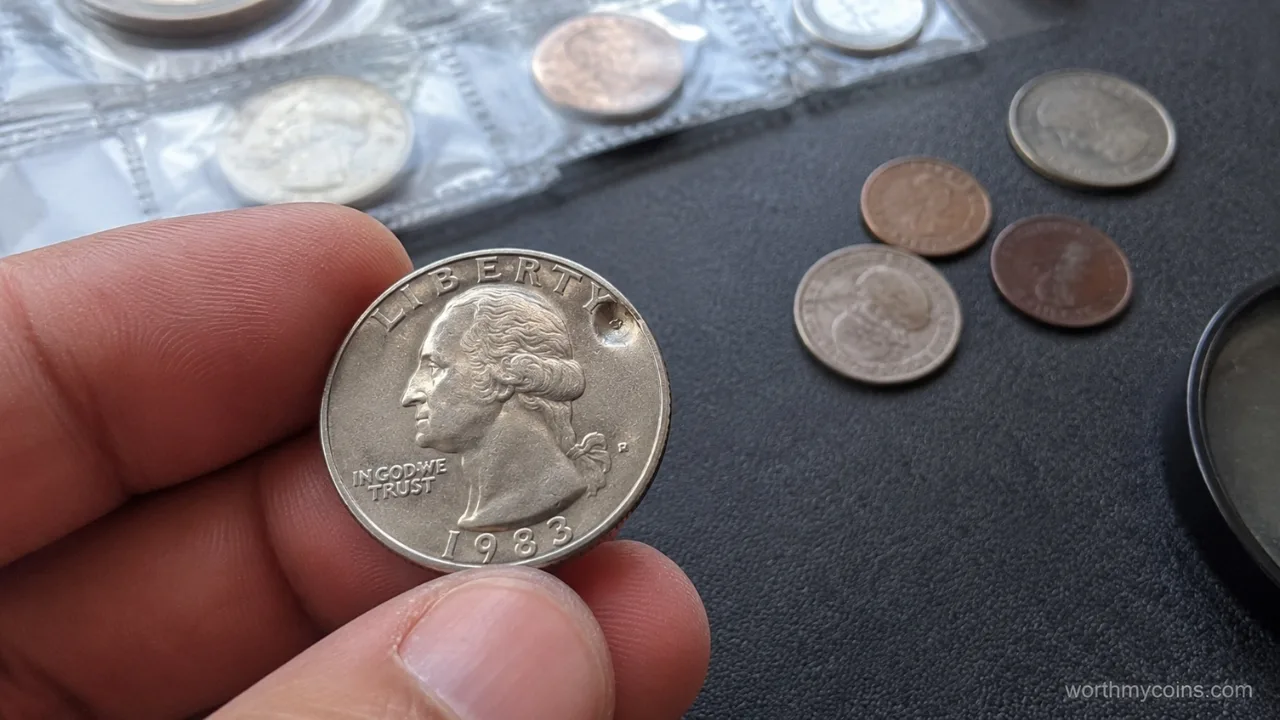
Washington Quarters have been a part of everyday American life since 1932, making them one of the most collected U.S. coins. While most circulated quarters are worth only their face value, a small number contain genuine mint errors or rare die varieties that attract significant interest from collectors. Learning to recognize genuine mint errors helps you quickly distinguish an ordinary quarter from one that may deserve additional research or professional evaluation.
Not every unusual-looking quarter is a genuine mint error. Everyday wear, scratches, corrosion, environmental damage, and post-mint alterations can all resemble mint errors. True mint errors occur during production at the United States Mint and are confirmed through recognized numismatic references or professional authentication.
This guide walks you through the basics of identifying Washington Quarters, locating mint marks, understanding what affects collector value, and recognizing genuine mint errors. You’ll also learn which verified error types collectors pay the most attention to and how to tell them apart from ordinary damage.
If you’re new to error coin collecting, our Coin Error Guide for Beginners is a helpful place to start before examining your own coins.
History of the Washington Quarter
The Washington Quarter was introduced in 1932 to commemorate the 200th anniversary of George Washington’s birth. Originally intended as a one-year commemorative issue, the design became so popular that it permanently replaced the Standing Liberty Quarter.
The obverse features a portrait of George Washington based on the work of sculptor Jean-Antoine Houdon and adapted by designer John Flanagan. For decades, the reverse displayed an eagle with outstretched wings before being replaced temporarily by the 50 State Quarters Program beginning in 1999. Since then, several reverse designs have appeared through programs such as the District of Columbia and U.S. Territories Quarters, America the Beautiful Quarters, and the American Women Quarters Program.
Despite these design changes, Washington Quarters remain one of the longest-running and most recognizable coin series produced by the United States Mint.
Collectors interested in older quarter designs may also enjoy our Standing Liberty Quarter Value Guide for historical comparisons.
Washington Quarter Specifications
| Specification | Details |
|---|---|
| Denomination | Quarter Dollar (25 Cents) |
| First Issued | 1932 |
| Designer | John Flanagan (original design) |
| Diameter | 24.3 mm |
| Weight (1932–1964) | 6.25 grams |
| Composition (1932–1964) | 90% Silver, 10% Copper |
| Weight (1965–Present) | 5.67 grams |
| Composition (1965–Present) | Copper-Nickel Clad over Copper Core |
| Edge | Reeded |
| Mint Authority | United States Mint |
Because Washington Quarters have been produced using different compositions over the decades, identifying the coin’s date is one of the first steps in evaluating it. Silver quarters struck through 1964 differ significantly from modern clad issues in both composition and collector appeal.
How to Identify a Washington Quarter
Before searching for mint errors, confirm the coin’s date, mint mark, and design type.
Obverse Design
The obverse features George Washington facing left with the inscriptions “LIBERTY,” “IN GOD WE TRUST,” and the date. Modern redesigns have slightly updated Washington’s portrait while retaining the overall appearance.
Reverse Design
The reverse depends on the year of issue.
Earlier coins display a heraldic eagle, while later programs introduced hundreds of commemorative reverse designs representing states, national parks, territories, and notable American women.
Because reverse designs vary widely, always compare your coin with official United States Mint images when identifying a specific issue.
Washington Quarter Mint Marks
Mint marks identify where a Washington Quarter was produced. Although they do not automatically make a coin valuable, they are essential when researching varieties, errors, and collector demand.
Depending on the production year, the mint mark is generally found on the obverse near Washington’s ponytail or ribbon.
| Mint | Mint Mark |
| Philadelphia | No mint mark (before 1980), P (1980-present) |
| Denver | D |
| San Francisco | S |
| West Point | W (selected modern collector and circulation issues) |
West Point quarters released in recent years have generated considerable collector interest because they were produced in limited circulation quantities compared with standard Philadelphia and Denver issues.
If you’re unfamiliar with mint marks, our U.S. Mint Marks Guide explains how different facilities have produced American coins throughout history.
Before searching for errors, always confirm the coin’s date, mint mark, and design type. Many reported “rare” quarters turn out to be common issues once these basic details are verified, making accurate identification the most important first step.
What Determines the Value of an Error Quarter?
Finding an unusual Washington Quarter is exciting, but several factors determine whether collectors consider it valuable.
The Error Must Be Genuine
Only errors created during the minting process are considered legitimate mint errors. Damage occurring after the coin enters circulation generally does not increase collector value.
Rarity
Some error types occur only occasionally because of specific production mistakes. Others may appear on larger numbers of coins. Rarity is one factor collectors evaluate alongside demand and condition.
Condition
A sharply preserved error coin with minimal wear usually attracts more collector interest than the same error found on a heavily circulated quarter.
Authentication
If you believe you’ve found a valuable error coin, professional authentication can confirm that the error occurred during the minting process and wasn’t caused by damage after the coin entered circulation.
Collector Demand
Demand varies among different error types. Dramatic mint errors that are easy to recognize often receive greater attention from collectors than minor production abnormalities.
Because collector preferences change over time, there is no universal value assigned to every error coin. Prices depend on rarity, grade, authentication, eye appeal, and current market demand.
Our How to Spot Fake Coins guide also explains why authentication is especially important when dealing with valuable mint errors.
Coin Grading and Why It Matters
Grading measures the overall preservation of a coin and plays an important role in determining collector value.
Even two Washington Quarters with the same mint error can differ substantially in value if one is heavily worn while the other remains in Mint State condition.
| Grade | Description |
| Good (G) | Heavy circulation wear with major design visible |
| Very Good (VG) | Moderate to heavy wear |
| Fine (F) | Moderate wear with clear major details |
| Very Fine (VF) | Light to moderate wear |
| Extremely Fine (XF) | Slight wear on the highest points |
| About Uncirculated (AU) | Very light friction with nearly full detail |
| Mint State (MS) | No circulation wear; graded from MS60 to MS70 |
Professional graders also examine strike quality, luster, surface preservation, contact marks, and overall eye appeal. These factors can influence desirability even among coins assigned the same numerical grade.
When evaluating potentially valuable Washington Quarter errors, collectors should avoid cleaning or altering the coin before professional examination. Original surfaces are generally preferred, and improper cleaning may reduce both authenticity confidence and collector appeal.
In the next section, we’ll examine several of the best-known and verified Washington Quarter mint errors, explain how they occurred, and discuss what collectors should look for when identifying them.
Verified Washington Quarter Mint Errors and Rare Varieties
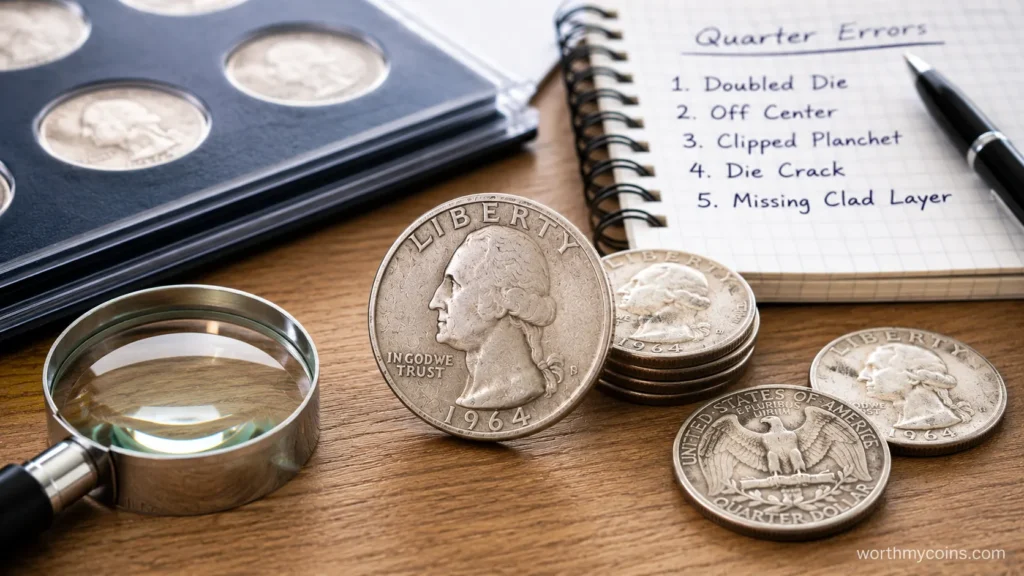
Not every unusual-looking Washington Quarter is a genuine mint error. True mint errors occur during the manufacturing process at the United States Mint and are documented by respected numismatic organizations and error specialists. Understanding the difference between authentic mint errors and post-mint damage is essential before assuming a coin has significant collector value.
| Verified Error or Variety | Description | Collector Notes |
|---|---|---|
| Doubled Die Obverse (DDO) | Design elements appear doubled because of a misaligned hub during die creation. | Requires careful examination and attribution. |
| Doubled Die Reverse (DDR) | Doubling appears on lettering or reverse design details. | Premium depends on the specific variety and grade. |
| Off-Center Strike | The planchet was not centered during striking, leaving part of the design missing. | More dramatic off-center strikes are generally more desirable. |
| Broadstrike | Coin was struck without the retaining collar, resulting in a wider-than-normal coin. | Genuine examples are collected by error specialists. |
| Clipped Planchet | A portion of the blank planchet was missing before striking. | Curved clips are among the most recognized planchet errors. |
| Die Crack | Raised lines caused by cracks developing in the die. | Minor die cracks are common; larger examples attract more attention. |
| Cud Error | A piece of the die breaks away, leaving a raised blob of metal on the coin. | Often easy to identify and popular among collectors. |
| Struck Through Error | Foreign material was between the die and planchet during striking. | Appearance varies depending on the object involved. |
Some Washington Quarter series also include well-known die varieties, but each variety should be verified using reliable references before being considered rare. Professional attribution may be necessary for valuable discoveries.
If you enjoy searching circulation for unusual coins, our Rare Coin Error Guide explains additional error types found across many U.S. coin series.
Famous Washington Quarter Varieties
Several Washington Quarter varieties have become especially well known among collectors due to their documented characteristics.
1932-D and 1932-S Quarters
Although these are not error coins, they are considered important key dates because of their relatively low mintages compared with many later Washington Quarters. Condition plays a major role in determining collector value.
1950s and 1960s Doubled Dies
Certain doubled die varieties from this period have been recognized by major grading services. Genuine examples require careful attribution because machine doubling is often mistaken for true doubled dies.
State Quarter Errors
The 50 State Quarters Program introduced millions of new collectors to the hobby. While many internet claims exaggerate “rare” state quarter errors, only documented and authenticated mint errors should be considered collectible.
America the Beautiful and American Women Quarters
Modern quarter programs have also produced legitimate mint errors, including off-center strikes, struck-through errors, and occasional die varieties. These should always be evaluated individually rather than assuming every unusual coin is valuable.
What Makes a Washington Quarter More Valuable?
Several factors influence collector interest beyond the presence of a mint error.
Grade
Higher-grade coins generally command stronger demand because they show less wear and retain more original detail.
Error Size and Visibility
A dramatic off-center strike or large cud error is usually easier for collectors to recognize than a subtle die crack, making more obvious errors particularly desirable.
Authentication
Professional certification by respected grading services provides confidence that the error is genuine and accurately identified.
Eye Appeal
Original surfaces, attractive toning, and strong luster often increase collector interest, particularly for Mint State examples.
Market Demand
Collector demand changes over time. Popular error types may become more desirable as interest in error collecting grows, while values continue to depend on recent sales, rarity, grade, and authentication.
Because these factors vary widely, there is no fixed value that applies to every Washington Quarter error.
Our Coin Grading Guide explains how professional grading affects collector confidence and marketability.
Tips for Finding Washington Quarter Errors
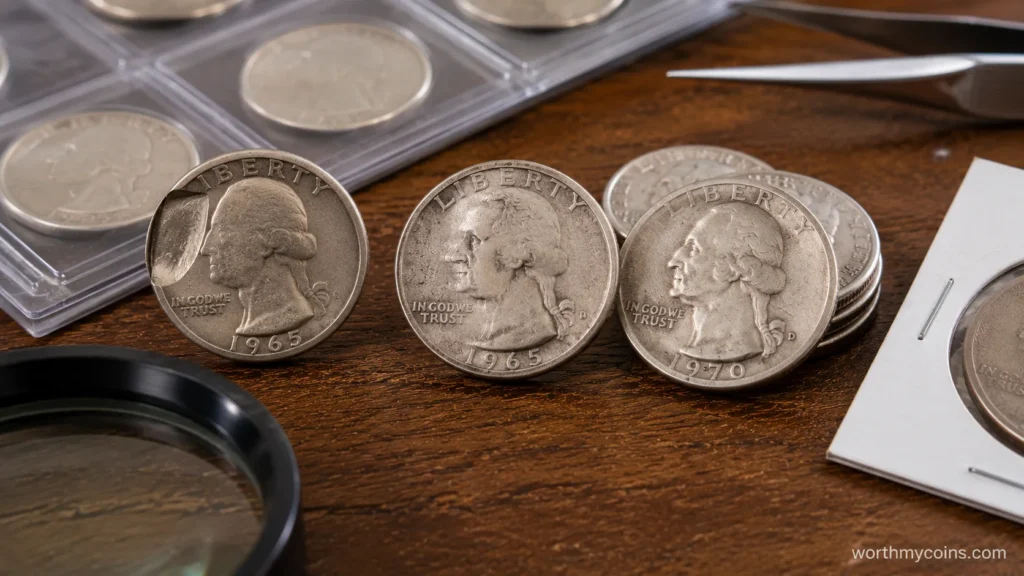
Searching circulation can be both educational and rewarding if approached carefully.
- Examine coins under good lighting using a quality magnifier.
- Compare suspicious coins with official reference photographs.
- Learn the difference between machine doubling and true doubled dies.
- Avoid cleaning coins before evaluation.
- Store potential discoveries in protective holders.
- Research recent auction records instead of relying on social media claims.
- Consider professional authentication for unusual or valuable-looking coins.
Building knowledge gradually is often more valuable than hoping to find a rare coin overnight.
Keeping notes or photographs of unusual finds can also make future identification easier. Comparing the same coin under different lighting angles often reveals details that are difficult to notice during a quick inspection.
Common Mistakes Collectors Make
Many beginners unintentionally overlook important details when searching for error coins.
Mistaking Damage for Mint Errors
Scratches, dents, corrosion, heat damage, and environmental wear are often confused with genuine mint errors.
Cleaning Coins
Cleaning may permanently alter a coin’s original surface and reduce collector appeal, even if the error itself remains visible.
Ignoring Mint Marks
Mint marks help identify where a quarter was produced and can be essential when researching certain varieties.
Believing Every Online Claim
Many online videos and social media posts dramatically overstate the rarity of ordinary quarters. Always verify information using trusted numismatic references.
Skipping Authentication
Potentially valuable error coins should be examined by reputable grading services before significant buying or selling decisions are made.
Our Coin Storage Guide also explains how proper storage helps preserve both condition and long-term collector value.
Frequently Asked Questions
Are all Washington Quarter errors valuable?
No. Many errors are relatively minor, while others are extremely scarce. Value depends on the specific error, grade, rarity, authentication, and collector demand.
How do I know if my quarter has a real mint error?
Compare the coin with recognized references from trusted organizations. If the coin appears unusual, professional authentication may be worthwhile.
Can damaged quarters be worth more?
Generally, no. Damage that occurs after a coin leaves the Mint is not considered a collectible mint error.
Where is the mint mark located?
On most modern Washington Quarters, the mint mark appears on the obverse near Washington’s ponytail or ribbon. Its exact location varies slightly by design.
Should I clean an error coin?
No. Cleaning can permanently reduce collector appeal and may affect the coin’s marketability.
Are silver Washington Quarters more valuable?
Quarters dated 1932 through 1964 contain 90% silver, giving them intrinsic silver value in addition to any collector premium based on date, mint mark, condition, or recognized variety.
What is the best way to store Washington Quarters?
Use archival-quality coin holders or albums designed for long-term storage. Avoid PVC-containing materials and excessive humidity.
Should I have an error coin professionally graded?
Professional grading is often recommended for significant errors, key dates, or coins that appear to have substantial collector value.
Conclusion
Washington Quarters remain one of the most rewarding U.S. coin series for collectors because they combine rich history with the possibility of discovering fascinating mint errors and die varieties. While genuine errors are much less common than internet rumors often suggest, learning how coins are made and understanding the characteristics of authentic mint errors can help you make informed collecting decisions.
Whether you’re checking pocket change or building a dedicated collection, taking the time to identify genuine mint errors, verify important varieties, and rely on trusted references will help you make better collecting decisions. A careful approach also makes it much easier to separate truly collectible coins from ordinary circulation damage.
References
- United States Mint
- Professional Coin Grading Service (PCGS)
- Numismatic Guaranty Company (NGC)
- American Numismatic Association (ANA)
- Heritage Auctions
- Stack’s Bowers Galleries
- Newman Numismatic Portal
- A Guide Book of United States Coins (The Official Red Book)

Narayan Kumar is the Founder and Author of Worth My Coins. She specializes in U.S. coin collecting, with a focus on coin identification, mint errors, grading, rare varieties, and collector education. Her goal is to publish accurate, well-researched, and easy-to-understand guides that help both new and experienced collectors make informed decisions. Every article is created using trusted numismatic references and is written with a commitment to accuracy, transparency, and long-term educational value.