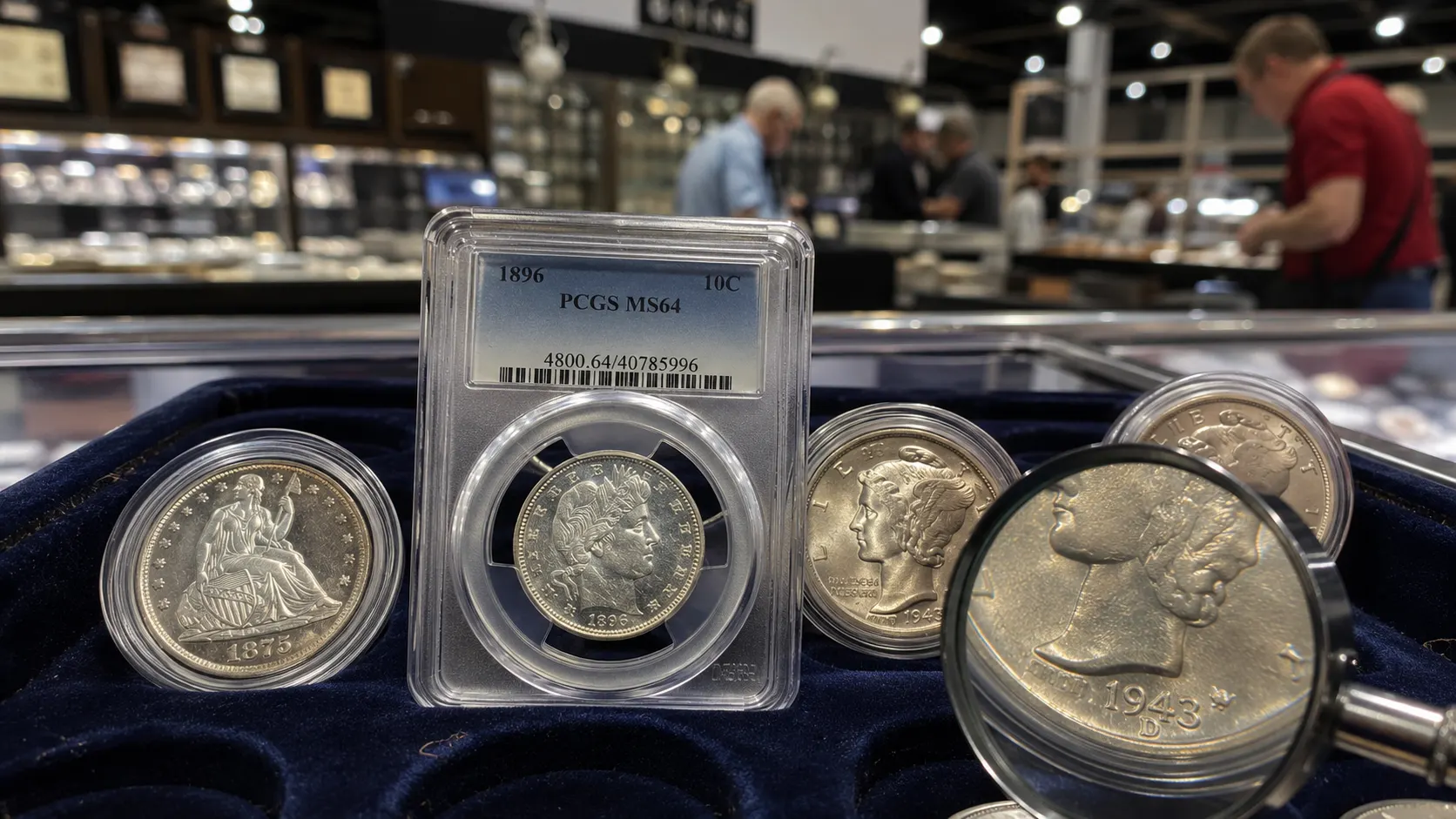
Silver dimes are some of the most widely collected coins in American numismatics. While most pre-1965 dimes contain silver and are worth more than face value, a small group of rare dates, mint errors, and low-mintage issues have achieved extraordinary prices at auction. Some have sold for hundreds of thousands of dollars, while a few have crossed the million-dollar mark.
For collectors, these coins offer an important lesson: rarity alone does not create value. Condition, certification, historical significance, collector demand, and population reports all play major roles in determining what a coin is worth.
This guide highlights 10 silver dimes that have produced remarkable auction results and explains why collectors continue to pursue them.
Quick Answer
The most valuable silver dime ever sold is the 1894-S Barber Dime. One example graded Proof 66 by PCGS realized $2.16 million at a Heritage Auctions sale in January 2025, making it one of the most famous and valuable United States coins of any denomination.
Top Silver Dimes That Brought Record Prices
| Rank | Coin |
|---|---|
| 1 | 1894-S Barber Dime |
| 2 | 1916-D Mercury Dime |
| 3 | 1873-CC No Arrows Seated Liberty Dime |
| 4 | 1871-CC Seated Liberty Dime |
| 5 | 1872-CC Seated Liberty Dime |
| 6 | 1796 Draped Bust Dime |
| 7 | 1804 Draped Bust Dime |
| 8 | 1822 Capped Bust Dime |
| 9 | 1942/1 Mercury Dime Overdate |
| 10 | 1919-D Mercury Dime Full Bands |
The order reflects a combination of rarity, historical significance, and documented auction performance.
1. 1894-S Barber Dime
Why It Matters
The 1894-S Barber Dime is often called the king of American dimes. Only 24 pieces were struck at the San Francisco Mint, and fewer than a dozen examples are known today. It is considered one of the greatest rarities in all of U.S. coin collecting.
The story behind its creation remains one of numismatics’ enduring mysteries. Several theories exist, but no definitive explanation has been proven.
Record Sale
A PCGS PR66 example sold for $2,160,000 at Heritage Auctions in January 2025. According to PCGS auction records, this currently stands as the highest publicly reported auction result for the issue.
Identification Tips
- Date: 1894
- Mint mark: Small “S” on the reverse
- Barber design by Charles E. Barber
- All genuine examples are proof strikes
Collector Note
Because of its extreme rarity, most collectors will never own one. However, it remains an important benchmark for understanding how rarity and historical significance influence coin values.
2. 1916-D Mercury Dime
Why It Matters
The 1916-D Mercury Dime is the key date of the Mercury Dime series. Although more than a quarter-million were minted, relatively few survived in high grades. Collector demand has remained strong for decades.
Record Sale
PCGS reports that a toned example graded MS67+ Full Bands sold for $300,000 in 2020 after previously setting a record at $195,500 in 2010.
Collectors who want a deeper look at this famous key date should see 1916-D Mercury Dime Value Guide: Rare Key Date, Errors, Mint Marks & Current Value, which covers identification, rarity, and collector demand in greater detail.
Identification Tips
- Date: 1916
- Denver mint mark on reverse
- Designed by Adolph A. Weinman
- Look for authentic Full Bands designation on certified examples
Value Factors
The biggest price driver is condition. Lower-grade examples are collectible, but the largest auction prices occur for coins with exceptional preservation and Full Bands details.
Understanding Full Bands
Many Mercury Dimes feature horizontal bands wrapped around the fasces on the reverse.
A coin receiving a Full Bands designation shows complete separation of these bands. Because fully struck examples are harder to find, collectors often pay substantial premiums for certified Full Bands specimens.
Collectors interested in other sought-after issues from the same series may also enjoy Most Valuable Mercury Dimes Worth Money: 15 Rare Coins Every Collector Should Know.
3. 1873-CC No Arrows Seated Liberty Dime
Why It Matters
Few U.S. dimes are rarer than the 1873-CC No Arrows issue from Carson City.
During 1873, weight changes resulted in arrows being added beside the date on many coins. Only a tiny number of No Arrows dimes were produced before the change occurred, making this one of the legendary Carson City rarities.
Identification Tips
- Carson City mint mark
- No arrows next to the date
- Seated Liberty design
Why Collectors Love It
It combines three desirable characteristics:
- Carson City origin
- Extremely low survival rate
- Historical connection to a major design transition
High-grade certified examples are rarely offered for sale.
4. 1871-CC Seated Liberty Dime
Why It Matters
Coins from the Carson City Mint are popular across nearly every series, and the 1871-CC dime is no exception.
Many surviving examples saw heavy circulation throughout the American West, leaving relatively few high-grade specimens available today.
Identification Tips
- CC mint mark below the wreath
- Seated Liberty obverse
- Silver composition
Value Factors
Collectors often compete aggressively for:
- Original surfaces
- Problem-free examples
- Higher Mint State grades
- Certified Carson City coins
Because demand greatly exceeds supply, premium examples can realize substantial auction prices.
5. 1872-CC Seated Liberty Dime
Why It Matters
Another Carson City rarity, the 1872-CC dime remains one of the toughest dates in the Seated Liberty series.
Like many Western branch mint issues, survival rates are much lower than original production numbers suggest.
Identification Tips
- Date: 1872
- Carson City mint mark
- Seated Liberty design
Common Mistake
Many beginners focus only on mintage figures. While mintage matters, surviving population is often far more important.
A coin with a moderate original mintage may become exceptionally valuable if very few examples survive in collectible condition.
What Makes a Silver Dime Valuable?
Before chasing expensive coins, collectors should understand the main value drivers.
| Factor | Why It Matters |
|---|---|
| Rarity | Fewer available examples increase demand |
| Grade | Better preservation usually means higher value |
| Mint Mark | Certain mints produced scarcer coins |
| Historical Significance | Important issues attract collectors |
| Certification | PCGS and NGC authentication improves buyer confidence |
| Eye Appeal | Attractive toning and surfaces can command premiums |
A common silver dime in worn condition may only trade for bullion value, while a rare date in exceptional condition can sell for thousands or even millions of dollars.
Common Beginner Mistakes
Assuming Every Silver Dime Is Rare
Most silver dimes are collectible, but only a small percentage are genuinely rare.
Ignoring Condition
A key date in poor condition may be worth far less than the same coin in Mint State.
Cleaning Coins
Cleaning can permanently damage surfaces and reduce collector value.
Trusting Unverified Internet Claims
Many online value claims lack evidence. Always compare information with respected numismatic references and auction records.
6. 1796 Draped Bust Dime
Why It Matters
The 1796 Draped Bust Dime holds a special place in American numismatics because it represents the first year dimes were issued by the United States Mint. Early federal coinage is highly sought after, and surviving examples are scarce.
Many pieces entered circulation and remained in use for decades, making well-preserved examples especially desirable today.
Identification Tips
- Date: 1796
- Draped Bust portrait on obverse
- Small Eagle reverse
- Thirteen stars surrounding Liberty
Record Auction Performance
Exceptional certified examples have regularly realized six-figure prices, with top-condition specimens reaching well into the hundreds of thousands of dollars at major auction houses. The combination of first-year status and limited surviving population drives strong collector demand.
Value Factors
Collectors pay close attention to:
- Surface originality
- Strike quality
- Wear patterns
- Certification by PCGS or NGC
- Overall eye appeal
7. 1804 Draped Bust Dime
Why It Matters
The 1804 Draped Bust Dime is another classic rarity from America’s early coinage era. While not as famous as the legendary 1804 Silver Dollar, this dime remains one of the most desirable early U.S. dimes.
Many examples experienced heavy circulation, leaving relatively few high-grade survivors.
Identification Tips
- Date: 1804
- Draped Bust design
- Heraldic Eagle reverse
Why Collectors Pursue It
The coin appeals to several collecting groups simultaneously:
- Early American coin collectors
- Type collectors
- Date collectors
- Advanced rarity specialists
Strong competition among these groups often supports impressive auction prices.
8. 1822 Capped Bust Dime
Why It Matters
The 1822 Capped Bust Dime is one of the key rarities within the Capped Bust series.
Although examples occasionally appear on the market, truly original high-grade specimens are difficult to locate.
Identification Tips
- Date: 1822
- Capped Bust design by John Reich
- Silver composition
Auction Importance
When premium examples become available, collectors often compete aggressively because opportunities to purchase elite-quality pieces are infrequent.
Collector Lesson
Scarcity alone does not guarantee record prices. The most expensive examples usually combine rarity with exceptional preservation.
9. 1942/1 Mercury Dime Overdate
What Is an Overdate?
An overdate occurs when one date is punched over another date on a working die.
The famous 1942/1 Mercury Dime was created when remnants of a “1” remained visible beneath the final “2” in the date.
Today it is considered one of the most important error varieties in twentieth-century U.S. coinage.
Another famous overdate from the series is covered in 1942/41 Mercury Dime Value Guide: Rare Overdate Error, Mint Marks & Current Prices, a key reference for collectors studying Mercury Dime varieties.
Identification Tips
Look closely at the date under magnification.
On genuine examples, portions of the underlying “1” can be seen beneath the “2.”
Because counterfeit examples exist, professional authentication is strongly recommended.
Why It Is Valuable
Collectors appreciate this coin because it combines:
- A major mint error
- Historical significance
- Strong demand
- Wide recognition among hobbyists
Certified high-grade examples have produced impressive auction results for decades.
Common Mistake
Many beginners mistake damaged dates or die deterioration for the genuine overdate variety.
Authentication from PCGS or NGC helps eliminate uncertainty.
10. 1919-D Mercury Dime Full Bands
Why It Matters
Unlike some entries on this list that are famous because of low mintages, the 1919-D Mercury Dime becomes particularly valuable when found with Full Bands details.
Obtaining complete strike characteristics on this issue is extremely difficult.
Identification Tips
- Date: 1919
- Denver mint mark
- Mercury design
- Certified Full Bands designation
Why Collectors Pay Premiums
Full Bands examples represent the best-struck coins from the issue.
Because relatively few survive with this level of detail, elite-grade specimens often command dramatic premiums over ordinary examples.
How to Identify Valuable Silver Dimes
Before assuming a silver dime is rare, check several important characteristics.
Date
Certain years are significantly scarcer than others.
Mint Mark
Look for:
- D (Denver)
- S (San Francisco)
- CC (Carson City)
The mint mark can dramatically affect value.
Mint-mark rarity is also a major factor in the Barber series, as explained in Top 10 Barber Dimes Worth Money That Collectors Are Hunting in 2026.
Condition
Coins with minimal wear generally command stronger prices.
Variety or Error
Some of the most valuable dimes are worth money because of recognized varieties rather than low mintages.
Certification
Professional grading provides:
- Authentication
- Grade assessment
- Market confidence
- Easier resale potential
Buying Tips for New Collectors
Buy the Best Quality You Can Afford
Higher-quality coins often remain more desirable over time.
Learn Before Spending
Study grading standards, auction records, and population reports before making expensive purchases.
Focus on Certified Coins
PCGS and NGC certification can help reduce the risk of purchasing altered or counterfeit material.
Research Auction Results
Recent auction records provide a more realistic picture of market value than random online listings.
Selling Tips for Valuable Silver Dimes
Obtain Professional Authentication
Rare coins typically attract more buyer confidence when certified.
Compare Multiple Auction Records
One sale does not define value. Review several recent results when possible.
Understand Market Conditions
Collector demand can fluctuate based on economic conditions and market trends.
Avoid Quick Cash Offers
Rare coins sometimes sell for significantly more through established auction firms than through immediate cash transactions.
How Grading Affects Silver Dime Values
The difference between grades can be enormous.
For example, a coin graded Fine may be worth a fraction of the price realized by a Mint State example of the same date.
Important grading factors include:
- Wear
- Strike quality
- Surface preservation
- Luster
- Marks and abrasions
- Eye appeal
Because small grading differences can have large financial consequences, professional certification plays a major role in the rare coin market.
FAQ
Are all silver dimes valuable?
No. Most silver dimes contain intrinsic silver value and are worth more than face value, but only certain rare dates, varieties, and high-grade examples achieve significant collector premiums.
What is the most valuable silver dime ever sold?
The 1894-S Barber Dime holds the record among U.S. dimes, with a PCGS Proof 66 example selling for $2.16 million at Heritage Auctions in 2025.
How do I know if my silver dime is rare?
Start by checking the date, mint mark, condition, and any recognized varieties. Compare the coin with trusted references and consider professional authentication.
What does Full Bands mean on a Mercury Dime?
Full Bands indicates complete separation of the horizontal bands on the fasces shown on the reverse. It is a strike-quality designation that often increases collector value.
Should I clean a silver dime before selling it?
No. Cleaning can permanently damage a coin’s surface and frequently reduces collector value.
Which grading companies are most trusted?
PCGS and NGC are widely regarded as the leading third-party grading services in the United States.
Can worn silver dimes still be valuable?
Yes. Some rare dates remain valuable even in circulated grades because of their scarcity and collector demand.
Conclusion
Silver dimes may be small in size, but some rank among the most valuable coins in American numismatics. From the legendary 1894-S Barber Dime to famous Carson City issues and sought-after Mercury Dime varieties, these coins demonstrate how rarity, condition, history, and collector demand can combine to create extraordinary value.
For beginners, the most important takeaway is that not every silver dime is rare, but every silver dime deserves a careful look. A quick examination of the date, mint mark, variety, and condition can reveal whether a coin is simply worth its silver content or represents a significant numismatic treasure.
Collectors who rely on trusted references, study grading standards, and focus on certified examples will be better positioned to make informed decisions when buying, selling, or building a collection.
Collectors who enjoy silver dimes should also explore Most Valuable Roosevelt Dimes Worth Money: 15 Rare Coins Every Collector Should Know to compare another popular U.S. dime series and its key rarities.
References
- United States Mint
- Professional Coin Grading Service (PCGS) CoinFacts
- Numismatic Guaranty Company (NGC)
- American Numismatic Association (ANA)
- Heritage Auctions Archives
- Stack’s Bowers Galleries Auction Archives
- Newman Numismatic Portal

Narayan Kumar is the Founder and Author of Worth My Coins. She specializes in U.S. coin collecting, with a focus on coin identification, mint errors, grading, rare varieties, and collector education. Her goal is to publish accurate, well-researched, and easy-to-understand guides that help both new and experienced collectors make informed decisions. Every article is created using trusted numismatic references and is written with a commitment to accuracy, transparency, and long-term educational value.