Classic U.S. coins remain popular because they combine distinctive designs, important moments in American history, famous rarities, and the challenge of finding exceptional examples. From the earliest Flowing Hair issues to the artistic coins of the early 20th century, these pieces continue to give collectors plenty of reasons to study dates, mintmarks, varieties, condition, and provenance.
Quick Answer
Some of the classic U.S. coins that continue to attract collectors include the 1793 Flowing Hair Cent, 1794 Flowing Hair Silver Dollar, 1804 Draped Bust Dollar, 1909-S V.D.B. Lincoln Cent, 1913 Liberty Head Nickel, 1893-S Morgan Dollar, 1916-D Mercury Dime, 1916 Standing Liberty Quarter, 1916 Walking Liberty Half Dollar, and 1933 Saint-Gaudens Double Eagle.
They are not all famous for the same reason. Some represent important firsts in U.S. coinage, some are recognized rarities, and others are remembered primarily for their designs and historical importance.
Why Classic U.S. Coins Remain So Popular
Classic coins offer something that modern issues often cannot: a direct connection to earlier periods of American history.
The United States Mint began producing coins in the 1790s, and early designs frequently portrayed Liberty rather than an actual historical person. Liberty remained a dominant theme on American circulating coins for more than a century.
That tradition gradually changed. The early 20th century brought a remarkable series of artistic designs influenced by President Theodore Roosevelt’s efforts to improve the appearance of American coinage. The result included the Lincoln cent, Buffalo nickel, Mercury dime, Standing Liberty quarter, Walking Liberty half dollar, and Saint-Gaudens gold designs.
For collectors, that period produced some of the most recognizable coins in the hobby.
1793 Flowing Hair Cent
The 1793 Flowing Hair cent belongs to the earliest chapter of federal U.S. coinage. The Mint delivered its first circulating coins on March 1, 1793, consisting of copper cents. One of the earliest designs featured Liberty with flowing hair on the obverse and a chain on the reverse.
The chain design was quickly replaced after criticism over what the chain represented. The Mint subsequently introduced a wreath reverse, making the earliest cents especially interesting to collectors studying the rapid development of American coin designs.
These coins are historically important even before considerations of condition or market value. They represent the beginning of the federal government’s attempt to establish a national coinage system.
1794 Flowing Hair Silver Dollar
The 1794 Flowing Hair silver dollar occupies an equally important position in American numismatics.
The first U.S. silver dollars were struck on October 15, 1794. The Mint produced only 1,758 examples dated 1794 before production increased the following year after the Philadelphia Mint installed a larger press.
The obverse depicts Liberty with flowing hair, while the reverse features an eagle surrounded by a wreath. The coin’s place as the first federal silver dollar type makes it one of the foundational pieces of U.S. coin collecting.
Its importance is not based simply on age. It combines early federal history, a first-year issue, limited production, and a design that documents the country’s earliest coinage.
1804 Draped Bust Dollar
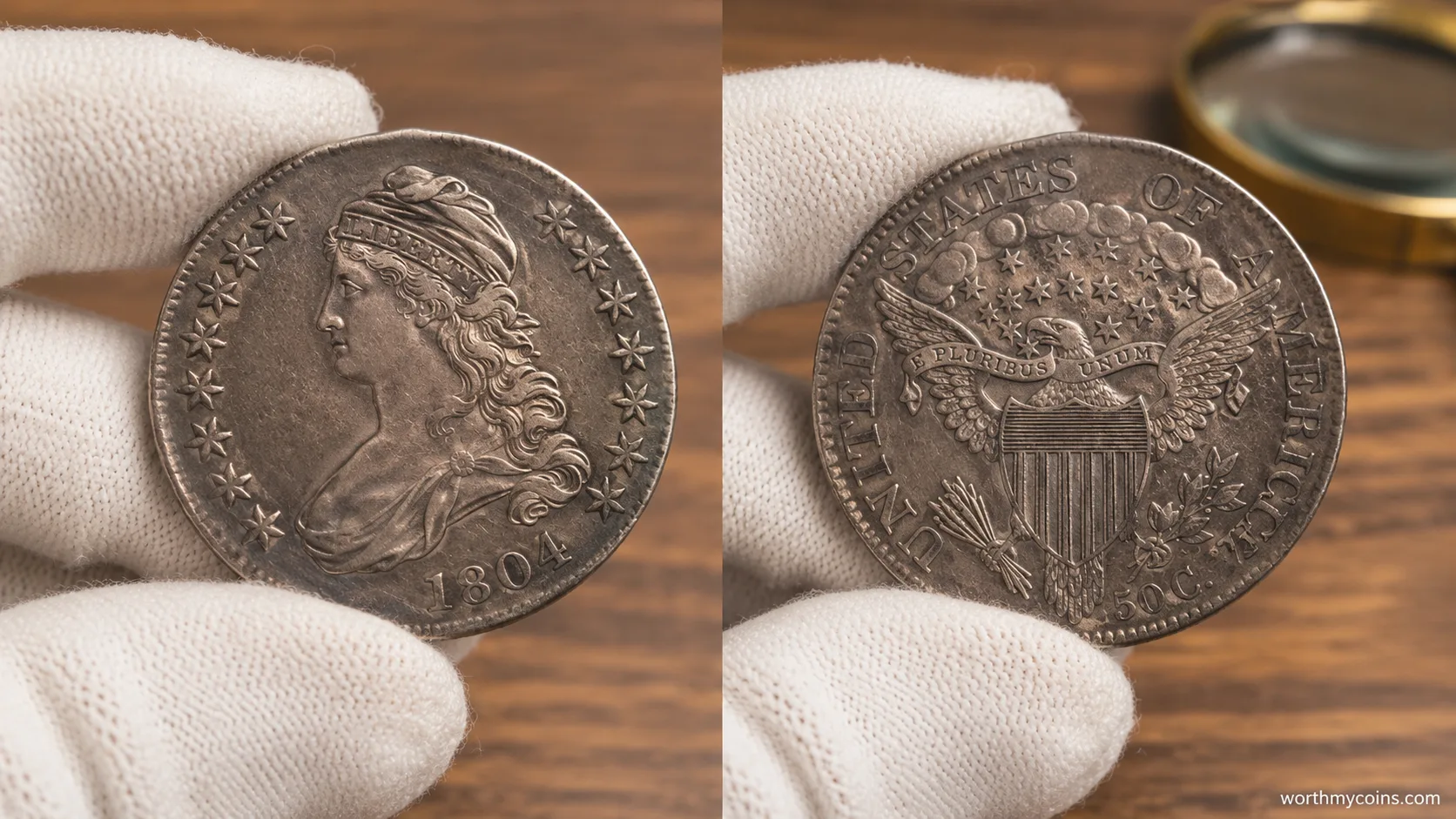
Few American coins have a more unusual history than the 1804 Draped Bust dollar.
Despite its famous date, the coins known as 1804 dollars were not actually struck during calendar year 1804. The U.S. Mint explains that some dollars struck in 1803 were intended for circulation in the following year, while the famous 1804-dated pieces were produced beginning in the 1830s for diplomatic presentation sets.
The 1804 dollar therefore represents an important lesson for collectors: the date stamped on a coin does not always tell the entire story of its production.
The United States Mint selected the 1804 dollar as one of its five historic designs for the 2026 Best of the Mint program, further demonstrating the coin’s enduring place in American numismatic history.
1909-S V.D.B. Lincoln Cent
The 1909 Lincoln cent changed American coinage by placing a real person on a circulating U.S. coin. Abraham Lincoln appeared on the cent in 1909 to commemorate the 100th anniversary of his birth, making him the first U.S. president to appearThe 1913 Liberty nickel is famous because only five examples are known. on a circulating coin.
The San Francisco Mint produced a particularly famous version carrying Victor David Brenner’s initials, V.D.B., on the reverse.
Collectors researching this famous first-year issue can learn more about its identifying features, rarity, and collecting significance in 1909-S VDB Lincoln Wheat Penny Value Guide: Why This Rare Cent Is So Important to Collectors.
The 1909-S V.D.B. became one of the best-known key dates in the Lincoln cent series. Its importance comes from the combination of first-year status, the San Francisco mintmark, and the distinctive designer initials.
Collectors should be careful not to confuse a 1909 V.D.B. from Philadelphia with the much more specifically identified 1909-S V.D.B. The mintmark and the initials both matter.
1913 Liberty Head Nickel
The 1913 Liberty Head nickel is one of the great mysteries of U.S. numismatics.
The Liberty Head nickel officially preceded the Buffalo nickel, which the Mint produced beginning in 1913. The Buffalo nickel replaced the earlier design with a portrait of a Native American on the obverse and a bison on the reverse.
The 1913 Liberty nickel is famous because only five examples are known. Its unusual status has made it one of the most recognized rarities in the hobby. PCGS describes the 1913 Liberty nickel, 1804 dollar, 1894-S dime, and 1933 Double Eagle as historically prominent U.S. rarities.
Because so few examples are known, collectors interested in this legendary rarity can explore its background and identifying details in 1913 Liberty Head Nickel Value Guide: Why This Rare Coin Is Worth Millions.
It is a useful reminder that rarity can sometimes come from circumstances surrounding production rather than simply from a low mintage listed in a standard production table.
1893-S Morgan Dollar
The Morgan dollar is one of the defining classic U.S. silver dollar series. Produced from 1878 through 1921, it is widely collected by date and mintmark.
Among its better-known rarities is the 1893-S Morgan dollar. The San Francisco issue has long been an important date for Morgan dollar collectors and is particularly challenging in higher grades.
Collectors studying this particularly important San Francisco issue can compare its history and key characteristics with the broader series information covered in The 1893-S Morgan Dollar That Sold for Over $2 Million: Why It’s the King of Morgan Dollars.
Morgan dollars are also a good example of why collectors should examine the entire coin rather than rely on the date alone. Mintmark, condition, strike quality, surface preservation, and eye appeal can all affect how an individual example is evaluated.
For a broader look at the dates, mintmarks, errors, and other characteristics collectors examine across the series, Morgan Dollar Value Guide: Rare Dates, Mint Errors & Collector Tips provides useful background.
1916-D Mercury Dime
The Mercury dime is one of the most recognizable American coin designs of the 20th century. Designed by Adolph A. Weinman, the coin was introduced in 1916 and remained in production through 1945. Its official name is the Winged Liberty Head dime, although collectors commonly call it the Mercury dime because Liberty’s winged cap resembles imagery associated with Mercury.
The 1916-D is the key date of the series. Only 264,000 were struck at Denver, the lowest mintage of the Mercury dime series. PCGS identifies the issue as a major 20th-century key date and emphasizes the importance of authentication because altered and counterfeit examples exist.
Collectors examining this famous key date can use 1916-D Mercury Dime Value Guide: Rare Key Date, Errors, Mint Marks & Current Value to focus on the date, mintmark, authentication concerns, and other details that distinguish genuine examples.
For anyone examining a possible 1916-D, authentication is especially important. A genuine mintmark is critical, and buying an uncertified example without knowing how to distinguish an authentic coin from an altered Philadelphia issue can be risky.
1916 Standing Liberty Quarter
The Standing Liberty quarter represents another major redesign of American coinage.
Produced from 1916 through 1930, the coin was designed by Hermon A. MacNeil. Liberty appears on the obverse stepping through an opening in a wall while carrying a shield and olive branch. The reverse depicts an eagle in flight.
The Standing Liberty quarter is particularly appealing to collectors who enjoy studying design changes. Its relatively short production period, distinctive artwork, and early 20th-century historical setting give the series a strong identity of its own.
The 1916 issue is especially significant because it was the first year of the type. The United States Mint included the 1916 Standing Liberty quarter among the historic designs selected for its 2026 Best of the Mint series.
Collectors who want to study the series more closely can also use Standing Liberty Quarter Key Dates: The Rare Issues Collectors Want Most to explore important dates and mint varieties associated with this distinctive quarter design.
1916 Walking Liberty Half Dollar
The Walking Liberty half dollar is another classic design from the remarkable year of 1916.
Collectors interested in the series can further explore important examples and high-demand issues through Top 10 Walking Liberty Half Dollars Worth Big Money, which provides another perspective on the coins that attract collector attention.
Adolph A. Weinman designed the coin, which was produced from 1916 through 1947. Liberty walks toward the rising sun on the obverse, carrying branches and wrapped in the American flag. The reverse features an eagle perched on a rock with a pine branch.
The design is often considered one of the most artistic ever used on a U.S. circulating coin. Its long production run also means collectors can study differences in dates, mintmarks, strikes, and preservation across decades of American history.
The Mint has continued to recognize the design’s importance. The Walking Liberty half dollar was one of the three iconic 1916 designs commemorated by the Mint’s 2016 Centennial program and was again selected for the 2026 Best of the Mint series.
1933 Saint-Gaudens Double Eagle
The Saint-Gaudens Double Eagle represents the height of the artistic transformation that took place in American coinage during the early 20th century.
Augustus Saint-Gaudens designed the $20 gold piece, and the 1907 issue became one of the most celebrated designs in U.S. Mint history. The Mint has described the 1907 Saint-Gaudens design as one of the country’s most beautiful coin designs.
The 1933 issue is a completely different story from ordinary examples of the series. Its history involves the end of the gold coinage era and complicated questions surrounding ownership and legal status.
One 1933 Double Eagle became particularly famous after being sold publicly for $7.59 million in 2002. PCGS notes that the coin was recognized as the only 1933 Double Eagle authorized for private ownership.
Because of its extraordinary history, the 1933 Double Eagle is far more than an expensive gold coin. It is an important example of how legal history, monetary policy, rarity, and collecting can intersect.
What Makes These Coins So Fascinating?
The classic coins above are not valuable or collectible for one single reason. Their appeal comes from several different characteristics.
Historical Importance
Some coins mark major moments in the development of U.S. coinage. The 1793 cent and 1794 dollar belong to the earliest federal issues, while the 1909 Lincoln cent marked a major change in the way Americans were represented on circulating coins.
Distinctive Designs
The Mercury dime, Standing Liberty quarter, Walking Liberty half dollar, Buffalo nickel, and Saint-Gaudens gold pieces demonstrate how dramatically U.S. coin design evolved during the early 20th century. The Mint itself has highlighted this period as an important artistic transformation in American coinage.
Those interested in the Mercury dime specifically can continue their research with Mercury Dime Value Guide: The Rare Coins Every Collector Wants to Find, which provides additional context on the series and the characteristics collectors study.
Rarity and Survival
Some classic coins are famous because relatively few examples survive, while others are difficult because high-grade examples are scarce. Those are not necessarily the same thing.
A coin can have a substantial original mintage but become difficult to locate in exceptional condition. Conversely, a low-mintage coin may have more surviving examples than its original production figure might suggest because collectors saved some pieces when they were new.
Collector Demand
Popularity matters as well. A coin with an attractive design, well-established collecting tradition, and strong historical identity can remain highly sought after even when it is not among the rarest coins ever made.
That is one reason classic series such as Morgan dollars, Lincoln cents, and Mercury dimes continue to attract new generations of collectors.
How to Study Classic U.S. Coins
Collectors beginning with classic U.S. coins should resist the temptation to focus exclusively on price.
Start by identifying the date, denomination, mintmark, and design type. Then examine the coin’s condition and surfaces. If the coin appears unusual, determine whether the feature is a recognized variety or mint-made error rather than assuming that every odd mark has numismatic significance.
Authentication becomes especially important for famous key dates. The 1916-D Mercury dime, for example, is known for counterfeiting and altered mintmarks, making professional authentication particularly valuable.
Condition also deserves careful attention. Two coins with the same date and mintmark can have dramatically different levels of collector interest because of differences in wear, surface preservation, strike, luster, and eye appeal.
Classic Coins Are More Than Rare Coins
One of the biggest mistakes a new collector can make is assuming that “classic” automatically means “rare.”
Many historic U.S. coins are collectible because they represent important designs or periods, even when they are not extreme rarities. The Buffalo nickel, Mercury dime, Standing Liberty quarter, and Walking Liberty half dollar are good examples: their historical and artistic appeal extends well beyond individual key dates.
For collectors exploring another major classic series, Buffalo Nickel Value Guide: Rare Dates, Mint Errors & Collector Tips offers a useful way to study how dates, errors, and condition can influence collector interest.
The best approach is to learn the series first and then investigate the dates and mintmarks that make individual coins especially interesting.
Common Mistakes to Avoid
Collectors examining classic U.S. coins should avoid a few common errors:
- Assuming age equals rarity. An old coin is not automatically scarce.
- Ignoring the mintmark. On many classic series, the mintmark can dramatically change the significance of an issue.
- Treating damage as an error. Scratches, dents, corrosion, and other post-mint problems are not automatically mint errors.
- Cleaning a coin. Cleaning can permanently alter a coin’s surfaces and may reduce its desirability to collectors.
- Using one auction result as a general value. A record-setting sale represents one particular coin in one particular condition, not every example of the date.
- Buying famous rarities without authentication. Key dates such as the 1916-D Mercury dime have enough counterfeiting history that authentication should be taken seriously.
Why Collectors Still Study These Coins
Classic U.S. coins remain fascinating because they bring together design, history, craftsmanship, rarity, and the physical evidence of America’s changing monetary system.
A 1793 cent tells a story about the earliest federal coinage. A 1794 dollar represents the beginning of America’s silver-dollar tradition. The 1909 Lincoln cent marks a major change in portraiture on circulating coins, while the extraordinary designs of 1916 demonstrate how American coinage entered a new artistic era.
Collectors beginning with Lincoln cents can build a stronger understanding of the series through Lincoln Wheat Penny Value Guide (1909–1958): Prices, Errors & Rare Coins, particularly when comparing dates, varieties, and condition.
That combination is what keeps classic U.S. coins relevant. They are not simply old pieces of money. Each one can provide a different window into the people, technology, politics, art, and history surrounding the period in which it was made.
FAQ
What is considered a classic U.S. coin?
The term generally refers to older U.S. coins, particularly issues from the early federal period through the first half of the 20th century. There is no single official cutoff that defines every coin as “classic.”
Which classic U.S. coins are especially famous?
The 1794 Flowing Hair dollar, 1804 Draped Bust dollar, 1909-S V.D.B. Lincoln cent, 1913 Liberty nickel, 1916-D Mercury dime, and 1933 Saint-Gaudens Double Eagle are among the best-known examples.
Does an old U.S. coin automatically have significant value?
No. Age alone does not determine a coin’s market value. Date, mintmark, rarity, condition, authenticity, eye appeal, and collector demand can all matter.
Why is 1916 important in U.S. coin collecting?
The year introduced three major designs: the Mercury dime, Standing Liberty quarter, and Walking Liberty half dollar. All three became enduring classics of American coinage.
Should classic U.S. coins be professionally authenticated?
For expensive or heavily counterfeited key dates, professional authentication can be extremely important. The 1916-D Mercury dime is a clear example where authentication is strongly recommended by PCGS.
References
- United States Mint — History of U.S. Circulating Coins
- United States Mint — Dollar Coins
- United States Mint — Penny
- United States Mint — Nickel
- United States Mint — Quarter
- United States Mint — Half Dollar
- United States Mint — The Evolution of Liberty on Coins
- PCGS CoinFacts — 1916-D Mercury Dime
- PCGS — The 6 Classic Mercury Dime Key Dates & Rarities
- PCGS — History of the 1804 Draped Bust Dollar

Narayan Kumar is the Founder and Author of Worth My Coins. She specializes in U.S. coin collecting, with a focus on coin identification, mint errors, grading, rare varieties, and collector education. Her goal is to publish accurate, well-researched, and easy-to-understand guides that help both new and experienced collectors make informed decisions. Every article is created using trusted numismatic references and is written with a commitment to accuracy, transparency, and long-term educational value.