
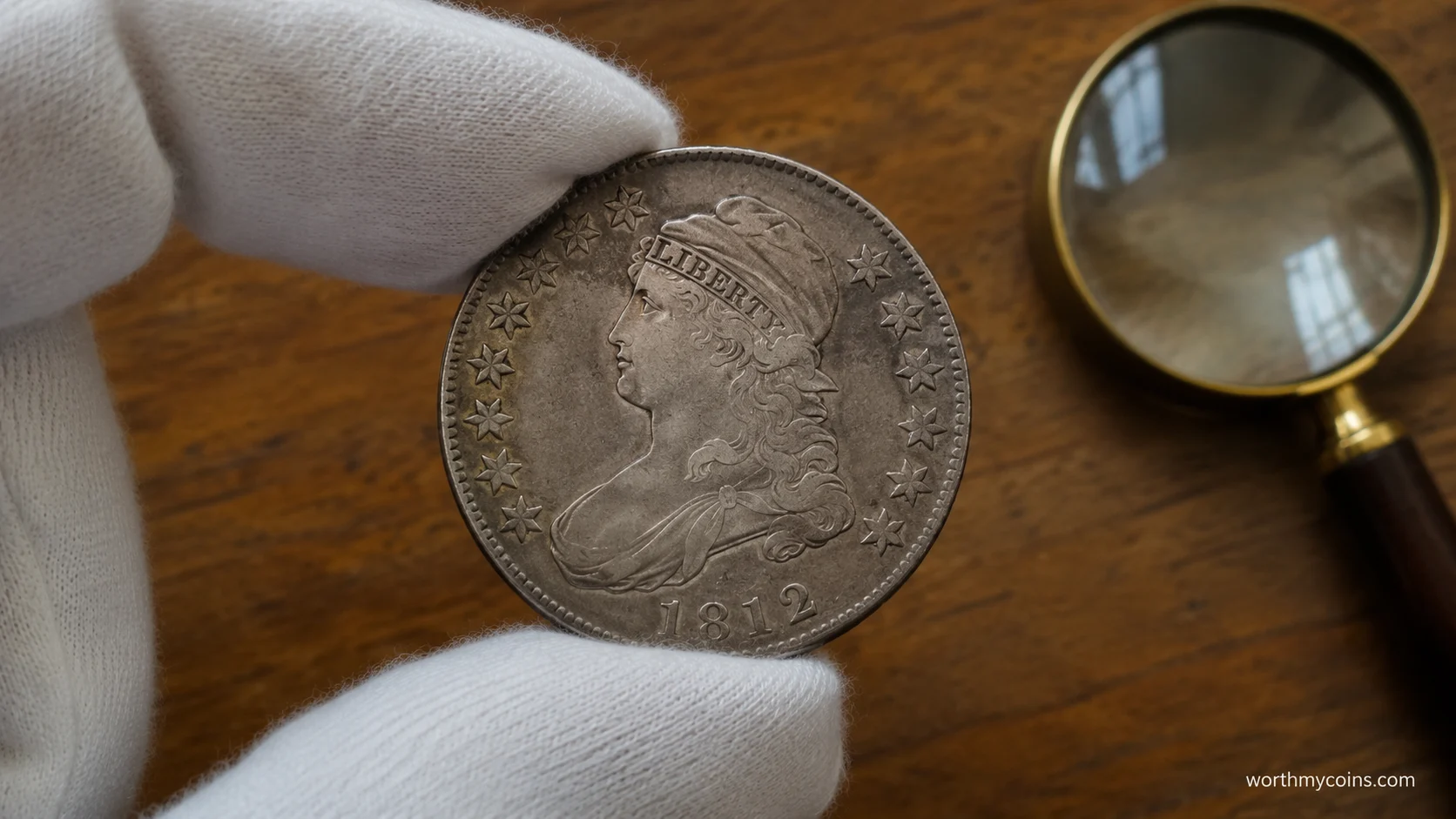
The Capped Bust Half Dollar is one of the most important series in early American numismatics. Struck from 1807 through 1839, these silver half dollars document a period when the United States Mint refined its production methods and introduced major design changes. While some dates are prized for their rarity, many have become collector favorites because of their historical importance, distinctive die marriages, first- or last-year significance, and enduring appeal among specialists.
Collectors who enjoy studying early American silver coinage may also appreciate our Morgan Dollar Value Guide: Rare Dates, Mint Errors & Collector Tips, which explores another iconic U.S. silver series prized for its key dates, mint marks, and collectible varieties.
Whether you’re new to coin collecting or expanding an early silver collection, understanding which Capped Bust Half Dollars have become collector favorites can help you recognize desirable pieces and make more informed collecting decisions.
Quick Answer
The most sought-after Capped Bust Half Dollars are not always the rarest coins in the series. Collectors often favor pieces with historical importance, distinctive die varieties, first- or last-year significance, exceptional strike quality, or strong availability in collectible grades. Coins such as the 1807 first-year issue, the 1815 single-year type, the 1836 Reeded Edge transition coin, and several Overton die varieties have become enduring favorites among specialists.
Understanding the Capped Bust Half Dollar Series
Before exploring the collector favorites, it’s helpful to understand what makes this series unique.
The United States Mint introduced the Capped Bust Half Dollar in 1807, replacing the Draped Bust design. The obverse was designed by John Reich, an assistant engraver hired to modernize the nation’s coinage. His Liberty portrait featured a soft cap and flowing curls, giving the series its familiar name.
From 1807 through most of 1836, Capped Bust Half Dollars were produced with a lettered edge before the Mint transitioned to a reeded edge during the series’ final years.
What Is an Overton Number?
Collectors of Capped Bust Half Dollars commonly identify coins by their Overton number, a standardized system developed by Al C. Overton and expanded through later research. Each Overton designation represents a specific pairing of obverse and reverse dies, known as a die marriage. While many collectors build sets by date alone, specialists often pursue individual Overton varieties because some are significantly scarcer than others.
Two major design subtypes exist:
| Type | Years | Distinguishing Feature |
|---|---|---|
| Lettered Edge | 1807–1836 | Lettering impressed into the coin’s edge |
| Reeded Edge | 1836–1839 | Vertical reeds replaced edge lettering |
Many collectors pursue one representative of each type, while advanced specialists often build complete date or die variety sets.
Why Capped Bust Half Dollars Remain Collector Favorites
More than 180 years after the series ended, Capped Bust Half Dollars remain popular because they combine early American history, extensive die-variety research opportunities, and strong demand among both type collectors and specialists.
Rich Early American History
These half dollars circulated during an era that included the War of 1812, westward expansion, and the rapid growth of the young United States. Many surviving examples witnessed decades of everyday commerce before entering collections.
Hundreds of Die Varieties
Unlike many later coin series, Capped Bust Half Dollars are famous for their numerous die marriages. Specialists commonly attribute them using the Overton reference system, which identifies specific obverse and reverse die combinations.
Some specialists spend years assembling collections focused on specific Overton die marriages, making Bust Half Dollar attribution one of the most established specialties in American numismatics.
Strong Collector Community
The series has long attracted dedicated researchers, grading specialists, and die variety enthusiasts. Decades of published research have made attribution easier than ever for collectors willing to study the series.
Attractive Classic Design
John Reich’s Liberty portrait and bold heraldic eagle remain among the most admired designs of early U.S. silver coinage. Well-preserved examples often display exceptional detail despite being more than 180 years old.
What Determines a Capped Bust Half Dollar’s Desirability?
Popularity alone does not determine market value. Experienced collectors evaluate several important characteristics before purchasing a coin.
Date and Historical Significance
First-year issues, transitional designs, and important historical dates generally attract greater attention than ordinary dates.
Die Variety
Certain Overton varieties are considerably scarcer than others. Even two coins from the same year may differ substantially in collector demand because of their die marriage.
Grade
Condition remains one of the largest factors affecting desirability.
Collectors generally classify coins into categories such as:
- Good (G)
- Very Good (VG)
- Fine (F)
- Very Fine (VF)
- Extremely Fine (XF)
- About Uncirculated (AU)
- Mint State (MS)
High-grade examples are generally much scarcer than circulated pieces, making them especially desirable to advanced collectors.
Original Surfaces
Collectors generally place a premium on coins that retain original surfaces and natural toning, as these characteristics often indicate minimal alteration after leaving circulation.
The same principles apply when evaluating classic silver dimes, as explained in Top 10 Silver Dimes Worth Money That Sold for Record Prices, where originality, eye appeal, and preservation significantly influence collector demand.
Certification
Authentication is particularly important for higher-value early U.S. silver coins because altered dates, added surface treatments, and counterfeit examples exist in the marketplace. Purchasing coins certified by established third-party grading services can provide greater confidence in authenticity and attribution.
Many valuable Capped Bust Half Dollars are authenticated and graded by independent third-party grading services, providing collectors with greater confidence in authenticity, grade, and attribution.
Top 10 Capped Bust Half Dollars That Became Collector Favorites
10. 1834 Capped Bust Half Dollar
The 1834 issue is frequently recommended to collectors entering the series because it combines historical appeal with comparatively good availability. While truly high-grade examples remain challenging, circulated pieces are encountered more often than several earlier dates.
Collectors appreciate the sharp execution typical of the later Lettered Edge years, when minting quality had generally improved compared with earlier production.
Why Collectors Like It
- Represents the mature Lettered Edge design.
- Good introduction to the series.
- Available across a wide range of collectible grades.
- Numerous die marriages provide additional collecting opportunities.
Identification Tips
- Date reads 1834 beneath Liberty.
- Lettered edge rather than reeded edge.
- Heraldic eagle reverse.
- No mint mark, as all coins were struck at Philadelphia.
9. 1827 Capped Bust Half Dollar
The 1827 issue enjoys a strong reputation among variety collectors because multiple die marriages exist within the year. Specialists often pursue different Overton numbers, making this date especially interesting beyond simply collecting by year.
Although not considered among the rarest dates overall, attractive original examples remain highly desirable.
Why Collectors Like It
- Excellent variety collecting opportunities.
- Well-documented die marriages.
- Attractive strike characteristics.
- Popular among intermediate collectors.
Identification Tips
- Date 1827.
- Lettered edge.
- Philadelphia issue without mint mark.
- Compare die characteristics carefully when attributing varieties.
8. 1817 Capped Bust Half Dollar
The 1817 issue comes from a period when die preparation and striking methods produced many distinctive characteristics that specialists continue to study today.
Collectors enjoy the broad selection of known die marriages and the opportunity to identify subtle differences between obverse and reverse dies.
Many surviving examples display moderate circulation, reflecting extensive use in commerce during the early nineteenth century.
Why Collectors Like It
- Strong historical context.
- Numerous collectible die marriages.
- Active interest among Overton specialists.
- Widely recognized within early half dollar collections.
Identification Tips
- Date beneath Liberty.
- Lettered edge.
- Philadelphia Mint production.
- Examine stars, date placement, and reverse lettering for die attribution.
7. 1807 Capped Bust Half Dollar (First-Year Issue)
Few coins receive as much attention as the very first year of any major U.S. coin design, and the 1807 Capped Bust Half Dollar is no exception.
As the inaugural issue designed by John Reich, it marks the beginning of a series that would continue for more than three decades. This historical importance alone makes it a centerpiece for many collections.
The first-year issue also includes multiple die varieties that remain popular subjects of advanced study.
Why Collectors Like It
- First year of the Capped Bust Half Dollar series.
- Historically important transition from the Draped Bust design.
- Strong demand from type collectors.
- Popular with advanced variety specialists.
Identification Tips
- Date 1807.
- Lettered edge.
- Liberty portrait differs noticeably from earlier Draped Bust coinage.
- Look for original surfaces and natural wear patterns.
6. 1815 Capped Bust Half Dollar (Single-Year Type)
The 1815 Capped Bust Half Dollar holds a unique place in the series because it is the only half dollar struck with that date.
Production of half dollars paused during portions of the War of 1812 due to bullion shortages and other operational challenges faced by the United States Mint. As a result, the 1815 issue represents a distinct return to regular production after that interruption.
Its status as a single-year issue has made it one of the most recognizable dates among collectors, even for those who do not specialize in early silver coinage.
Why Collectors Like It
- Only half dollar bearing the 1815 date.
- Closely associated with the post-War of 1812 period.
- Strong historical significance.
- Popular with both type collectors and date collectors.
Identification Tips
- Date 1815 beneath Liberty.
- Lettered edge.
- Philadelphia issue.
- Verify authenticity carefully due to the coin’s popularity.
5. 1830 Capped Bust Half Dollar
The 1830 Capped Bust Half Dollar is widely admired for its combination of historical appeal and collectability. By this point in the series, the Philadelphia Mint had refined many aspects of production, and numerous well-struck examples survive compared with some earlier issues.
Collectors appreciate the 1830 issue because it offers a balance between affordability in circulated grades and the opportunity to pursue challenging die marriages identified through the Overton attribution system.
Why Collectors Like It
- Popular date for building a complete series.
- Numerous documented die marriages.
- Often found with attractive natural toning.
- Appeals to both beginners and advanced specialists.
Identification Tips
- Date 1830 below Liberty.
- Lettered edge.
- Philadelphia Mint issue with no mint mark.
- Compare star placement and reverse lettering when attributing die varieties.
4. 1823 Capped Bust Half Dollar
The 1823 issue is especially respected among early half dollar enthusiasts because of its interesting die marriages and strong connection to specialized research. While it is not among the easiest dates to locate in higher grades, it has long been considered an important part of a serious Capped Bust collection.
Collectors often spend considerable time studying different Overton varieties for this year, making it a rewarding date for those interested in attribution.
Why Collectors Like It
- Well-known among Overton variety collectors.
- Represents classic early Mint production.
- Desirable across multiple collecting specialties.
- Strong historical appeal.
Identification Tips
- Date 1823.
- Lettered edge.
- No mint mark.
- Variety attribution requires careful examination of die characteristics.
3. 1832 Capped Bust Half Dollar
The 1832 Capped Bust Half Dollar is another favorite because of its attractive strikes, broad availability across circulated grades, and active collector interest. It is frequently included in type sets and complete date collections alike.
For newer collectors, the 1832 issue provides an excellent opportunity to study original surfaces, natural toning, and the differences between circulated and Mint State examples.
Why Collectors Like It
- Good availability for collectors.
- Excellent representative of the later Lettered Edge design.
- Multiple recognized die marriages.
- Suitable for both date and type collections.
Identification Tips
- Date 1832 beneath Liberty.
- Lettered edge.
- Philadelphia Mint production.
- Examine edge lettering carefully to confirm the correct subtype.
2. 1836 Reeded Edge Capped Bust Half Dollar
The 1836 Reeded Edge Half Dollar occupies a unique place in U.S. coinage history. It represents the transition from the long-running Lettered Edge format to a modern reeded edge, reflecting improvements in minting technology during the 1830s.
Unlike earlier Capped Bust Half Dollars, these coins were struck using a different production method that eliminated the separate edge-lettering process.
Because of this transitional significance, the 1836 Reeded Edge issue has become one of the most collected coins in the entire series.
Collectors interested in building a broader collection of historic U.S. half dollars can also explore the Kennedy Half Dollar Value Guide: Hidden Gems, Silver Issues & Rare Finds, which highlights another important half dollar series from a much later era.
Why Collectors Like It
- Transitional design marking a major technological change.
- Distinct reeded edge.
- Important milestone in U.S. Mint history.
- Essential coin for type collectors.
Identification Tips
- Date 1836.
- Reeded edge instead of lettered edge.
- No mint mark.
- Easily distinguished from earlier issues by the edge design.
1. 1807 Capped Bust Half Dollar (Large Stars Variety)
Among the many coins in the series, the 1807 Large Stars variety stands out as one of the most celebrated by specialists. As part of the inaugural year of the Capped Bust Half Dollar, it combines first-year significance with a well-known design variation that has attracted collectors for generations.
Early die preparation resulted in multiple recognizable varieties, and the Large Stars issue remains one of the most widely studied.
Its combination of historical importance, collectible varieties, and lasting demand has secured its place as a true collector favorite.
Why Collectors Like It
- First-year issue with a recognized design variety.
- Important place in early U.S. Mint history.
- Highly respected among variety collectors.
- Strong demand across all collecting levels.
Identification Tips
- Date 1807.
- Compare star size and spacing with other 1807 varieties.
- Lettered edge.
- Authentication is recommended for higher-grade examples.
Summary Comparison of the Top 10 Collector Favorites
| Rank | Coin | Primary Reason Collectors Favor It |
|---|---|---|
| 1 | 1807 Large Stars | First-year issue and famous variety |
| 2 | 1836 Reeded Edge | Historic transition to reeded edge |
| 3 | 1832 | Attractive, collectible later issue |
| 4 | 1823 | Popular Overton die varieties |
| 5 | 1830 | Balanced availability and variety collecting |
| 6 | 1815 | Only half dollar dated 1815 |
| 7 | 1807 | First year of the Capped Bust design |
| 8 | 1817 | Numerous collectible die marriages |
| 9 | 1827 | Well-known variety year |
| 10 | 1834 | Excellent introduction to the series |
How to Grade a Capped Bust Half Dollar
Accurate grading is one of the most important factors affecting both collector demand and market value. Even a one-grade difference can significantly influence desirability for scarcer dates or popular Overton varieties.
Good to Fine (G–F)
- Major design remains visible.
- Heavy wear across Liberty and the eagle.
- Date and legends remain readable.
Very Fine to Extremely Fine (VF–XF)
- Hair details become clearer.
- Eagle feathers show increasing definition.
- Moderate wear limited to the highest points.
About Uncirculated (AU)
- Only slight friction on high points.
- Most original mint luster remains.
- Strong eye appeal.
Mint State (MS)
- No wear from circulation.
- Original mint luster intact.
- Surface preservation, strike quality, and eye appeal become especially important.
For higher-value examples, many collectors prefer coins authenticated and graded by recognized third-party grading services such as PCGS or NGC.
Factors That Influence Value
When researching market prices, compare multiple recent auction records rather than relying on a single sale. Differences in certification, strike quality, toning, originality, and die variety can produce substantial differences in realized prices, even among coins with the same date and grade.
No single price applies to every Capped Bust Half Dollar. Market value depends on several interacting factors.
- Date and specific die marriage.
- Overall grade.
- Original, problem-free surfaces.
- Eye appeal and natural toning.
- Population reports for certified examples.
- Current collector demand.
- Recent auction results for comparable coins.
Rather than relying solely on generalized price guides, collectors often compare recent certified auction sales of similar coins. Factors such as grade, originality, eye appeal, die marriage, certification, and current demand all influence realized prices.
Buying Tips for Beginners
Before purchasing a Capped Bust Half Dollar, consider these best practices:
- Learn the difference between Lettered Edge and Reeded Edge types.
- Buy the coin—not just the grade on the holder. Original surfaces, eye appeal, strike quality, and proper attribution are often just as important as the numerical grade.
- Study genuine examples before making expensive purchases.
- Compare multiple certified coins whenever possible.
- Research the specific Overton variety if variety collecting interests you.
How to Store Capped Bust Half Dollars
Proper storage helps preserve both eye appeal and long-term collector value. Many collectors keep certified coins in their original holders and store raw examples in inert, archival-quality holders designed for long-term preservation. Coins should be handled only by their edges and stored in a cool, dry environment to minimize environmental damage.
Selling Tips
If you decide to sell a Capped Bust Half Dollar:
- Identify the exact date and type.
- Determine whether the coin has a recognized die variety.
- Consider professional grading for higher-value pieces.
- Compare recent auction results for certified examples of the same date, grade, and, when applicable, the same Overton variety before estimating market value.
- Obtain more than one opinion before accepting a significant offer.
Common Mistakes Collectors Make
New collectors sometimes overlook details that can affect both authenticity and desirability.
Common mistakes include:
- Confusing Lettered Edge and Reeded Edge coins.
- Ignoring die varieties.
- Cleaning or polishing coins.
- Assuming every old silver coin is rare.
- Purchasing expensive coins without authentication.
- Relying solely on online asking prices instead of verified auction records.
Avoiding these mistakes can lead to a more rewarding collecting experience and help preserve long-term value.
Frequently Asked Questions
Is every Capped Bust Half Dollar rare?
No. While all Capped Bust Half Dollars are historic coins, rarity varies considerably by date, die variety, grade, and surviving population. Some dates are relatively obtainable in circulated grades, while others are much more challenging.
Why is the 1815 Capped Bust Half Dollar so popular?
It is the only Capped Bust Half Dollar bearing the 1815 date. Its single-year status and connection to the post-War of 1812 period make it especially appealing to collectors.
What is an Overton variety?
An Overton variety, often called an Overton number, identifies a specific pairing of obverse and reverse dies used to strike a Capped Bust Half Dollar. The attribution system, introduced by Al C. Overton and expanded by later researchers, is the standard reference for die marriage specialists.
Should beginners buy certified examples?
Certification can provide added confidence, particularly for higher-value coins or those with important varieties. While not every collector begins with certified pieces, authentication by reputable grading services helps reduce the risk of purchasing altered or counterfeit coins.
How can I tell if my coin has a lettered or reeded edge?
Lettered Edge coins (1807–1836) have inscriptions impressed into the edge, while Reeded Edge coins (1836–1839) feature evenly spaced vertical grooves. Examining the edge carefully is one of the easiest ways to identify the subtype.
Conclusion
The Capped Bust Half Dollar series continues to captivate collectors because it offers far more than attractive early American silver. Each coin represents a chapter in the nation’s numismatic history, from John Reich’s influential redesign in 1807 to the technological transition represented by the Reeded Edge issues of the late 1830s.
Whether your goal is assembling a simple type set, completing a date collection, or exploring the fascinating world of Overton die marriages, these ten collector favorites provide an excellent starting point. As with any classic U.S. coin series, careful study, attention to originality, and reliance on trusted numismatic references will help you build a collection that is both historically meaningful and personally rewarding.
As your collection grows, you may also enjoy learning about another historic silver dollar series in Top 10 Peace Silver Dollars Worth Money That Sold for Record Prices, featuring notable coins that remain favorites among U.S. coin collectors.
References
- United States Mint
- Professional Coin Grading Service (PCGS)
- Numismatic Guaranty Company (NGC)
- American Numismatic Association (ANA)
- Heritage Auctions
- Stack’s Bowers Galleries
- Newman Numismatic Portal
- Early Half Dollar Die Varieties 1794–1836 by Al C. Overton (Later Editions and Revisions)

Narayan Kumar is the Founder and Author of Worth My Coins. She specializes in U.S. coin collecting, with a focus on coin identification, mint errors, grading, rare varieties, and collector education. Her goal is to publish accurate, well-researched, and easy-to-understand guides that help both new and experienced collectors make informed decisions. Every article is created using trusted numismatic references and is written with a commitment to accuracy, transparency, and long-term educational value.