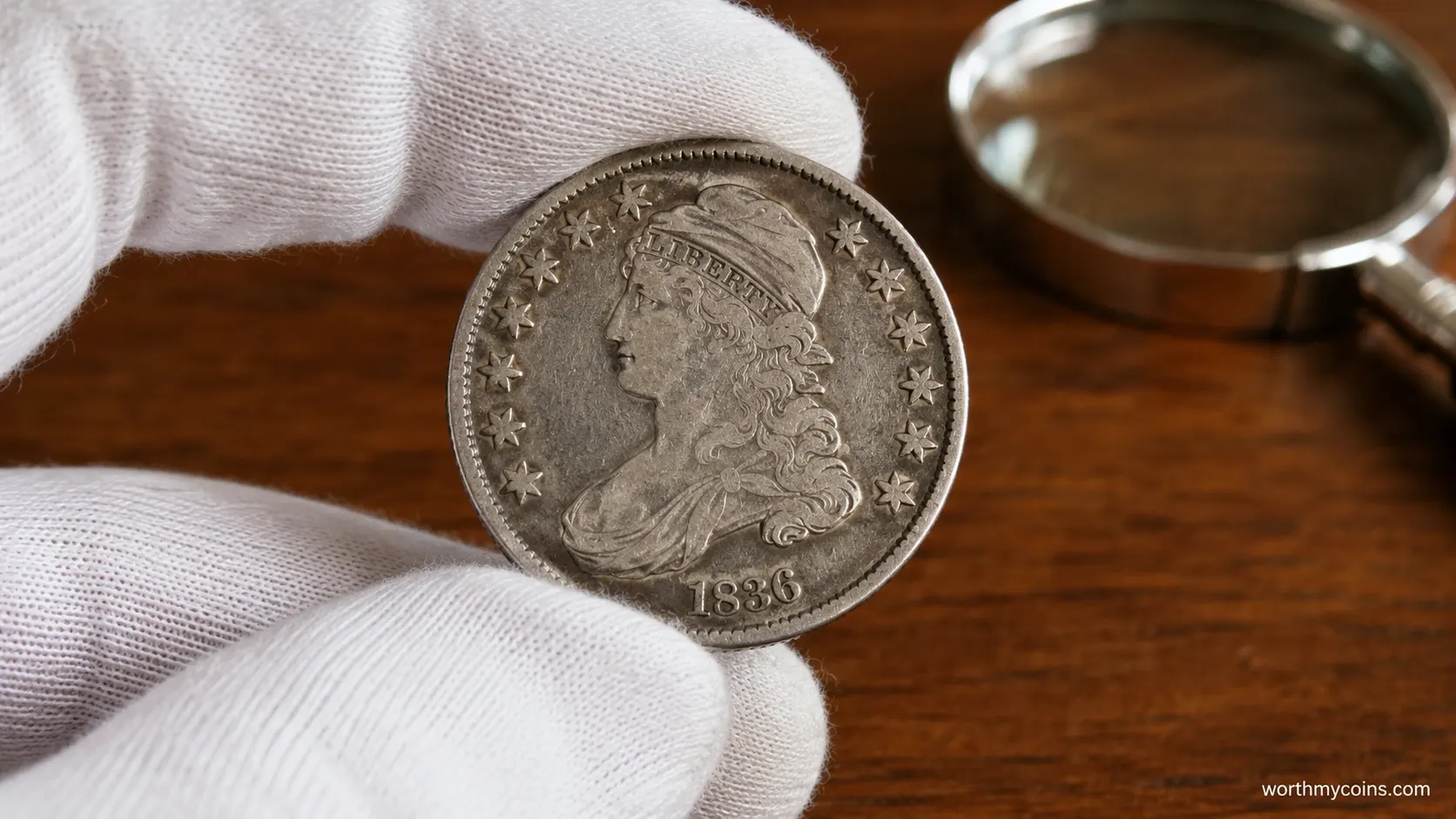
Few classic U.S. coins capture the imagination of collectors quite like the Capped Bust Half Dollar. Minted from 1807 through 1839, these silver coins circulated during the early years of the United States and remain one of the most extensively studied series in American numismatics. Collectors value them for their historical significance, numerous die marriages, and the challenges of finding attractive original examples.
If you’re interested in historic U.S. silver coinage beyond the Capped Bust series, our Morgan Dollar Value Guide: Rare Dates, Mint Errors & Collector Tips explores another iconic silver dollar series with key dates, mint marks, and valuable varieties.
While every Capped Bust Half Dollar carries historical significance, only certain dates, mint marks, die varieties, and high-grade survivors command substantial premiums. Understanding what makes these coins desirable can help beginners avoid costly mistakes and recognize genuinely valuable examples.
This guide explains the most important Capped Bust Half Dollars collectors should know, how to identify them, why they are valuable, and what factors influence their market value.
Quick Answer
Several Capped Bust Half Dollars are especially sought after because of their rarity, historical importance, famous die marriages, or strong collector demand. Their market value varies significantly depending on certification, grade, originality, and recent auction results rather than the date alone.
Understanding the Capped Bust Half Dollar Series
Although John Reich designed the original Capped Bust Half Dollar introduced in 1807, the series underwent important manufacturing changes over time. In 1836, modifications associated with Christian Gobrecht introduced a reeded edge and close-collar striking technology, making the later issues distinct from the earlier Lettered Edge coins.
Before looking at the most valuable issues, it’s helpful to understand the series itself.
The Capped Bust Half Dollar replaced the Draped Bust design in 1807. The obverse features Liberty wearing a soft cap, while the reverse displays a heraldic eagle holding arrows and an olive branch.
Two major design subtypes exist.
| Type | Years | Designer | Edge |
|---|---|---|---|
| Lettered Edge | 1807–1836 | John Reich | Lettered |
| Reeded Edge | 1836–1839 | Christian Gobrecht (modified) | Reeded |
The Lettered Edge coins are generally the most widely collected because they include numerous die marriages and famous varieties documented by Al C. Overton.
What Makes a Capped Bust Half Dollar Valuable?
Collectors evaluate these coins using several important factors.
Date Rarity
Some dates simply had lower production or experienced heavier circulation, resulting in fewer surviving examples today.
Mint Mark
Most Capped Bust Half Dollars were struck at the Philadelphia Mint and carry no mint mark.
Beginning in 1838, the New Orleans Mint produced half dollars marked with an “O” mint mark, creating one of the series’ most famous key issues.
Grade
Condition dramatically influences value.
A heavily worn coin is generally worth substantially less than a comparable uncirculated example, although rarity and specific die varieties may still make circulated coins desirable.
Professional grading services such as PCGS and NGC evaluate preservation using the Sheldon Scale, helping buyers and sellers compare coins using a consistent grading standard.
Original Surfaces
Collectors generally pay premiums for coins with original surfaces, natural toning when present, and no evidence of harsh cleaning or other surface impairments.
These same grading and originality principles also apply to smaller silver denominations covered in our Top 10 Silver Dimes Worth Money That Sold for Record Prices, where condition and eye appeal play a major role in determining collector value.
Die Varieties
Unlike many modern coin series, Capped Bust Half Dollars are famous for collectible die marriages.
Specialists often collect by Overton number, which identifies individual obverse and reverse die pairings.
Rare Overton varieties can sometimes be worth significantly more than common examples of the same date.
It is important to distinguish a die variety from post-mint damage. Features such as die cracks, repunched dates, or overdates were created during the minting process, while scratches, dents, and environmental damage occurred after the coin entered circulation and generally do not increase collector value.
Top 10 Capped Bust Half Dollars Worth Money
1. 1817/4 Overdate Capped Bust Half Dollar
The 1817/4 is one of the most famous overdates in early American numismatics.
During die preparation, an earlier 1814 die was repunched with the 1817 date, leaving traces of the underlying “4” visible beneath the final digit.
Why Collectors Want It
- Classic overdate variety
- Highly recognized by specialists
- Popular with both type collectors and Overton variety collectors
Identification Tips
Look closely beneath the final digit of the date using magnification.
Because attribution can be challenging, collectors often rely on certified examples or professional authentication when purchasing higher-value coins.
2. 1815 Capped Bust Half Dollar
The 1815 issue occupies a unique place in American coinage.
No half dollars were produced during 1814 because the Philadelphia Mint temporarily suspended silver coin production after bullion shortages caused by the War of 1812.
When production resumed in 1815, relatively few coins were struck compared with surrounding years.
Why It’s Important
- Only half dollar issued immediately following the wartime production interruption
- Historic significance
- Popular key date within the Lettered Edge series
- Strong collector demand across all grades
Higher-grade certified examples are considerably scarcer than circulated pieces.
3. 1838-O Capped Bust Half Dollar
The 1838-O represents a milestone in U.S. Mint history.
It was among the first silver coins struck at the newly established New Orleans Mint.
Although additional examples were produced in later years, the inaugural issue has long been recognized as one of the most important coins in the series.
Identification Tips
Look for the small “O” mint mark beneath the eagle on the reverse.
Collectors should carefully distinguish genuine examples from altered Philadelphia coins.
Professional authentication is strongly recommended due to the coin’s popularity.
4. 1807 Large Stars Capped Bust Half Dollar
As the first year of the series, the 1807 issue enjoys lasting popularity.
Several die marriages exist, and specialists study differences in star placement, date position, and other diagnostic features.
Why It Matters
- First year of the Capped Bust design
- Strong historical appeal
- Frequently collected as a type coin
- Numerous collectible Overton varieties
Although circulated examples are obtainable, attractive original coins with minimal problems are significantly more desirable.
5. 1823 “Broken 3” Variety
Among Capped Bust enthusiasts, the 1823 Broken 3 variety is immediately recognizable.
A die defect caused the numeral “3” in the date to appear partially broken.
Identification Tips
Using magnification, examine the final digit in the date.
The defect should appear as a clear break rather than post-mint damage.
Because die-state progression exists, specialists often compare multiple diagnostics before attributing the variety.
Why Variety Attribution Matters
For many early U.S. coins, identifying the correct die marriage can make a meaningful difference in desirability.
Specialists commonly use Overton numbers, the standard reference system for Capped Bust Half Dollars developed by Al C. Overton and later updated by other researchers. Two coins with the same date may have very different levels of collector demand depending on their specific die pairing.
When examining a potential purchase, compare features such as:
- Date placement
- Star positions
- Letter spacing
- Die cracks
- Clash marks
- Reverse eagle details
Accurate attribution often requires magnification and reference materials, and valuable varieties are best confirmed by PCGS, NGC, or another recognized attribution service.
Common Mistakes Beginners Make
Many new collectors assume every early silver half dollar is rare or extremely valuable. While these coins are historically important, market value depends on far more than age.
Some common mistakes include:
- Buying cleaned coins without recognizing surface damage.
- Assuming every old coin is a key date.
- Ignoring die varieties when purchasing higher-value examples.
- Overlooking the importance of professional grading.
- Confusing natural toning with environmental damage.
Learning these basics can help collectors make more informed decisions and avoid paying premiums for problem coins.
6. 1836 Reeded Edge Capped Bust Half Dollar
The 1836 Reeded Edge Half Dollar marks an important transition in the series. Although it still features Liberty wearing the familiar Capped Bust design, several technical changes were introduced before the series gave way to the Seated Liberty Half Dollar.
Unlike the earlier Lettered Edge issues, these coins have a reeded edge and were struck using a close collar, resulting in more consistent diameters and improved strike quality.
Why Collectors Value It
- Transitional issue between two major half dollar designs
- Represents improvements in U.S. Mint technology
- Popular with type collectors
- Available in multiple die varieties
Well-struck examples with original mint luster are especially desirable, while certified Mint State coins become increasingly scarce.
7. 1827 Capped Bust Half Dollar
The 1827 Capped Bust Half Dollar is another favorite among early U.S. coin collectors because of its numerous collectible die marriages.
Although it is not considered the rarest date in the series overall, certain Overton varieties are much scarcer than others and receive significant attention from specialists.
Identification Tips
Collectors should examine:
- Date position
- Star alignment
- Reverse lettering
- Die cracks
- Edge characteristics
Because several varieties appear similar, attribution guides and professional certification can help ensure accurate identification.
8. 1839-O Capped Bust Half Dollar
The 1839-O is historically significant as one of the final Capped Bust Half Dollars and one of the early silver issues produced at the New Orleans Mint.
Its combination of historical importance and collector demand makes it one of the more notable coins from the closing years of the series.
Why It Matters
- Early New Orleans Mint issue
- Final years of the Capped Bust design
- Popular among mint mark collectors
- Strong demand from type collectors
As with the 1838-O, buyers should exercise caution because valuable early branch mint coins have occasionally been altered or misrepresented.
9. 1811 Capped Bust Half Dollar
The 1811 issue is widely collected because it belongs to the early years of the Lettered Edge series and includes several collectible die marriages.
While many circulated examples survive, attractive coins with original surfaces and minimal wear become much more challenging to locate.
What Collectors Look For
Premium examples typically exhibit:
- Even wear
- Original silver-gray color
- Strong design details
- Minimal cleaning or damage
- Quality eye appeal
Collectors often prefer naturally toned examples over those that have been harshly cleaned.
10. 1820 Capped Bust Half Dollar
The 1820 Capped Bust Half Dollar rounds out this list because it offers collectors numerous interesting die varieties while remaining an important part of the early U.S. silver series.
Certain Overton marriages receive considerably more attention than common varieties, making proper attribution worthwhile.
Identification Tips
Look carefully at:
- Date placement
- Star arrangement
- Reverse lettering
- Die cracks
- Edge lettering
Specialists often use these diagnostics to distinguish one die marriage from another.
Comparison Table: Top Capped Bust Half Dollars Worth Knowing
| Coin | Why It’s Notable | Key Feature |
|---|---|---|
| 1817/4 Overdate | Famous overdate variety | Underlying “4” beneath the “7” |
| 1815 | Historic post-War of 1812 issue | Lower production after bullion shortage |
| 1838-O | First New Orleans half dollar | “O” mint mark |
| 1807 Large Stars | First year of the design | Early die varieties |
| 1823 Broken 3 | Popular die variety | Broken final digit |
| 1836 Reeded Edge | Transitional design | Reeded edge |
| 1827 | Multiple Overton varieties | Numerous collectible die marriages |
| 1839-O | Early branch mint issue | New Orleans mint mark |
| 1811 | Early series favorite | Strong collector demand |
| 1820 | Variety-rich issue | Numerous die marriages |
How to Identify a Valuable Capped Bust Half Dollar
If you believe you’ve found a Capped Bust Half Dollar, take time to examine it carefully before assuming it is rare.
Start by checking:
- The date.
- Whether the coin has a mint mark.
- Whether it has a lettered or reeded edge.
- Overall condition and remaining detail.
- Signs of cleaning, damage, or repairs.
- Possible die varieties using recognized attribution guides.
Avoid cleaning the coin, as even gentle cleaning can permanently reduce collector value.
Understanding Mint Marks
Most Capped Bust Half Dollars were struck at the Philadelphia Mint and therefore have no mint mark.
Coins struck at the New Orleans Mint in 1838 and 1839 carry a small “O” mint mark on the reverse beneath the eagle.
Because branch mint issues are especially popular, always inspect the mint mark carefully and consider professional authentication for higher-value pieces.
How Grading Affects Value
In addition to the numerical grade, experienced collectors often evaluate strike quality, eye appeal, originality, and surface preservation. Two coins with the same certified grade may attract different levels of buyer interest depending on these characteristics.
Grade is one of the biggest factors influencing market value.
Although two coins may share the same date and variety, their values can differ dramatically depending on preservation.
Generally speaking:
| Grade | Typical Characteristics |
|---|---|
| Good (G) | Heavy wear with major design visible |
| Very Fine (VF) | Moderate wear with clear major details |
| Extremely Fine (XF) | Light wear on high points |
| About Uncirculated (AU) | Slight friction with most mint luster remaining |
| Mint State (MS) | No circulation wear |
Professional grading by PCGS or NGC provides an independent assessment that many buyers trust, especially for more valuable early U.S. coins.
Tips for Buying and Selling Capped Bust Half Dollars
Whether you’re adding to your collection or preparing to sell, following a few best practices can help you make informed decisions.
When Buying
- Purchase from reputable coin dealers, established auction firms, or certified coin marketplaces with strong reputations.
- Verify certification for expensive coins.
- Learn the basic diagnostics of key varieties.
- Compare multiple examples before making a decision.
- Focus on originality rather than simply the highest numeric grade.
When Selling
- Avoid cleaning the coin beforehand.
- Consider professional grading if the coin appears scarce or high grade.
- Research recent auction records for comparable certified coins sold through major auction firms whenever possible.
- Obtain multiple opinions when selling significant coins.
Factors That Influence Market Value
No single price applies to every Capped Bust Half Dollar because each coin is evaluated individually based on rarity, preservation, originality, certification, and current market demand.
Actual market value depends on a combination of factors, including:
- Date
- Mint mark
- Die variety
- Grade
- Original surfaces
- Eye appeal
- Certification
- Collector demand
- Recent auction activity
For this reason, published price guides should be viewed as references rather than guarantees of what any specific coin will sell for.
Where to Verify Attribution
If you believe you have an important Capped Bust Half Dollar, compare it with recognized attribution references or seek professional evaluation. Resources such as PCGS CoinFacts, NGC VarietyPlus, the Newman Numismatic Portal, and the Overton reference remain among the most trusted sources for identifying die marriages and confirming important varieties.
Conclusion
Capped Bust Half Dollars represent one of the most fascinating chapters in early American coinage. Their rich history, diverse die varieties, and connection to the formative years of the United States continue to attract collectors of every experience level.
While famous issues such as the 1817/4 Overdate, 1815, and 1838-O often receive the most attention, every coin in the series deserves careful examination because individual die marriages, originality, and preservation can significantly influence collector interest. Factors such as grade, originality, mint mark, and die marriage frequently have as much impact on desirability as the date itself.
Whether you’re building your first early U.S. silver collection or researching a family heirloom, taking the time to identify your coin accurately and relying on trusted numismatic references can help you make confident collecting decisions.
If you enjoy collecting historic American silver coins, you may also want to explore our Top 10 Peace Silver Dollars Worth Money That Sold for Record Prices for another classic series prized by collectors.
Frequently Asked Questions
Are all Capped Bust Half Dollars valuable?
Not necessarily. Every Capped Bust Half Dollar has historical appeal, but market value varies according to the date, mint mark, die variety, grade, originality, certification, and collector demand.
Which Capped Bust Half Dollar is considered the most famous?
Among collectors, the 1817/4 Overdate is one of the best-known varieties because of its distinctive overdate and strong demand from early U.S. coin specialists.
How can I tell if my Capped Bust Half Dollar is rare?
Begin by identifying the date, edge type, mint mark (if present), and any observable die variety before comparing the coin with trusted attribution references.
Comparing the coin with recognized references or obtaining professional authentication can help determine its rarity.
Should I clean an old silver half dollar before selling it?
No. Cleaning can permanently alter a coin’s surfaces and may significantly reduce its desirability and market value.
What does the “O” mint mark mean?
The “O” indicates the coin was struck at the New Orleans Mint. Capped Bust Half Dollars with this mint mark were produced in 1838 and 1839.
What are Overton varieties?
Overton varieties are individual die marriages identified using the standard attribution system developed for Capped Bust Half Dollars. Many collectors specialize in assembling complete sets of these die pairings.
References
- Early Half Dollar Die Varieties 1794–1836 by Al C. Overton (Later Editions & Revisions)
- United States Mint
- Professional Coin Grading Service (PCGS)
- Numismatic Guaranty Company (NGC)
- American Numismatic Association (ANA)
- Heritage Auctions
- Stack’s Bowers Galleries
- Newman Numismatic Portal

Narayan Kumar is the Founder and Author of Worth My Coins. She specializes in U.S. coin collecting, with a focus on coin identification, mint errors, grading, rare varieties, and collector education. Her goal is to publish accurate, well-researched, and easy-to-understand guides that help both new and experienced collectors make informed decisions. Every article is created using trusted numismatic references and is written with a commitment to accuracy, transparency, and long-term educational value.