
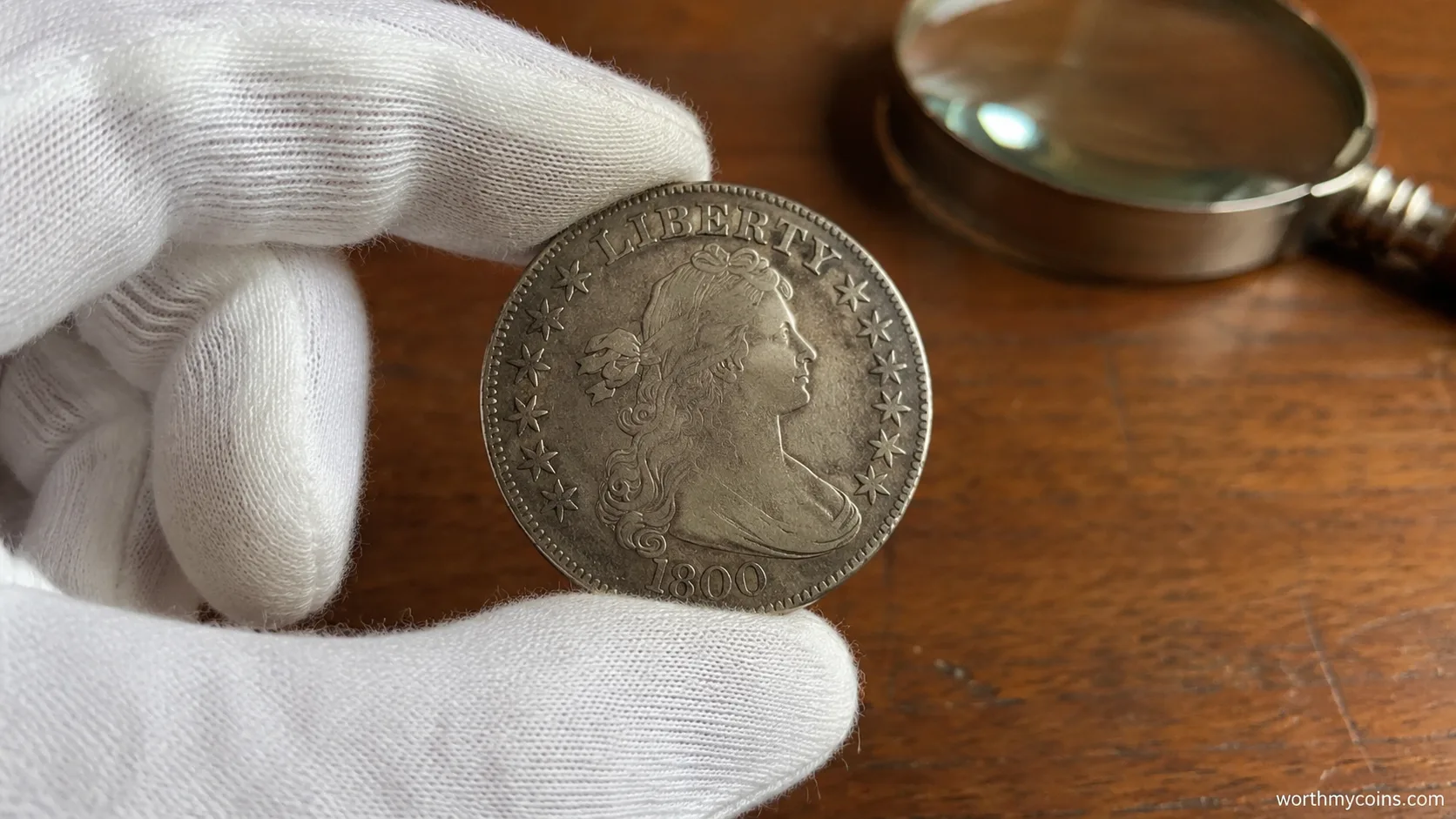
The Draped Bust Half Dollar stands among the most historically significant coins produced by the early United States Mint. Struck from 1796 through 1807, these silver coins circulated during the nation’s formative years and remain a cornerstone of early U.S. coin collecting. Their historical importance, numerous die marriages, and limited surviving high-grade examples continue to attract collectors today.
Whether you’re just beginning to explore early American silver or looking to understand why these coins command such respect among numismatists, this guide explains the most notable Draped Bust Half Dollars every collector should know.
Quick Answer
Draped Bust Half Dollars were minted from 1796 through 1807 and represent one of the earliest circulating silver coin series produced by the United States Mint. Collectors value them for their historical importance, low mintages, collectible die marriages, and their connection to the earliest years of United States coinage. Among the best-known issues are the 1796 first-year half dollar, the overdate varieties of the early 1800s, and the final-year 1807 issue.
Understanding the Draped Bust Half Dollar Series
Throughout the series, all Draped Bust Half Dollars were struck at the Philadelphia Mint, as it was the only operating U.S. Mint producing silver coinage during these years. Consequently, genuine examples do not carry mint marks.
Before exploring individual dates, it helps to understand why this series occupies such an important place in American numismatics.
The Draped Bust design replaced the earlier Flowing Hair motif and was introduced on the half dollar in 1796. Liberty appears facing right with flowing hair secured by a ribbon, while the reverse features a small eagle on early issues and the larger Heraldic Eagle beginning in 1801.
Unlike many modern coin series, Draped Bust Half Dollars were struck from hand-prepared dies. As a result, individual die marriages, overdates, repunched elements, and progressive die states are important characteristics that specialists use when attributing these coins.
Most surviving examples circulated extensively during the early nineteenth century, making well-preserved specimens much scarcer today.
Draped Bust Half Dollar Specifications
| Feature | Details |
|---|---|
| Years Produced | 1796–1807 |
| Composition | 89.24% silver, 10.76% copper (1796–1837 standard) |
| Weight | Approximately 13.48 grams |
| Diameter | Approximately 32.5 mm |
| Edge | Lettered edge |
| Mint | Philadelphia |
| Mint Marks | None (Philadelphia was the only operating U.S. Mint during the series) |
What Makes Certain Draped Bust Half Dollars More Desirable?
Collectors evaluate these coins using several important factors rather than focusing only on the date.
Original Rarity
Some dates had comparatively low mintages, while others survive in smaller numbers because of extensive circulation and the loss of silver coins through melting over time.
Die Varieties
Early U.S. coin specialists often collect by die marriage rather than by date alone. Works such as Al C. Overton’s reference on early half dollars identify numerous varieties that can significantly influence collector demand.
Grade
Most Draped Bust Half Dollars circulated extensively before collectors began preserving coins. As a result, attractive examples with strong details and minimal wear are considerably more difficult to locate.
Surface Quality
Originality is especially important for early U.S. silver coins. Many surviving Draped Bust Half Dollars have been cleaned or otherwise altered over the past two centuries, making problem-free examples particularly desirable. Collectors generally place the strongest premiums on coins with natural, undisturbed surfaces and no evidence of harsh cleaning.
Top 10 Draped Bust Half Dollars Every Early U.S. Coin Collector Should Know
1. 1796 Draped Bust Half Dollar (First-Year Issue)
The 1796 Draped Bust Half Dollar occupies a special place in American coin history as the inaugural year of the series. For many collectors, owning an example represents acquiring one of the earliest silver half dollars ever issued by the United States Mint.
Because production was limited and relatively few examples survive today, the 1796 issue remains highly sought after across nearly every grade level.
Why Collectors Value It
- First year of the Draped Bust Half Dollar series
- One of the earliest federally issued silver half dollars
- Strong historical importance
- Popular among both type collectors and early U.S. specialists
Identification Tips
Collectors should examine:
- The 1796 date placement
- Small Eagle reverse design
- Lettered edge
- Absence of a mint mark
Because of the series’ popularity and the existence of altered and counterfeit examples, many collectors prefer coins authenticated and graded by recognized third-party grading services.
2. 1797 Draped Bust Half Dollar
The second year of the series continued production using the Small Eagle reverse while introducing additional die varieties that remain popular among specialists today.
Although often overshadowed by the 1796 issue, the 1797 half dollar presents numerous collecting opportunities through its multiple die marriages documented by researchers.
Why It Matters
- Multiple collectible die marriages
- Scarcer in higher grades
- Strong demand among Overton variety collectors
What Beginners Should Know
Two coins bearing the same date can differ considerably depending on the dies used during production. Experienced collectors frequently identify 1797 half dollars by die marriage rather than by date alone.
3. 1801 Draped Bust Half Dollar (Heraldic Eagle Reverse)
After several years without half dollar production, the denomination returned in 1801 featuring the Heraldic Eagle reverse adapted from the Great Seal of the United States.
This design change marked an important transition in early American coinage.
Key Features
- First Heraldic Eagle reverse for the series
- Larger, more elaborate reverse design
- Important transitional issue
- Popular one-year design introduction
Identification
The reverse displays:
- A large eagle with outstretched wings
- Union shield
- Scroll bearing E PLURIBUS UNUM
- Clouds and stars above the eagle
Collectors often seek attractive examples with original surfaces because cleaned coins are relatively common.
4. 1802/1 Draped Bust Half Dollar Overdate
Among the best-known varieties in the series, the 1802/1 overdate resulted when a die originally punched with the date 1801 was modified for use in 1802.
Overdates provide fascinating insight into early Mint production practices, when dies represented valuable resources that were often reused instead of discarded.
Why Collectors Like Overdates
- Visible evidence of hand-prepared dies
- Historically important manufacturing practice
- Well-known Red Book variety
- Popular among both variety collectors and type collectors
How to Identify It
Under magnification, remnants of the underlying “1” beneath the final “2” may be visible. Because overdate attribution can be challenging, professional authentication or comparison with recognized reference images is often advisable.
5. 1805 Draped Bust Half Dollar
The 1805 issue is often considered one of the more approachable dates for collectors seeking an example of the Draped Bust series without focusing exclusively on the rarest issues.
Although collectible in every grade, original, problem-free examples remain challenging to locate because most surviving coins experienced extensive circulation.
Why It Deserves Attention
- Represents mature production of the Heraldic Eagle design
- Multiple recognized die marriages
- Frequently included in early U.S. type collections
What Affects Value
Rather than the date alone, collectors evaluate:
- Overall grade
- Original surfaces
- Strike quality
- Eye appeal
- Professional certification
- Attribution of recognized die varieties
6. 1806 Draped Bust Half Dollar (Pointed 6 and Knob 6 Varieties)
The 1806 Draped Bust Half Dollar is especially interesting because it exists with two major date styles known as the Pointed 6 and Knob 6. These varieties are widely recognized by collectors and illustrate how small design differences can become important in early U.S. coin collecting.
For beginners, this is an excellent example of why early American coins are often collected by variety as well as by date.
Why Collectors Like It
- Two major date style varieties
- Multiple documented die marriages
- Readily recognized in standard numismatic references
- Strong demand among variety specialists
Identification Tips
Look closely at the shape of the numeral “6” in the date.
- Pointed 6 has a sharper, narrower upper curve.
- Knob 6 has a rounded, bulb-like end.
Because several die marriages exist for each style, experienced collectors frequently attribute these coins using Overton numbers.
7. 1806/5 Draped Bust Half Dollar Overdate
One of the most popular varieties in the entire series, the 1806/5 overdate demonstrates the resourceful practices of the early Philadelphia Mint.
Rather than discard an unused die dated 1805, Mint employees modified it by punching a new “6” over the existing digit. Today, this feature provides collectors with an easily recognized and historically significant variety.
Why It Matters
- Classic early U.S. overdate
- Strong collector demand
- Frequently listed in major numismatic references
- Important example of early die reuse
How to Identify It
Under magnification, remnants of the underlying “5” may be visible beneath the “6,” although visibility varies depending on the die state and the coin’s preservation.
Professional authentication is recommended because overdate varieties are popular and valuable enough to attract altered examples.
8. 1807 Draped Bust Half Dollar (Large Stars Variety)
The 1807 issue marks the final year of the Draped Bust Half Dollar series before the introduction of the Capped Bust design later that year.
The transition from Draped Bust to Capped Bust marks one of the most important design changes in early American coinage, making the Top 10 Capped Bust Half Dollars That Became Collector Favorites a natural next resource for collectors interested in how the half dollar series evolved.
Several varieties exist, including differences in star size and die characteristics, making the date appealing to both type collectors and die marriage specialists.
Why Collectors Seek It
- Final year of the Draped Bust design
- Represents the end of an important chapter in early U.S. coinage
- Multiple collectible varieties
- Popular historical transition coin
Collector Notes
Many collectors building a type set choose an 1807 example because it represents the conclusion of the series while remaining more obtainable than the first-year 1796 issue.
9. 1807 Draped Bust Half Dollar (Small Stars Variety)
Another recognized variety of the final-year issue features noticeably smaller obverse stars compared with other dies used during 1807.
Although subtle to new collectors, these design differences are important to specialists studying early Mint production methods.
Highlights
- Recognized major variety
- Popular with Overton collectors
- Demonstrates differences among individual die pairs
- Historically significant final-year issue
Identification
Comparing the star size with certified examples or detailed reference photographs is often the easiest method for beginners.
10. 1805 O-105 (Representative Die Marriage)
While date collectors may seek one example from each year, many advanced numismatists eventually begin collecting by die marriage.
One frequently discussed example is the 1805 O-105, one of the recognized Overton varieties documented in Early Half Dollar Die Varieties 1794–1836. It illustrates how two coins with the same date can represent entirely different collecting challenges.
Why Die Marriages Matter
- Reveal the hand-crafted nature of early U.S. coin production
- Offer additional collecting goals beyond date sets
- Allow researchers to study die states and Mint practices
- Form the basis of specialized early half dollar collections
For newcomers, learning about Overton numbers can be a rewarding next step after completing a basic date set.
Comparison of the Featured Draped Bust Half Dollars
| Coin | Why It’s Important | Best Known For |
|---|---|---|
| 1796 | First year of issue | Historical significance |
| 1797 | Early Small Eagle issue | Numerous die marriages |
| 1801 | First Heraldic Eagle reverse | Design transition |
| 1802/1 | Overdate variety | Early Mint die reuse |
| 1805 | Representative Heraldic Eagle issue | Type collecting |
| 1806 Pointed 6 | Major date variety | Variety collecting |
| 1806 Knob 6 | Distinct numeral style | Die study |
| 1806/5 | Famous overdate | Early overdate variety |
| 1807 Large Stars | Final year | Design transition |
| 1807 Small Stars | Final-year variety | Specialized collecting |
How to Identify a Genuine Draped Bust Half Dollar
Authentication becomes increasingly important as rarity and value increase. Collectors commonly compare suspected varieties with trusted references such as PCGS CoinFacts, NGC VarietyPlus, and the Newman Numismatic Portal before purchasing higher-value examples.
Because these coins are valuable and widely collected, proper identification is essential.
Start by confirming the basic specifications:
- Diameter of approximately 32.5 mm
- Weight of about 13.48 grams
- Lettered edge
- No mint mark
- Silver composition used by the early U.S. Mint
Next, compare the date style, star placement, lettering, and reverse design with photographs from trusted references. Genuine examples should match the design details and diagnostics documented in trusted numismatic references for the appropriate date and variety.
Whenever purchasing a higher-value specimen, collectors should strongly consider examples authenticated by recognized third-party grading services such as PCGS or NGC.
What Determines the Value of a Draped Bust Half Dollar?
No single price applies to every Draped Bust Half Dollar.
Market value depends on a combination of factors, including:
- Date and recognized variety
- Die marriage
- Overall rarity
- Certified grade
- Original surfaces
- Strike quality
- Eye appeal
- Collector demand
- Recent auction results
Even two coins of the same date and variety may realize different prices because of differences in grade, originality, eye appeal, certification, and current market demand.
Understanding Grades
Grade has a major influence on collector value.
Good (G)
Heavy wear is present, but the date and major design elements remain identifiable.
Very Fine (VF)
Moderate wear with noticeably stronger detail in Liberty’s portrait and the eagle.
Extremely Fine (XF)
Only light circulation wear appears on the highest points of the design.
About Uncirculated (AU)
Most original mint detail remains with only slight evidence of handling.
Mint State (MS)
No circulation wear is present. Certified Mint State Draped Bust Half Dollars are considerably scarcer than circulated examples because relatively few survived without entering commerce.
Common Mistakes New Collectors Make
Many beginners make avoidable errors when purchasing early silver coins.
Buying Cleaned Coins Without Recognizing Surface Alterations
Harsh cleaning can significantly reduce collector desirability. Hairline scratches, unnatural brightness, or altered surfaces often indicate past cleaning.
Ignoring Variety Attribution
Some varieties command stronger collector interest than standard examples. Learning basic Overton attribution can help collectors better understand the series.
Purchasing Unauthenticated High-Value Coins
Because counterfeit early U.S. silver exists, certification offers important peace of mind for expensive purchases.
Focusing Only on the Date
Original surfaces, eye appeal, and overall quality frequently matter just as much as rarity.
Buying Tips for Beginners
If you’re adding your first Draped Bust Half Dollar to a collection, consider these practical guidelines:
- Buy the best original example your budget comfortably allows.
- Learn the difference between normal wear and damage.
- Study certified examples before purchasing raw coins.
- Familiarize yourself with common varieties using established reference books.
- Review recent auction records for comparable certified examples to better understand current market activity rather than relying solely on published price guides.
Building knowledge first often leads to better collecting decisions than simply chasing the lowest price.
Why Die Marriage Attribution Matters
Many advanced collectors build collections based on die marriages rather than dates alone. The standard reference for Draped Bust Half Dollars is Al C. Overton’s Early Half Dollar Die Varieties 1794–1836, which assigns a unique attribution number to each known obverse and reverse die pairing. Proper attribution can significantly improve a collector’s understanding of a coin, even when it does not change its market value.
Conclusion
The Draped Bust Half Dollar represents one of the most fascinating chapters in early American numismatics. Produced during the nation’s formative years, these coins combine historical significance, artistic appeal, and remarkable variety in a way few U.S. series can match.
Collectors who continue exploring the evolution of early American half dollars often move next to the Top 10 Capped Bust Half Dollars Worth Money Every Collector Should Know, which highlights the series that succeeded the Draped Bust design and introduces many of the most desirable early U.S. half dollars.
Whether you’re drawn to the historic first-year 1796 issue, the well-known overdates of the early 1800s, or the final-year varieties of 1807, each coin tells part of the story of the young United States Mint. As your knowledge grows, studying die marriages, original surfaces, and grading standards can make collecting this series even more rewarding.
For both beginning and advanced collectors, Draped Bust Half Dollars remain enduring symbols of America’s earliest silver coinage and continue to hold a respected place in U.S. numismatic history.
Frequently Asked Questions
What years were Draped Bust Half Dollars produced?
The Draped Bust Half Dollar was produced from 1796 through 1807 at the Philadelphia Mint.
Do Draped Bust Half Dollars have mint marks?
No. All Draped Bust Half Dollars were struck at the Philadelphia Mint during a period when U.S. coins did not carry mint marks.
Why are overdate varieties important?
Overdates provide direct evidence of how the early U.S. Mint reused dies. They are historically significant and remain popular among collectors because they illustrate nineteenth-century minting practices.
Are all Draped Bust Half Dollars rare?
Every Draped Bust Half Dollar is historically important, but rarity varies by date, die marriage, grade, and surviving population. Some varieties are considerably more difficult to locate than others.
Should beginners buy certified examples?
For higher-value early U.S. coins, many collectors prefer certified examples because professional authentication helps confirm authenticity, grade, and variety attribution.
References
- United States Mint
- Professional Coin Grading Service (PCGS)
- Numismatic Guaranty Company (NGC)
- American Numismatic Association (ANA)
- Heritage Auctions
- Stack’s Bowers Galleries
- Newman Numismatic Portal
- A Guide Book of United States Coins (The Official Red Book), Whitman Publishing
- Early Half Dollar Die Varieties 1794–1836 by Al C. Overton (Latest Revised Editions)

Narayan Kumar is the Founder and Author of Worth My Coins. She specializes in U.S. coin collecting, with a focus on coin identification, mint errors, grading, rare varieties, and collector education. Her goal is to publish accurate, well-researched, and easy-to-understand guides that help both new and experienced collectors make informed decisions. Every article is created using trusted numismatic references and is written with a commitment to accuracy, transparency, and long-term educational value.