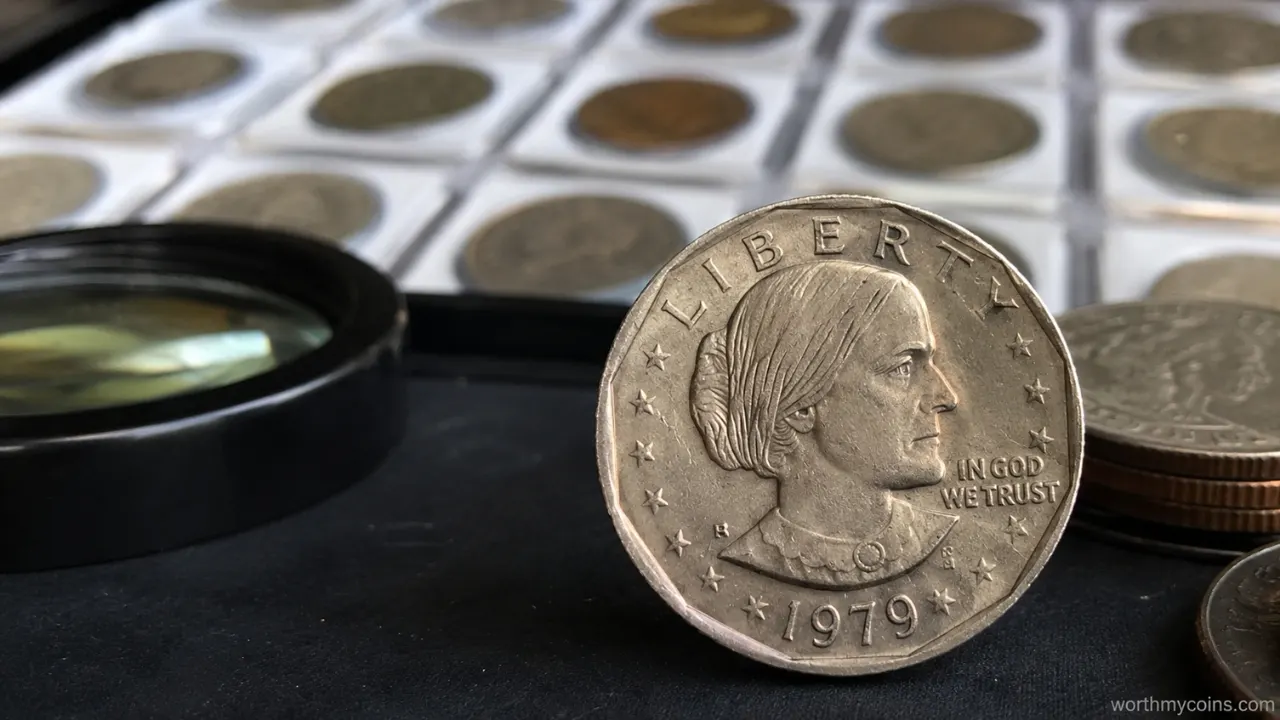
The Susan B. Anthony Dollar is one of the most recognizable modern U.S. coins, yet it remains one of the most misunderstood. Introduced in 1979 as the nation’s first circulating small-size dollar featuring a real American woman, the coin had a short production run for circulation but continues to attract collectors because of its history, collectible varieties, and surprising rarities.
If you’re researching a Susan B. Anthony Dollar’s value, it’s important to understand that no single price applies to every coin. Its worth depends on several factors, including the date, mint mark, condition, grade, authentication, rarity, and current collector demand. While many examples remain common because they were saved in large numbers, certain varieties and high-grade coins are significantly more desirable.
Whether you found a Susan B. Anthony Dollar in circulation, inherited one, or recently started collecting modern dollar coins, learning how to identify important dates and varieties is the best place to start. Understanding these basics will help you evaluate the coin with greater confidence.
History of the Susan B. Anthony Dollar
The Susan B. Anthony Dollar was first issued in 1979 after Congress authorized a new small-size dollar coin to replace the larger Eisenhower Dollar in everyday circulation. The goal was to create a dollar coin that was easier to carry while reducing long-term production costs compared to paper currency.
The coin honors Susan B. Anthony, a leading advocate for women’s rights and the women’s suffrage movement. She became the first real woman portrayed on a circulating U.S. coin, marking an important milestone in American numismatic history.
Chief Engraver Frank Gasparro designed both the obverse and reverse. The obverse features a portrait of Susan B. Anthony, while the reverse carries an adaptation of the Apollo 11 mission insignia originally introduced on the Eisenhower Dollar. It depicts an eagle landing on the Moon while holding an olive branch, symbolizing peace and achievement.
Although the coin entered circulation with high expectations, many Americans confused it with the quarter because of its similar size and color. As a result, public acceptance remained limited, and production for general circulation ended after 1981.
However, demand from the United States Postal Service eventually led to one final circulation issue in 1999 before the series was replaced by the Sacagawea Dollar in 2000.
Today, the Susan B. Anthony Dollar represents an important chapter in modern U.S. coinage and remains a popular series among collectors.
Susan B. Anthony Dollar Specifications
| Specification | Details |
|---|---|
| Designer | Frank Gasparro |
| Years Issued | 1979–1981, 1999 |
| Denomination | One Dollar |
| Country | United States |
| Composition | Outer layers: 75% Copper, 25% Nickel bonded to a pure copper core |
| Weight | 8.1 grams |
| Diameter | 26.5 mm |
| Thickness | 2.0 mm |
| Edge | Reeded |
| Mint Authority | United States Mint |
Unlike Morgan or Peace Dollars, Susan B. Anthony Dollars contain no silver. Their collectible value depends on rarity, condition, certification, and collector demand rather than precious metal content.
How to Identify a Susan B. Anthony Dollar
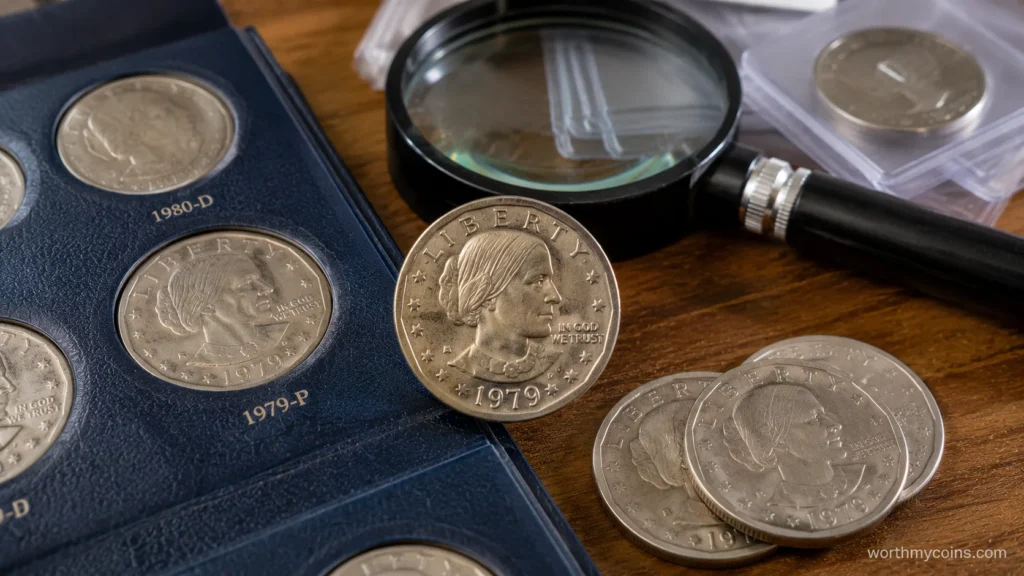
Before estimating value, identify the coin’s date, mint mark, overall condition, and any recognized variety. These details form the foundation of every accurate evaluation.
Correct identification is the first step in determining whether a Susan B. Anthony Dollar may have collectible value.
Obverse Design
The front of the coin features a right-facing portrait of Susan B. Anthony. The word “LIBERTY” appears above the portrait, while the date is positioned at the bottom. “IN GOD WE TRUST” is placed to the right of the portrait.
Frank Gasparro’s initials “FG” appear near the lower edge of the bust.
Reverse Design
The reverse displays an eagle landing on the Moon with an olive branch in its claws. This design was adapted from the Apollo 11 mission insignia and also appeared on the Eisenhower Dollar.
The inscriptions “UNITED STATES OF AMERICA” and “ONE DOLLAR” surround the design, while “E PLURIBUS UNUM” appears above the eagle.
Edge
Every Susan B. Anthony Dollar features a reeded edge similar to that found on quarters and dimes.
Mint Marks
Susan B. Anthony Dollars were struck at three United States Mint facilities.
The mint mark appears on the obverse above the left shoulder of Susan B. Anthony.
| Mint | Mint Mark | Years Produced |
| Philadelphia | P | 1979–1981, 1999 |
| Denver | D | 1979–1981, 1999 |
| San Francisco | S | 1979–1981, 1999 (primarily Proof issues, with circulation-quality collector issues in 1981 and 1999) |
Because the mint mark is located on the front of the coin, it is generally easy to identify without magnification.
What Determines Susan B. Anthony Dollar Value?
While age can attract interest, collectors usually place greater importance on rarity, condition, certified grade, and recognized varieties than on age alone. In reality, several important factors determine its collectible appeal.
Date and Mint Mark
Some dates are more difficult to locate in high grades than others. Collectors typically build complete date-and-mint collections, making certain combinations more desirable.
Condition
Condition is often the most important factor affecting value. Coins showing little or no wear, strong original luster, and minimal contact marks generally receive greater collector interest than circulated examples.
Because many Susan B. Anthony Dollars were stored in government bags and rolls, high-grade coins exist for several dates. However, finding exceptional examples with outstanding surfaces can still be challenging.
Strike Quality
Not every Susan B. Anthony Dollar was struck equally well. Coins displaying sharper details and fewer weaknesses are generally preferred by collectors.
Original Surfaces
Collectors favor coins with original mint surfaces. Cleaning, polishing, or other alterations can permanently reduce a coin’s desirability even if it appears brighter.
Authentication
Most Susan B. Anthony Dollars are common, but recognized varieties and exceptional Mint State examples should be professionally authenticated before they’re bought or sold. Certification helps confirm that the coin is genuine and accurately graded.
The same principles apply throughout U.S. coin collecting. Our Lincoln Wheat Penny Value Guide (1909–1958): Prices, Errors & Rare Coins explains how rarity, mint marks, condition, and collector demand work together to determine a coin’s value.
Coin Grading Overview
Professional grading provides a standardized method for evaluating preservation and condition.
| Grade | Description |
| Good (G) | Heavy wear with major details visible |
| Very Good (VG) | Moderate wear with stronger design features |
| Fine (F) | Moderate circulation wear while retaining clear details |
| Very Fine (VF) | Light to moderate wear on the highest points |
| Extremely Fine (XF) | Only slight wear with most original detail remaining |
| About Uncirculated (AU) | Trace friction with nearly full mint luster |
| Mint State (MS) | No circulation wear; graded from MS60 through MS70 |
In addition to wear, grading professionals evaluate luster, strike quality, eye appeal, contact marks, and overall surface preservation. For potentially valuable coins or recognized varieties, certification by a respected grading service can make buying and selling easier while providing greater confidence in authenticity and assigned grade.
Verified Susan B. Anthony Dollar Errors and Important Varieties
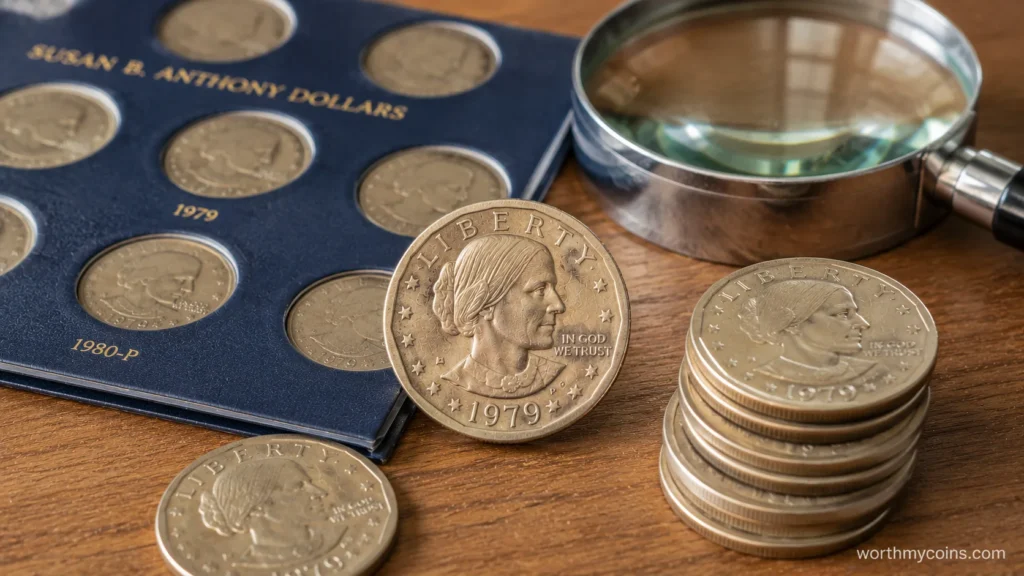
One of the biggest reasons collectors enjoy the Susan B. Anthony Dollar series is the presence of several well-documented varieties. It’s important to distinguish genuine Mint-made varieties from damage that occurred after the coin entered circulation. Scratches, dents, plating damage, and other post-mint alterations are not considered collectible mint errors.
Below are some of the best-known Susan B. Anthony Dollar varieties recognized by major grading services and numismatic references.
| Variety | Description | Notes |
|---|---|---|
| 1979-P Wide Rim (Near Date) | The rim is noticeably wider, with the date appearing closer to the edge | One of the most popular circulation varieties in the series |
| 1979-P Narrow Rim (Far Date) | More common design with a thinner rim around the date | Standard circulation issue |
| 1981-S Type 2 Proof | Improved, clearer “S” mint mark compared to the earlier Type 1 | Popular among Proof collectors |
| Doubled Die Varieties | Minor doubling on selected dies | Must be authenticated individually |
| Off-Center Strikes | Coins struck off-center during production | Premium depends on the amount of the off-center strike and overall condition |
| Broadstrikes | Coins struck without the retaining collar | Verified mint error that requires authentication |
While genuine mint errors can attract collector interest, premiums vary depending on the specific error, the coin’s grade, and overall eye appeal. Authentication is recommended before assuming any unusual coin is rare.
Collectors interested in famous U.S. Mint mistakes can also explore the 1943 Bronze Lincoln Wheat Penny Value Guide, which covers one of the most celebrated minting errors in American numismatic history.
Rare Dates That Collectors Watch Closely
Although the Susan B. Anthony Dollar series is relatively short, some dates and varieties are more desirable than others.
Collectors often pay close attention to:
- 1979-P Wide Rim (Near Date)
- 1981 Proof issues
- 1981-S Type 2 Proof
- High-grade 1979, 1980, and 1981 circulation coins
- Certified Mint State examples with exceptional eye appeal
- High-grade 1999 circulation issues
Rather than focusing only on the date, experienced collectors evaluate the complete package, including the mint mark, grade, originality, and certification.
That same approach helps explain why key-date coins attract so much attention. The 1909-S VDB Lincoln Wheat Penny Value Guide is another excellent example of how rarity and collector demand can dramatically influence value.
Why Some Susan B. Anthony Dollars Are Worth More Than Others
Many people are surprised to learn that two coins from the same year can have very different collector values.
Several factors explain these differences.
Grade
Higher-grade coins generally command greater collector interest. Mint State examples with strong luster, clean surfaces, and minimal contact marks are often the most desirable.
Certified Authenticity
Coins authenticated and graded by respected third-party grading services provide buyers with greater confidence regarding authenticity and condition.
Variety
Recognized varieties, such as the 1979 Wide Rim and 1981-S Type 2 Proof, are collected separately from standard issues and may receive additional attention from specialists.
Eye Appeal
Natural luster, attractive surfaces, and strong strikes often increase collector demand. Even among coins with identical grades, eye appeal can influence desirability.
Collector Demand
Market demand changes over time. As more collectors assemble complete Susan B. Anthony Dollar sets, demand for key varieties and high-grade examples may fluctuate.
Because of these variables, no fixed value applies to every Susan B. Anthony Dollar. Current market prices depend on recent sales, certification, and collector interest rather than age alone.
Tips for Collecting Susan B. Anthony Dollars
The Susan B. Anthony Dollar is an excellent series for beginners because it includes a manageable number of dates and mint marks while still offering interesting collecting challenges.
Some helpful tips include:
- Learn to identify the 1979 Wide Rim variety before purchasing circulated examples.
- Compare mint marks carefully when building a complete collection.
- Buy the highest quality coin your budget allows.
- Handle coins only by their edges to avoid fingerprints.
- Store coins in archival-quality holders designed for long-term preservation.
- Consider certified examples for recognized varieties or high-grade coins.
- Research recent auction results before making expensive purchases.
Many collectors enjoy completing a full date-and-mint set, while others focus on Proof coins, certified Mint State examples, or major varieties.
Collectors who enjoy assembling complete U.S. coin sets often expand into classic series like the Buffalo Nickel Value Guide: Rare Dates, Mint Errors & Collector Tips, another favorite among hobbyists because of its key dates and collectible varieties.
Common Mistakes New Collectors Make
Avoiding a few common mistakes can make collecting more enjoyable and help protect your investment.
Assuming Every Susan B. Anthony Dollar Is Rare
Millions of these coins were produced. While some varieties are collectible, many circulated examples remain common.
Confusing Damage with Mint Errors
Scratches, dents, discoloration, and other post-mint damage are often mistaken for valuable errors. Genuine mint errors require careful examination and, in many cases, professional authentication.
Ignoring Condition
Even common dates can become desirable in exceptional Mint State grades, while heavily worn examples are generally less sought after.
Cleaning the Coin
Cleaning is one of the quickest ways to reduce collector appeal. Abrasive polishing and chemical cleaning can permanently alter a coin’s original surfaces.
Relying on Unverified Online Claims
Internet videos and social media posts sometimes exaggerate coin values. Always verify information using respected numismatic references and recent auction records.
The following answers cover the questions collectors ask most often when researching Susan B. Anthony Dollar values and varieties.
Frequently Asked Questions
Is every Susan B. Anthony Dollar valuable?
No. Many circulated examples remain common, while certain varieties, certified high-grade coins, and recognized errors receive greater collector interest.
Does the Susan B. Anthony Dollar contain silver?
No. Standard Susan B. Anthony Dollars are struck from a copper-nickel clad composition over a pure copper core.
Where is the mint mark located?
The mint mark appears on the obverse above Susan B. Anthony’s left shoulder.
What is the most famous Susan B. Anthony Dollar variety?
The 1979-P Wide Rim (Near Date) variety is widely recognized as one of the most popular collectible varieties in the series.
Should I have my coin professionally graded?
Professional grading may be worthwhile for recognized varieties, high-grade Mint State coins, Proof issues, or coins believed to be genuine mint errors.
Are 1981 Susan B. Anthony Dollars rare?
Circulation-strike 1981 coins were produced primarily for collectors rather than general circulation, making them less commonly encountered in everyday change today.
Can I still find Susan B. Anthony Dollars in circulation?
Yes. Although uncommon, they occasionally appear in circulation, bank rolls, vending machine change, and older collections.
How can I tell if my coin is genuine?
Check the coin’s weight, dimensions, design details, and mint characteristics against official specifications. Valuable examples should be authenticated by a reputable third-party grading service.
Conclusion
The Susan B. Anthony Dollar remains an important part of modern U.S. coin collecting because of its history, collectible varieties, and short circulation run. Whether you’re searching for a 1979-P Wide Rim, a high-grade Mint State example, or simply building a complete set, understanding the date, mint mark, variety, and condition will help you make more informed collecting decisions. With a little research and careful evaluation, it’s easier to recognize the coins that deserve a closer look.
Every Susan B. Anthony Dollar deserves to be evaluated on its own merits. By examining the date, mint mark, variety, condition, and originality, you’ll be better equipped to identify collectible examples and make informed collecting decisions.
If you’re interested in comparing different U.S. coin series, our Morgan Dollar Value Guide and Kennedy Half Dollar Value Guide show how mintage, silver content, condition, and collector demand can influence values across very different types of coins.
References
- United States Mint
- Professional Coin Grading Service (PCGS)
- Numismatic Guaranty Company (NGC)
- American Numismatic Association (ANA)
- Heritage Auctions
- Stack’s Bowers Galleries
- Newman Numismatic Portal
- A Guide Book of United States Coins (The Official Red Book)

Narayan Kumar is the Founder and Author of Worth My Coins. She specializes in U.S. coin collecting, with a focus on coin identification, mint errors, grading, rare varieties, and collector education. Her goal is to publish accurate, well-researched, and easy-to-understand guides that help both new and experienced collectors make informed decisions. Every article is created using trusted numismatic references and is written with a commitment to accuracy, transparency, and long-term educational value.