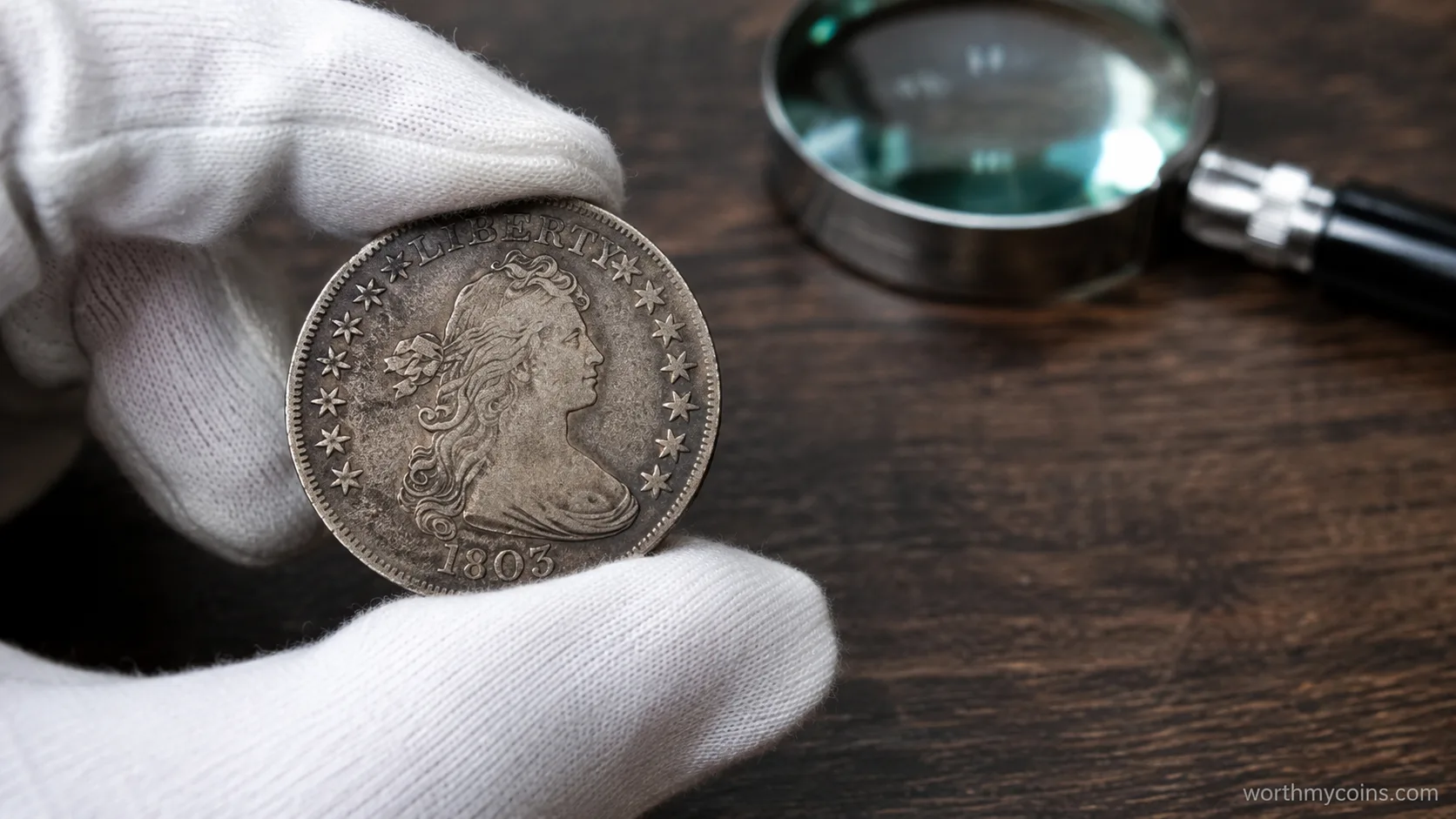
Finding an old U.S. coin can be exciting, but finding a truly rare one is something else entirely. Most coins that turn up in old collections, inherited groups, or forgotten jars are collectible rather than exceptionally rare. A small group, however, has become legendary because so few examples survive, because of unusual circumstances surrounding their production, or because collectors have pursued them for generations. These are the coins that can transform a routine discovery into a major numismatic story.
Quick Answer: Which Rare U.S. Coins Stand Out Most?
Among the most famous U.S. coin rarities are the 1794 Flowing Hair Dollar, 1804 Draped Bust Dollar, 1894-S Barber Dime, 1913 Liberty Head Nickel, 1933 Saint-Gaudens Double Eagle, 1822 Half Eagle, and 1943 Bronze Lincoln Cent.
These coins are rare for different reasons. Some have extremely small surviving populations, some were struck under unusual circumstances, and others became famous because of their historical importance and extraordinary demand. PCGS includes several of these issues among its list of the greatest and most famous U.S. coins.
The important lesson for collectors is that old does not automatically mean rare. A coin’s date is only the starting point. Mint of origin, variety, condition, authenticity, surviving population, and documented market demand all matter.
What Actually Makes a U.S. Coin Rare?
Before looking at individual coins, it helps to understand what numismatists mean when they describe a coin as rare.
Low Mintage Is Only Part of the Story
A coin with a low original mintage may be scarce today, but a low mintage by itself does not prove that a coin is rare.
Some coins were saved in large numbers when they were new. Others had substantial numbers survive because collectors recognized their importance early. Conversely, a coin with a much larger original production can become difficult to find in a particular grade if most surviving examples were heavily circulated or lost.
Surviving Population Matters
Collectors ultimately deal with the coins that exist today, not simply the number originally struck.
This is particularly important for famous rarities. The 1913 Liberty Head Nickel, for example, is known from only five examples. Two are held by museums, leaving three that can potentially circulate among private collectors.
Collectors who want to study this legendary nickel in greater detail can explore 1913 Liberty Head Nickel Value Guide: Why This Rare Coin Is Worth Millions, which focuses on the coin’s rarity, identification, and extraordinary place in U.S. numismatic history.
Condition Can Create Rarity
A date may be relatively available in worn condition but extraordinarily difficult to find in Mint State.
The Barber dime series provides a useful example. NGC notes that some dates become particularly elusive in higher grades even though circulated examples can be found.
This means collectors should be careful with statements such as “rare coin.” A better question is often:
Rare in what grade, with what level of preservation, and with what authentication?
1. 1794 Flowing Hair Dollar
The 1794 Flowing Hair Dollar occupies a special place in American numismatics because it comes from the earliest period of federal silver-dollar production.
It is also one of the most important coins ever struck by the United States Mint.
PCGS has described a remarkable 1794 specimen graded SP66 as possibly the first U.S. silver dollar struck, noting its silver plug, fully struck design, prooflike appearance, and relationship to a copper die trial. That specimen sold for $10,016,875 in January 2013.
That auction result should not be interpreted as a standard value for every 1794 dollar. The coin’s extraordinary grade, preservation, provenance, and specific characteristics made it exceptional.
What Makes the 1794 Dollar So Important?
The Flowing Hair Dollar represents the earliest generation of U.S. silver-dollar coinage.
For collectors, its importance comes from more than age. It combines:
- Early federal Mint history
- Extremely limited surviving examples
- Strong historical significance
- Exceptional collector demand
- Important varieties and die characteristics
- The possibility of major differences in value based on grade and individual quality
The 1794 dollar should therefore be viewed as a historical numismatic object rather than simply an old silver coin.
What Should Collectors Look For?
A genuine 1794 Flowing Hair Dollar should never be evaluated from photographs alone when a major purchase is involved.
Collectors should examine:
- Date and lettering style
- Portrait and hair details
- Reverse design
- Edge characteristics
- Surface texture
- Signs of tooling or alteration
- Weight and dimensions
- Provenance and certification
Because early U.S. dollars are valuable and heavily studied, authentication is essential when dealing with an apparent 1794 example.
2. 1804 Draped Bust Dollar
Few American coins have generated as much publicity and mythology as the 1804 Draped Bust Dollar.
Interestingly, the famous “1804” dollars were not actually struck in 1804 as ordinary circulation dollars. The pieces known today as the 1804 dollars were produced later for presentation purposes, and the surviving examples are divided into three recognized classes.
PCGS identifies approximately 15 known examples across Classes I, II, and III.
This unusual history is one reason the coin became such an important part of American numismatic culture.
Why Is the 1804 Dollar So Famous?
The coin combines rarity, historical mystery, diplomatic presentation, collecting history, and decades of publicity.
One famous Class I example, the Sultan of Muscat specimen, was graded PCGS PR68 and sold for $4.14 million in 1999. At the time, it became the world’s most expensive coin.
Again, that price is not a general valuation for an “1804 dollar.” The specific specimen, grade, provenance, and historical significance were critical.
The Three Classes
Collectors generally encounter the 1804 dollar through its three classifications:
| Class | General Description |
|---|---|
| Class I | Original presentation dollars with the original reverse design |
| Class II | Later restrikes with a plain edge |
| Class III | Later restrikes with lettered edges |
The differences are significant, and identifying the correct class requires careful study.
A Warning About 1804 Dollars
An apparent 1804 Draped Bust Dollar should be treated as a major authentication candidate, not as an ordinary coin find.
Because the date is so famous, altered and counterfeit examples are a serious concern. A genuine specimen should have its authenticity established by a respected professional grading service or another highly qualified numismatic expert.
3. 1894-S Barber Dime
The 1894-S Barber Dime is one of the most famous small-denomination rarities in American coinage.
For a broader look at the Barber dime series and other collectible issues from the same design family, see Top 10 Barber Dimes Worth Money That Collectors Are Hunting in 2026, which highlights dates and issues that deserve closer attention when evaluating older Barber Dimes.
According to NGC, only 24 examples were reportedly struck, and only about ten can currently be accounted for. All known examples are proofs struck from the same dies.
That combination makes the coin extraordinary.
The 1894-S is also one of the classic “Big Three” U.S. rarities, alongside the 1804 Dollar and 1913 Liberty Head Nickel.
Why Is the 1894-S Dime So Rare?
The circumstances surrounding its production remain part of the coin’s appeal.
The San Francisco Mint reportedly produced just 24 pieces, and the exact reason for the unusual issue has been debated by numismatists. The small number originally produced and the extremely small number known today make it one of the ultimate U.S. dime rarities.
The famous “Ice Cream Specimen” story is also associated with the issue. According to the long-standing account, San Francisco Mint Superintendent John Daggett gave three examples to his daughter Hallie, who later spent one on ice cream.
Collectors should distinguish the documented numismatic facts from stories that have been repeated for decades. The coin’s rarity does not depend on the ice-cream story being true.
What Does an 1894-S Barber Dime Look Like?
At first glance, it looks like a normal Barber Dime.
The obverse features Liberty wearing a cap, laurel wreath, and headband, while the reverse carries the denomination and wreath design used on Barber dimes.
The crucial identification point is the:
1894 date + S mint mark + Barber Dime design
However, an apparent 1894-S should never be authenticated simply by finding an “S” under the reverse wreath.
The issue has been counterfeited and altered, making professional authentication especially important. NGC specifically notes that the 1894-S has been subjected to significant counterfeiting and alteration attempts.
Auction Evidence
The 1894-S is not merely famous in theory. Certified examples have brought extraordinary prices at major auctions.
NGC’s auction records show a PCGS-graded PR66 example selling for $1,997,500 in January 2016, while other certified specimens have also exceeded $1 million.
These results demonstrate why condition and certification matter enormously when discussing famous rarities.
4. 1913 Liberty Head Nickel
The 1913 Liberty Head Nickel is another legendary American rarity and one of the first coins experienced collectors think of when discussing impossible-to-find U.S. coins.
Only five examples are known.
That fact alone places the coin in a category far beyond ordinary key dates.
PCGS describes the 1913 Liberty Head Nickel as one of the most famous and coveted rarities in American numismatics. Of the five known examples, two are permanently housed in museum collections, including the Smithsonian, leaving three potentially available to private collectors.
Why Does the 1913 Nickel Exist?
This is part of what makes the coin so fascinating.
Liberty Head Nickels were replaced by the Buffalo Nickel in 1913. Yet five Liberty Head Nickels bearing the 1913 date are known.
Their origin and circumstances have been the subject of extensive numismatic research and discussion.
The five pieces have developed individual identities and pedigrees, and their appearances in the marketplace are major events for collectors.
How Rare Is It?
There is a major difference between saying a coin has a low mintage and saying only five examples are known.
The 1913 Liberty Nickel falls into the latter category.
Its rarity is not simply based on an old Mint production figure. Its importance comes from the tiny number of surviving examples known to numismatists.
That is why a genuine 1913 Liberty Head Nickel should immediately receive professional attention rather than being treated as an ordinary old nickel.
What About Its Value?
The finest-known example was part of a three-coin transaction involving an 1804 Dollar and an 1894-S Barber Dime. PCGS reported the combined transaction at $13.35 million in 2021 and identified the 1913 nickel as a PCGS PR66 specimen.
Such transactions should never be used to assign a value to an unverified coin. A supposed 1913 Liberty Nickel would first need to be authenticated, examined for alterations, and evaluated in its actual grade.
5. 1933 Saint-Gaudens Double Eagle
The 1933 Saint-Gaudens Double Eagle is among the most historically complicated U.S. coins ever produced.
It is also one of the most famous American gold coins.
The issue is especially notable because examples became entangled with the legal status of the coins after production and before they entered ordinary circulation. This makes authentication and legal ownership considerations particularly important.
PCGS lists the 1933 Double Eagle among the greatest U.S. coin rarities.
Why Collectors Dream of Finding One
Unlike many rare coins that might realistically appear in an old collection, the 1933 Double Eagle is an extreme rarity.
Its fame comes from a combination of:
- Gold coinage history
- Extremely limited legally collectible examples
- Government involvement
- International publicity
- Major auction appearances
- Extraordinary collector demand
PCGS notes that a unique “legal” 1933 Saint-Gaudens Double Eagle sold for $7.59 million in July 2002, at the time becoming the most valuable U.S. coin sold at auction.
Do Not Assume Every 1933 Double Eagle Is Valuable
This is an important distinction.
Finding an old gold coin that appears to be a 1933 Double Eagle does not automatically mean the owner has a legally marketable rarity.
The history and legal status of individual examples matter enormously.
Any apparent 1933 Double Eagle should be handled carefully and submitted to qualified experts before any attempt is made to sell, clean, alter, or otherwise modify it.
The Biggest Lesson From These Famous Rarities
The most important thing collectors can learn from the coins above is that rarity is more complicated than a date on the obverse.
That principle is especially useful when studying major U.S. auction rarities, and Top 10 U.S. Coins That Changed Hands for Record Prices at Major Auctions offers additional context on how exceptional coins have performed when offered in major public sales.
A coin can become important because of:
| Rarity Factor | Why It Matters |
| Extremely small surviving population | Few collectors can own one |
| Important historical connection | Adds lasting numismatic significance |
| Unusual production circumstances | Can create unique or nearly unique issues |
| Rare variety | Some die varieties are much scarcer than normal issues |
| Exceptional condition | High-grade survivors may be extremely difficult to locate |
| Authenticity and provenance | Establishes confidence in an important coin |
| Strong collector demand | Makes scarce examples especially desirable |
The same principle applies to much more affordable coins.
A collector does not need to find an 1804 Dollar or 1913 Liberty Nickel to make an important discovery. Some genuinely scarce coins can be found in older collections, inherited groups, dealer inventories, or long-held albums. The challenge is knowing which characteristics deserve a closer look.
Before You Assume You Found a Rare Coin
If an old U.S. coin appears unusual, resist the temptation to clean it or immediately sell it.
First record:
- The exact date
- The mint mark
- The denomination
- The major design type
- Any unusual lettering or numbers
- Possible doubling or other variety characteristics
- The coin’s condition
- Where the coin came from
Then compare it with reliable numismatic references.
Most importantly, remember that authentication comes before valuation when a coin appears to be an extreme rarity.
A rare coin that is genuine can be worth dramatically more than a similar-looking counterfeit. Professional examination can therefore be far more important than an online price estimate.
6. 1822 Capped Head Left Half Eagle
The 1822 Capped Head Left Half Eagle is one of the great rarities of early U.S. gold coinage.
The denomination is a $5 gold piece, but its importance goes far beyond its face value. PCGS identifies only three known examples of the 1822 Capped Head half eagle. One of those is permanently held by the Smithsonian Institution, leaving two examples in private hands.
That makes the 1822 half eagle an extraordinary example of true numismatic rarity.
Why Is the 1822 Half Eagle So Important?
The coin belongs to the Capped Head Left series of early U.S. half eagles. While many early gold coins are scarce, the 1822 issue is in another category because of the extremely small number of surviving examples.
It is also an excellent reminder that a coin’s rarity cannot always be understood by looking at its age alone.
A collector might find an early nineteenth-century gold coin and assume that any example must be extremely rare. That is not necessarily true. The specific date, variety, surviving population, and condition have to be established first.
What Should You Do With an Apparent 1822 Half Eagle?
If an old $5 gold coin appears to be dated 1822, do not clean it, polish it, or attempt to authenticate it with an online photograph.
A coin of this importance should be examined by a recognized professional grading and authentication service.
The difference between an authentic early gold coin and an altered or counterfeit example can be enormous.
7. 1796 Draped Bust Quarter
The 1796 Draped Bust Quarter is another early American rarity that deserves attention.
It has an especially important place in U.S. coinage because it is the only quarter-dollar issue struck during the eighteenth century. PCGS has described the 1796 quarter as a type coin of exceptional rarity.
This is one of those coins where historical importance and scarcity come together.
What Makes the 1796 Quarter Different?
The Draped Bust design represents the early federal period of American coinage.
The 1796 quarter features Liberty on the obverse and a small eagle on the reverse. Its early date, limited surviving population, and status as the first U.S. quarter issue make it highly desirable among specialists in early American coinage.
The coin is also a useful lesson in why type and date matter together.
A collector searching an old group of quarters should not simply look for silver. Early dates and unusual designs deserve closer examination.
Condition Matters
The surviving 1796 quarters are found in a range of grades, and individual pieces can differ dramatically in quality.
A heavily worn example and a sharply preserved example should not be treated as interchangeable.
PCGS auction reporting illustrates how strongly condition can influence the market. A PCGS MS64 example of the 1796 Draped Bust Quarter realized $303,750 at a 2020 GreatCollections auction.
That result represents one particular certified coin and should not be interpreted as a universal value for every 1796 quarter.
8. 1793 Chain Cent
The 1793 Chain Cent is one of the most historically important early U.S. cents.
PCGS describes the Chain Cent as the first mass-produced circulating issue created by the United States Mint. The series contains several die-design varieties because the early dies were hand engraved and hand punched.
This is where collecting becomes particularly interesting.
Two coins can share the same date and basic design while still being different recognized varieties.
Why the Chain Cent Is Special
The Chain Cent was part of the earliest generation of federal copper coinage.
The reverse depicts a chain intended to symbolize unity, although the design was criticized and soon replaced.
Several varieties are known, including differences in the lettering and punctuation.
PCGS notes that the 1793 Chain Cent includes multiple die varieties, including the famous AMERI. reverse variety.
For a specialist, those tiny differences can be more important than a casual collector might expect.
A Realistic Discovery Opportunity
Unlike an 1804 Dollar or 1913 Liberty Nickel, an early copper cent is at least the kind of object that could turn up in an old collection or estate group.
That does not mean finding one is easy.
It means collectors should learn to recognize early U.S. cents rather than automatically dismissing them as worn copper coins.
If a coin appears to date from the 1790s, identify the exact design before deciding that it is ordinary.
9. 1943 Bronze Lincoln Cent
The 1943 Bronze Lincoln Cent is one of the most famous U.S. mint errors.
Collectors studying famous Lincoln cent rarities can also use 1943 Bronze Lincoln Wheat Penny Value Guide: Identification, Rarity & Collector’s Guide to examine the identification challenges, rarity, and authentication concerns surrounding this celebrated error.
During World War II, the Mint changed the composition of the Lincoln cent to zinc-coated steel to conserve copper for wartime purposes. A small number of bronze planchets were nevertheless struck with the 1943 date.
NGC describes the 1943 Bronze Cent as one of the most famous mint errors of all time.
Why Collectors Still Search for It
The 1943 cent creates an appealing collecting story because the date is common enough to be familiar, while the genuine bronze error is exceptionally scarce.
But this is also one of the most dangerous coins for inexperienced collectors to authenticate.
NGC specifically warns that the 1943 Bronze Cent is heavily counterfeited. Many ordinary 1943 steel cents have been altered or copper-plated in attempts to imitate a genuine bronze example.
How to Approach a Suspected Example
If you find a 1943 Lincoln cent that appears copper-colored, do not assume you have discovered a major rarity.
Start by determining whether the coin is actually bronze rather than a normal steel cent that has been plated, chemically altered, or otherwise modified.
A suspected example should receive professional authentication.
The potential importance of the coin makes expert examination worthwhile.
10. 1955 Doubled Die Obverse Lincoln Cent
The 1955 Doubled Die Obverse Lincoln Cent is another legendary variety that has become part of American collecting culture.
For a closer examination of this famous doubled-die variety, 1955 Doubled Die Lincoln Penny Value Guide: How to Identify This Famous Error Coin provides a focused reference for recognizing the distinctive doubling and understanding why authentication matters.
Unlike the 1943 Bronze Cent, this is not an off-metal planchet error. It is a famous die variety characterized by strong doubling on the obverse.
The doubling is especially noticeable in areas such as the date and lettering.
PCGS lists the 1955 Doubled Die among the Lincoln Cent rarities that helped attract collectors to the series.
Variety Versus Error
This distinction matters.
Collectors often use the word “error” for every unusual-looking coin, but numismatists distinguish between different categories.
A variety is a recurring difference associated with a die or design, while an error generally results from an unintended problem involving the planchet, die, or striking process.
The U.S. Mint defines a variety as a minor change from the basic design type, usually resulting from changes in the dies used during striking.
PCGS likewise explains that die varieties can repeat exactly, while planchet and striking errors are different categories.
Understanding this distinction makes it much easier to evaluate unusual coins without falling for exaggerated claims.
Other Rare U.S. Coins Worth Knowing
The coins above are only a starting point.
PCGS’s historical list of major U.S. rarities also includes coins such as the 1827 Capped Bust Quarter and other early federal issues.
For collectors, the broader lesson is important: rare coins exist across nearly every major denomination.
Early U.S. Coins
Early cents, half cents, half dimes, dimes, quarters, half dollars, dollars, and gold coins can contain extraordinary rarities.
The earliest federal coinage deserves special attention because surviving examples can be scarce, varieties can be complex, and authentication can require specialist knowledge.
Rare Varieties
Some coins become valuable not because the date itself is rare, but because a particular die variety is scarce.
Collectors interested in the wider world of unusual mint-made pieces can also consult Top 10 Rare Coin Errors Worth Money Found in Circulation for additional examples of documented errors and the characteristics that can make them collectible.
This is why serious collectors learn to compare lettering, dates, mint marks, die characteristics, and other design details.
Major Mint Errors
Mint errors can also be highly collectible.
The U.S. Mint notes that examples of errors include off-center strikes, multiple strikes, overstrikes, clipped planchets, and defective dies.
However, not every unusual-looking coin is a valuable error.
Minor production imperfections can be common. Major, clearly identifiable errors are a different matter.
How to Check an Old Coin for Rarity
Finding a potentially rare coin is only the first step. The next challenge is identifying exactly what you have.
Use a systematic approach rather than relying on appearance alone.
Step 1: Identify the Denomination
Determine whether the coin is a cent, nickel, dime, quarter, half dollar, dollar, or gold denomination.
This sounds obvious, but it establishes which reference material you need.
Step 2: Record the Date
Look carefully at the date.
Do not guess a partially worn digit.
If necessary, use good lighting and a magnifier, but avoid aggressive rubbing or cleaning.
Step 3: Check the Mint Mark
The mint mark can completely change the significance of a coin.
The U.S. Mint explains that mint marks identify the facility where a coin was produced. Modern U.S. mint marks include P for Philadelphia, D for Denver, S for San Francisco, and W for West Point.
Historical mint marks include C for Charlotte, D for Dahlonega, O for New Orleans, and CC for Carson City.
Do not assume that no mint mark means something is wrong.
Philadelphia traditionally produced coins without a mint mark, and mint-mark practices have changed throughout U.S. history.
Step 4: Identify the Design Type
A date alone is not enough.
Determine which design is on the coin.
For example, an early dollar could be a Flowing Hair, Draped Bust, or another type. A nineteenth-century gold coin could belong to several different designs.
Correctly identifying the type prevents major mistakes.
Step 5: Look for Varieties or Errors
Once the basic coin is identified, check for recognized varieties.
Look at:
- Date positioning
- Mint mark shape and placement
- Lettering
- Numerals
- Die cracks
- Repunched features
- Doubled design elements
- Off-center strikes
- Clipped planchets
- Wrong-planchet strikes
- Other documented varieties
Do not label something an error simply because it looks different.
Compare it with a trusted reference first.
Why Cleaning a Rare Coin Can Be a Serious Mistake
One of the worst things a new collector can do to a potentially valuable coin is clean it.
A polished or harshly cleaned coin may lose important surface originality and can become less desirable to collectors.
The U.S. Mint specifically advises collectors to protect coins from scratches, corrosion, and other surface damage and recommends appropriate holders and careful handling.
If you find a coin that looks dirty, resist the urge to make it shiny.
The original surface may contain important information about the coin’s preservation.
How Should You Handle a Valuable Coin?
Hold a coin carefully by its edges when possible.
Work over a soft surface so that an accidental drop does not damage the piece.
Good lighting and a quality magnifier are more useful than aggressive cleaning products. The U.S. Mint recommends a good magnifying glass, proper lighting, suitable holders, and soft materials for handling coins.
Understanding Grade and Condition
Rarity alone does not determine market value.
Condition can make an enormous difference.
Collectors generally distinguish between circulated and uncirculated coins, while professionally graded coins receive numerical grades under established grading systems.
The U.S. Mint notes that the Sheldon grading scale is used in determining a coin’s grade, with factors including how well the coin was made, how much wear it has developed, and its luster.
Circulated Coins
Circulated coins have experienced use and normally show varying degrees of wear.
The amount and location of wear help determine the grade.
Uncirculated Coins
An uncirculated coin generally shows no wear from circulation, although strike quality, marks, luster, and other characteristics still matter.
Two coins can both be uncirculated and still differ substantially in quality.
Certified Coins
For major rarities, professional certification can provide important authentication and grading information.
A professional holder does not automatically make a coin valuable, but certification can give buyers greater confidence that the coin has been examined and identified.
What Determines the Value of a Rare Coin?
There is no universal price for a rare U.S. coin.
A realistic evaluation considers several factors:
| Factor | Why It Matters |
|---|---|
| Date | Some dates are much scarcer than others |
| Mint mark | Different Mints can have dramatically different populations |
| Variety | Certain recognized varieties are much scarcer |
| Error status | Major documented errors can command strong demand |
| Grade | Better-preserved examples generally attract greater demand |
| Eye appeal | Attractive surfaces and overall appearance matter |
| Certification | Authentication and professional grading can increase market confidence |
| Provenance | Important ownership or auction history can add significance |
| Collector demand | Market interest directly affects prices |
| Recent auction results | Actual transactions provide useful evidence of market levels |
The safest way to discuss the value of a rare coin is to compare it with documented sales of genuinely comparable examples.
A price realized for an MS65 coin should not automatically be applied to an AU or circulated example.
Common Mistakes New Collectors Make
Assuming Every Old Coin Is Rare
Age is not the same thing as rarity.
Millions of old U.S. coins survive, and some nineteenth- and early twentieth-century dates are relatively accessible to collectors.
Searching Only for Expensive Dates
Some valuable discoveries involve varieties or errors rather than famous key dates.
Learning how coins were produced can therefore be more useful than memorizing a list of expensive dates.
Trusting a Magnet Test Alone
A magnet can sometimes provide a useful clue, but it is not a substitute for authentication.
A genuine rare coin should be identified through its complete physical characteristics.
Cleaning the Coin
This can permanently damage the coin’s surfaces.
When in doubt, leave the coin alone.
Assuming a Photograph Proves Authenticity
Photographs are useful for preliminary research, but they cannot replace hands-on examination for a major rarity.
Counterfeiters can reproduce dates, mint marks, colors, and surfaces well enough to fool inexperienced collectors.
Using One Online Price as “The Value”
Rare coins do not have one universal price.
Grade, certification, eye appeal, provenance, market conditions, and the exact variety all matter.
When Should You Get Professional Authentication?
Professional authentication becomes especially important when:
- The date is historically rare.
- The coin appears to be a major error.
- The mint mark seems unusual.
- The coin is an apparent off-metal strike.
- The coin may be an important die variety.
- The value could be substantial.
- You suspect the coin has been altered.
- You are preparing to sell a major rarity.
For an ordinary circulated coin, professional grading may not always make economic sense.
For a suspected 1913 Liberty Head Nickel, 1943 Bronze Cent, 1822 Half Eagle, or other extreme rarity, the situation is completely different.
Buying Rare U.S. Coins Safely
Buying a rare coin requires the same discipline as identifying one.
Start by researching the exact coin rather than buying solely because the seller calls it “rare.”
Ask:
- What is the exact date?
- What is the mint mark?
- Is it a recognized variety?
- Is it certified?
- What is the certified grade?
- Are there comparable auction results?
- Does the coin show signs of cleaning or alteration?
- Is the seller willing to provide clear photographs and documentation?
For expensive coins, established auction houses, reputable dealers, and professionally certified examples can provide additional confidence.
Selling a Rare Coin
If you believe you have discovered an important rarity, do not rush into the first offer.
First establish what the coin actually is.
For a major rarity, consider obtaining professional authentication and grading before negotiating a sale.
Then compare recent auction results for coins of the same date, variety, grade, and certification level.
Remember that an auction result is evidence of what a particular coin brought at a particular time. It is not a guaranteed future selling price.
The Best Rare-Coin Discovery Is Sometimes the One You Almost Ignored
The most exciting part of collecting is not necessarily owning a famous million-dollar rarity.
It is learning enough to recognize something unusual.
A worn early copper coin can teach you about the first years of the U.S. Mint. A strange-looking Lincoln cent can lead to research into planchets and striking errors. An unusual mint mark can reveal an entirely different branch Mint and collecting history.
That is why experienced collectors often examine coins that beginners might overlook.
The real skill is not simply knowing which coins are expensive.
It is knowing why a coin is rare and how to prove it.
FAQ About Rare U.S. Coins
What is the rarest U.S. coin?
There is no single answer because rarity can be measured in different ways. Coins such as the 1913 Liberty Head Nickel and 1822 Capped Head Left Half Eagle are famous because extremely few examples are known. Other coins may be unique or nearly unique in a particular variety, grade, or error category.
Can a rare U.S. coin still be found in circulation?
It is possible for scarce coins, varieties, and errors to be discovered outside professional collections, but the chances of finding one of the most famous classic rarities in everyday circulation are extremely small.
More realistic discoveries can involve older key dates, varieties, or mint errors that have entered collections or remained unnoticed.
How do I know if my old U.S. coin is rare?
Start with the denomination, date, mint mark, design type, and condition. Then compare the coin with a trusted numismatic reference.
If it appears to match a major rarity or important error, seek professional authentication rather than relying solely on online photographs.
Does a missing mint mark make a coin rare?
Not automatically.
Philadelphia has traditionally produced many U.S. coins without mint marks, and mint-mark practices have changed over time. The U.S. Mint’s historical information should be consulted for the specific coin and period.
Are error coins always valuable?
No.
Some errors are common and relatively minor, while major documented errors can be highly collectible.
The significance depends on the type of error, how dramatic and genuine it is, rarity, condition, and collector demand.
Should I clean a rare coin before selling it?
No.
Cleaning can damage the coin’s original surface and may reduce its desirability. Leave a potentially valuable coin in its existing condition until it has been evaluated.
Is a coin worth more because it is certified?
Certification can provide authentication and a professional grade, which can increase buyer confidence. However, certification itself does not make an ordinary coin rare. The underlying coin, grade, variety, authenticity, and market demand remain the important factors.
What should I do if I think I found a 1943 Bronze Cent?
Do not clean it or sell it immediately.
A genuine 1943 Bronze Cent is a major rarity, but the issue is also heavily counterfeited. NGC specifically warns about copper-plated and altered 1943 cents.
Have the coin examined by an experienced numismatist or professional grading service.
What is the most important thing to remember when collecting rare coins?
Learn to identify the coin before trying to price it.
The correct sequence is:
Identify → Authenticate → Grade → Research comparable sales → Evaluate the market.
That approach protects collectors from many of the mistakes caused by online hype and unsupported price claims.
Final Thoughts
Rare U.S. coins are fascinating because every major rarity has a story behind it.
The 1794 Flowing Hair Dollar represents the earliest years of federal silver-dollar production. The 1804 Draped Bust Dollar became legendary through its unusual history and presentation issues. The 1894-S Barber Dime and 1913 Liberty Head Nickel demonstrate what happens when only a tiny number of examples survive. The 1822 Half Eagle shows just how scarce early American gold can become, while the 1943 Bronze Cent demonstrates how an unusual Mint error can create an enduring numismatic legend.
But the biggest lesson for collectors is simple: do not chase rarity without evidence.
Study the date. Check the mint mark. Understand the design. Learn the varieties. Examine the condition. Compare the coin with trusted references. And when something truly unusual turns up, protect it and have it authenticated before making a major decision.
The dream of finding a rare U.S. coin is what makes searching exciting. The knowledge to recognize one is what makes collecting rewarding.
References
- United States Mint — Collecting Basics, Mint Marks, Coin Anatomy, and Coin Care
- Professional Coin Grading Service (PCGS) — U.S. coin rarity, varieties, major rarities, and auction information
- Numismatic Guaranty Company (NGC) — Barber Dimes and major U.S. mint errors

Narayan Kumar is the Founder and Author of Worth My Coins. She specializes in U.S. coin collecting, with a focus on coin identification, mint errors, grading, rare varieties, and collector education. Her goal is to publish accurate, well-researched, and easy-to-understand guides that help both new and experienced collectors make informed decisions. Every article is created using trusted numismatic references and is written with a commitment to accuracy, transparency, and long-term educational value.