Finding a Franklin Half Dollar in a family collection, inherited coin jar, estate sale, or old coin album can be exciting. While every Franklin Half Dollar contains 90% silver, only certain dates, mint marks, varieties, and exceptionally well-preserved examples consistently command collector premiums.
While many Franklin Half Dollars are common silver coins worth more than their face value because of their silver content, some dates, mint marks, and varieties are significantly more desirable to collectors. Knowing what to look for before selling or spending one could help you identify a scarcer example that deserves closer attention.
Whether you’re completely new to coin collecting or simply curious about a coin you found, this guide explains how to identify Franklin Half Dollars, recognize important dates and mint marks, understand notable varieties, and learn what factors determine collector value.
Quick Answer
Not every Franklin Half Dollar is rare, but collectors should first check:
- The date (1948–1963)
- The mint mark (Philadelphia, Denver, or San Francisco)
- Whether it’s a circulation strike or Proof
- The coin’s condition
- Whether it displays recognized die varieties such as Doubled Dies or Repunched Mint Marks
- Whether certified examples qualify for the coveted Full Bell Lines (FBL) designation
These factors—not silver content alone—determine whether a Franklin Half Dollar carries a premium among collectors.
What Is a Franklin Half Dollar?
Why Franklin Half Dollars Remain Popular With Collectors
Franklin Half Dollars appeal to both collectors and silver investors because the series is short, historically important, and struck entirely in 90% silver. Many collectors attempt complete date-and-mint sets, while others focus on high-grade certified examples with the Full Bell Lines designation. The combination of silver content, classic mid-century design, and attainable collecting goals has helped keep the series popular for decades.
The Franklin Half Dollar was produced by the United States Mint from 1948 through 1963. It replaced the Walking Liberty Half Dollar and was itself replaced by the Kennedy Half Dollar following President John F. Kennedy’s assassination.
Collectors interested in the series that came before Franklin’s design may also enjoy Top 10 Walking Liberty Half Dollars Worth Big Money, which explores some of the most desirable Walking Liberty Half Dollars and explains why certain dates remain favorites among advanced collectors.
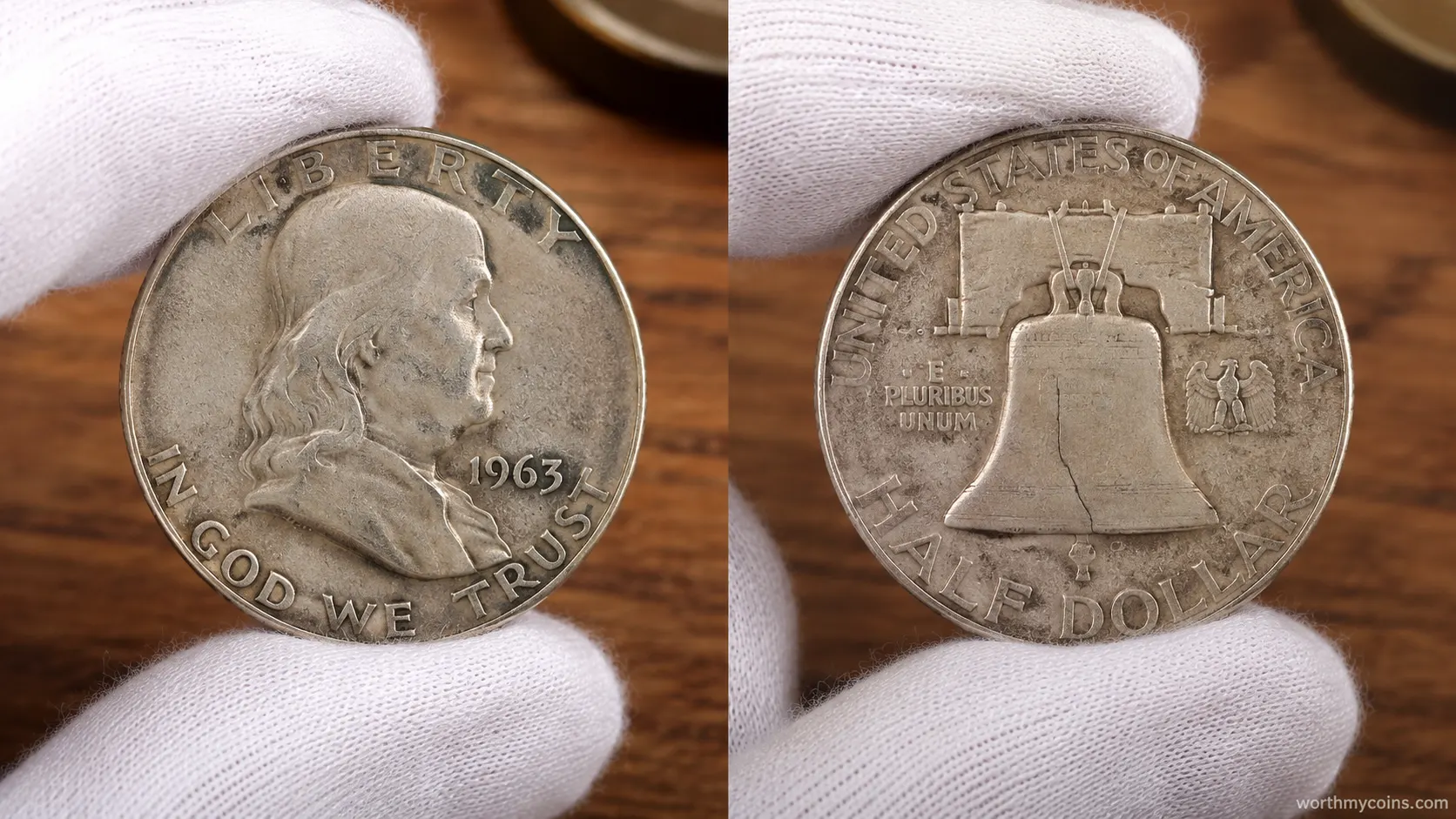
Designed by Chief Engraver John R. Sinnock, the obverse features Benjamin Franklin, while the reverse depicts the Liberty Bell with a small eagle added to satisfy the legal requirement that half dollars display an eagle.
Every Franklin Half Dollar struck for circulation contains 90% silver and 10% copper, making the series attractive to collectors who appreciate both its historical significance and intrinsic silver content.
How to Identify a Franklin Half Dollar
Before evaluating rarity or collector demand, first confirm that your coin is a genuine Franklin Half Dollar and compare its design features with official specifications.
Obverse
Look for:
- Portrait of Benjamin Franklin facing right
- LIBERTY around the rim
- IN GOD WE TRUST along the left side
- Date beneath the portrait
Reverse
The reverse shows:
- The Liberty Bell
- UNITED STATES OF AMERICA
- HALF DOLLAR
- E PLURIBUS UNUM
- A small eagle to the right of the bell
Composition and Specifications
| Specification | Details |
|---|---|
| Years Produced | 1948–1963 |
| Composition | 90% Silver, 10% Copper |
| Weight | 12.50 grams |
| Diameter | 30.6 mm |
| Edge | Reeded |
Understanding Franklin Half Dollar Mint Marks
Franklin Half Dollars were struck at three U.S. Mint facilities.
| Mint | Mint Mark | Location |
|---|---|---|
| Philadelphia | None | No mint mark |
| Denver | D | Reverse above the Liberty Bell near the right side |
| San Francisco | S | Reverse above the Liberty Bell near the right side |
Proof coins from 1950 through 1963 were produced at the Philadelphia Mint and do not carry a mint mark.
Identifying the mint mark is one of the quickest ways to narrow down whether your coin may be a more desirable date-and-mint combination, although condition and strike quality remain equally important.
Franklin Half Dollar Dates Collectors Check First
Certain dates attract greater collector interest because of lower mintages, stronger demand in high grades, or relative scarcity with Full Bell Lines.
1948
The first year of the series is always popular with collectors. Although not especially rare overall, attractive Mint State examples often command stronger demand than heavily circulated coins.
1949-S
The 1949-S is one of the better-known semi-key dates of the series. High-grade examples, especially those with Full Bell Lines, are considerably more difficult to locate.
1953-S
Collectors often pay close attention to the 1953-S because sharply struck examples are much less common than average circulated pieces.
1955
Philadelphia struck relatively few circulation coins in 1955 compared with many other years, making this issue important for collectors assembling complete date-and-mint collections.
1958
Although not the lowest-mintage coin overall, premium-quality Mint State examples with exceptional strike and eye appeal become much more difficult to locate.
1961-D
Many Denver issues survive, but fully struck coins meeting Full Bell Lines standards are considerably scarcer than their overall mintage might suggest.
1963
The final circulation year of the Franklin Half Dollar series remains popular with collectors completing date sets.
Many collectors also continue their half dollar collections into the next series with Kennedy Half Dollar Value Guide: Hidden Gems, Silver Issues & Rare Finds, which explains important silver issues, collectible varieties, and key dates introduced after the Franklin Half Dollar.
Franklin Half Dollar Proof Coins
Proof Franklin Half Dollars were struck for collectors between 1950 and 1963.
Unlike business strikes, Proof coins were specially manufactured using polished dies and specially prepared planchets to create sharper details and mirrored fields.
Collectors often distinguish between:
- Standard Proofs
- Cameo Proofs
- Deep Cameo (Ultra Cameo) Proofs
Certified Cameo and Deep Cameo Proofs are generally scarcer than standard Proofs and often receive stronger collector interest because of their pronounced frosted devices and mirrored fields.
Important Franklin Half Dollar Varieties
Not every unusual-looking coin represents a valuable error. Collectors focus primarily on recognized varieties documented by major numismatic references.
Doubled Die Varieties
Some Franklin Half Dollars exhibit doubling created during die production rather than damage after leaving the Mint.
Depending on the variety, doubling may appear on:
- Date
- Lettering
- Motto
- Design details
Collectors rely on attribution guides from recognized experts before identifying a coin as a genuine doubled die.
Repunched Mint Marks (RPMs)
Before mint marks became part of the master die, they were punched into working dies by hand. Occasionally the punch shifted, leaving traces of multiple impressions.
Recognized Repunched Mint Marks exist for several Franklin Half Dollar issues.
Die Cracks
Raised lines caused by cracked dies are common throughout many U.S. coin series.
Most minor die cracks add little collector value, although dramatic examples on popular issues may attract specialists.
Die Clash Marks
Sometimes dies strike one another without a planchet between them.
This can leave faint transferred design elements on later coins.
While interesting, not every clash mark increases value. Demand depends on the specific variety and collector interest.
What Is Full Bell Lines (FBL)?
One of the most important terms in Franklin Half Dollar collecting is Full Bell Lines, commonly abbreviated FBL.
The designation recognizes coins displaying uninterrupted horizontal lines across the Liberty Bell on the reverse.
Because many Franklin Half Dollars were weakly struck or experienced die wear, complete bell lines are relatively scarce for several dates.
Both PCGS and NGC award Full Bell Lines designations, although each service uses its own published attribution standards.
Because Full Bell Lines indicate a stronger strike rather than lower wear alone, the designation can significantly increase collector demand for certain dates, especially in higher Mint State grades.
How Coin Grade Affects Value
Two Franklin Half Dollars with the same date and mint mark can differ substantially in collector value because grading measures preservation, surface quality, strike, and eye appeal—not simply age.
Collectors generally consider:
Circulated Coins
These display varying amounts of wear from everyday use.
Lightly circulated examples typically command stronger premiums than heavily worn coins.
About Uncirculated (AU)
These coins show only slight friction on the highest points while retaining much of their original mint luster.
Mint State (MS)
Mint State Franklin Half Dollars show no circulation wear.
Higher Mint State grades become progressively more difficult to obtain due to fewer contact marks, stronger luster, and superior eye appeal.
Proof
Proof coins were specially struck for collectors and should not be confused with uncirculated circulation strikes.
Certified Proofs are evaluated separately using the Proof grading scale.
Common Mistakes New Collectors Make
Many beginners accidentally overlook important details.
Common mistakes include:
- Assuming every silver Franklin Half Dollar is rare.
- Ignoring the mint mark.
- Confusing circulation strikes with Proof coins.
- Mistaking post-mint damage for genuine Mint errors.
- Cleaning coins before having them evaluated.
- Assuming internet asking prices reflect actual market value.
- Failing to check whether a coin qualifies for Full Bell Lines.
Avoiding these mistakes can help preserve both the coin’s condition and its potential collector value.
Should You Clean a Franklin Half Dollar?
No.
Cleaning almost always reduces collector appeal because it permanently alters the coin’s original surfaces, something experienced collectors and grading services readily recognize.
Even gentle polishing can leave hairline scratches or unnatural brightness that professional graders immediately recognize.
If you believe your Franklin Half Dollar may be valuable, store it in an inert holder and avoid unnecessary handling until it can be examined by a knowledgeable dealer or certified grading service.
How to Evaluate a Franklin Half Dollar Before Selling
Should You Have Your Coin Authenticated?
Professional authentication is generally worth considering if your Franklin Half Dollar appears to be an important date, a recognized variety, or an unusually well-preserved Mint State or Proof example. Third-party grading services can verify authenticity, assign a grade, and determine whether the coin qualifies for the Full Bell Lines designation, helping buyers and sellers evaluate the coin with greater confidence.
If you’ve discovered an old Franklin Half Dollar, follow these steps:
- Confirm the date.
- Identify the mint mark.
- Determine whether it is a circulation strike or Proof.
- Examine the coin under good lighting for possible recognized varieties.
- Assess overall wear without cleaning the coin.
- Check whether the Liberty Bell displays Full Bell Lines.
- Compare recent certified auction results for similar dates and grades rather than relying solely on online asking prices, which may not reflect actual market transactions.
- Consider professional authentication if the coin appears unusually well preserved or matches a recognized variety.
Where Collectors Verify Franklin Half Dollar Values
Proper Storage Helps Preserve Collector Value
Franklin Half Dollars should be stored in inert archival holders or capsules and handled only by their edges. Exposure to moisture, fingerprints, abrasive cleaning, or improper storage can permanently affect a coin’s surfaces and reduce its desirability among collectors.
Because collector demand and auction activity change over time, experienced numismatists rely on recent certified auction records, grading-service population reports, and current market data instead of outdated printed price lists.
Helpful resources include:
- Certified auction archives
- Professional grading service price guides
- Population reports
- Dealer market activity
- Collector demand for specific dates, grades, and Full Bell Lines examples
Actual market value depends on authenticity, grade, strike quality, originality, certification, eye appeal, collector demand, and recent comparable auction results.
Conclusion
Franklin Half Dollars remain one of the most approachable classic U.S. silver coin series. Every example contains silver, but only certain dates, mint marks, recognized varieties, and exceptionally preserved coins attract substantial collector premiums.
If you’ve found a Franklin Half Dollar, start by identifying the date, mint mark, and strike type, then examine the coin for recognized varieties, Full Bell Lines potential, originality, and overall preservation before estimating its collector appeal. Most importantly, resist the temptation to clean the coin before seeking expert advice. A careful examination using trusted numismatic references can reveal whether your Franklin Half Dollar is simply a historic silver coin or a collectible with greater numismatic significance.
Frequently Asked Questions
Which Franklin Half Dollar dates are considered the most important?
Collectors often pay special attention to issues such as the 1949-S, 1953-S, 1955, and certain dates that are difficult to find with Full Bell Lines. The significance of each coin depends on condition, strike quality, and collector demand rather than the date alone.
Where is the mint mark located on a Franklin Half Dollar?
The mint mark appears on the reverse above the Liberty Bell and to the right side. Philadelphia circulation coins have no mint mark, while Denver coins carry a “D” and San Francisco circulation coins carry an “S.”
What does Full Bell Lines mean?
Full Bell Lines (FBL) indicates that the horizontal lines at the base of the Liberty Bell are complete and uninterrupted according to the standards of the grading service. The designation recognizes strike quality and can increase collector demand for certain issues.
Are all Franklin Half Dollars made of silver?
Yes. Every Franklin Half Dollar struck for circulation from 1948 through 1963 contains 90% silver and 10% copper.
Should I clean my Franklin Half Dollar before selling it?
No. Cleaning can permanently damage the coin’s surfaces and reduce its collector value. Most collectors and professional grading services prefer coins with original, untouched surfaces.
How can I tell if my Franklin Half Dollar is a Proof?
Proof Franklin Half Dollars were produced from 1950 through 1963 for collectors. They typically exhibit mirrored fields, sharper details, and a higher-quality finish than standard circulation strikes, although certification is the most reliable way to confirm authenticity for uncertain examples.
References
The information presented in this guide is supported by established numismatic organizations and research resources, including:
- United States Mint
- Professional Coin Grading Service (PCGS)
- Numismatic Guaranty Company (NGC)
- American Numismatic Association (ANA)
- Heritage Auctions Auction Archives
- Stack’s Bowers Galleries Auction Archives
- Newman Numismatic Portal
- A Guide Book of United States Coins (The Official Red Book)

Narayan Kumar is the Founder and Author of Worth My Coins. She specializes in U.S. coin collecting, with a focus on coin identification, mint errors, grading, rare varieties, and collector education. Her goal is to publish accurate, well-researched, and easy-to-understand guides that help both new and experienced collectors make informed decisions. Every article is created using trusted numismatic references and is written with a commitment to accuracy, transparency, and long-term educational value.