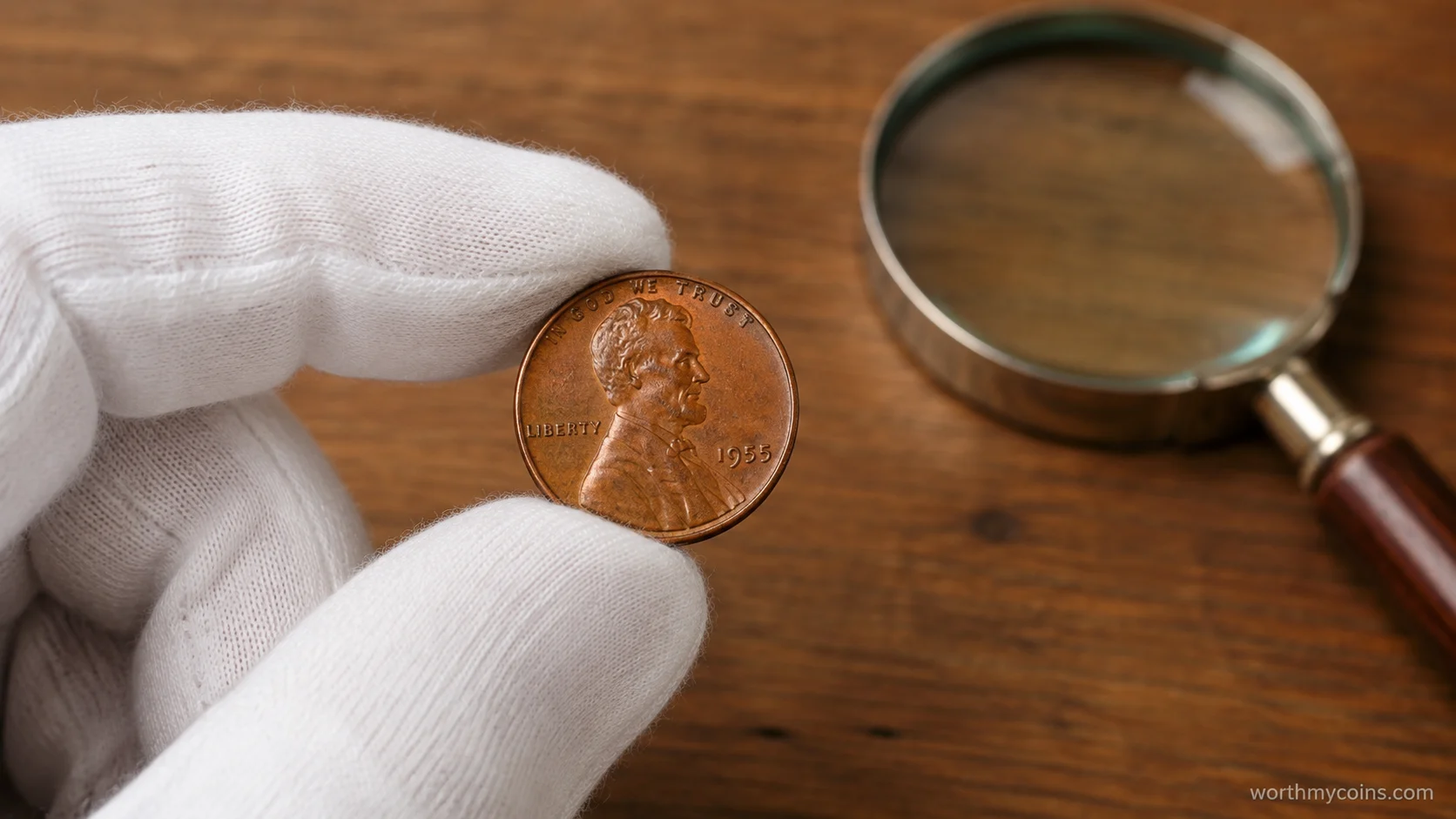
Some Wheat Pennies are worth far more than others, but the most valuable dates are not simply the oldest ones. The biggest premiums usually come from key dates, scarce mintmarked issues, major varieties, and rare mint errors. Among the dates collectors watch most closely are 1909-S VDB, 1914-D, 1931-S, 1922 No D, 1955 Doubled Die, and the extraordinary 1943 bronze cents.
Quick Answer
The Wheat Penny dates most associated with high values include 1909-S VDB, 1914-D, and 1931-S. These are traditionally considered the major regular-issue key dates of the Lincoln Wheat Cent series.
Several unusual issues can be worth dramatically more. The 1922 No D, 1955 Doubled Die Obverse, and 1943 bronze cents are especially important because they involve recognized varieties or mint errors rather than simply being scarce dates.
The most valuable Wheat Pennies can bring extraordinary prices when they are rare, authentic, and in exceptional condition. One known 1943-D bronze cent, for example, sold for $1.7 million in 2010.
Why Some Wheat Penny Years Are Worth More
Lincoln Wheat Cents were produced from 1909 through 1958, with the familiar wheat-ear reverse used throughout the series. The United States Mint introduced the Lincoln cent in 1909, featuring Victor David Brenner’s portrait of Abraham Lincoln on the obverse.
Not every old Wheat Penny is rare. Large numbers of Lincoln Cents were produced during the series, and many dates remain relatively obtainable. What makes certain years stand out is a combination of mintage, survival, mintmark, condition, and collector demand.
That is why a common 1918 or 1946 Wheat Penny should not automatically be valued like a 1914-D or 1909-S VDB. The exact date and mintmark can make a major difference.
For a broader look at Wheat Penny dates, errors, mintmarks, and the factors that influence collector interest, see the Lincoln Wheat Penny Value Guide (1909–1958): Prices, Errors & Rare Coins.
The Most Valuable Regular-Issue Wheat Penny Dates
The 1909-S VDB deserves especially close attention because of its place among the major Wheat Penny key dates. The 1909-S VDB Lincoln Wheat Penny Value Guide: Why This Rare Cent Is So Important to Collectors provides a focused reference for identifying and understanding this famous issue.
When collectors discuss the classic key dates of the Lincoln Wheat Cent series, three dates consistently appear at the top: 1909-S VDB, 1914-D, and 1931-S. PCGS describes these as the traditional “big three” key dates.
| Date | Mintmark | Why It Matters |
|---|---|---|
| 1909-S VDB | S | Famous first-year key with VDB initials |
| 1914-D | D | Low-mintage Denver issue with relatively few high-grade survivors |
| 1931-S | S | Low-mintage Depression-era issue |
| 1909-S | S | Scarce early San Francisco issue even without VDB |
| 1911-S | S | One of the important early San Francisco dates |
1909-S VDB
The 1909-S VDB is probably the most famous regular-issue Wheat Penny key date.
It was struck at the San Francisco Mint during the first year of the Lincoln Cent. The “VDB” initials of designer Victor David Brenner appear prominently on the reverse, but public criticism led to their removal later in 1909.
PCGS notes that just under half a million 1909-S cents were struck with the VDB initials. That relatively small production, combined with strong collector demand and the coin’s historical importance, made the issue one of the central keys to the series.
When checking one, make sure the coin is actually an S-mint 1909 with VDB on the reverse. A 1909 Philadelphia cent without the S mintmark is a different issue.
1914-D
The 1914-D is another major Wheat Penny key date.
Only 1,193,000 were struck at the Denver Mint, according to NGC. Unlike the 1909-S VDB, which received considerable attention from collectors at the time, many 1914-D cents entered circulation. Relatively few were preserved in top condition.
That makes the mintmark particularly important. A 1914 cent without a D is not the same rarity as the 1914-D.
Collectors checking a suspected 1914-D can take a closer look at the date and mintmark using the 1914-D Lincoln Wheat Penny Value Guide: Key Date, Mint Marks & Current Prices, which focuses specifically on this important Denver issue.
Collectors should examine the area below the date carefully for the D mintmark and be cautious about altered or counterfeit examples. Because the 1914-D is a famous key date, authentication becomes especially important for valuable specimens.
1931-S
The 1931-S is the third traditional major key date.
Only 866,000 were struck at San Francisco, making it one of just two Lincoln Cent issues with a mintage below one million when errors and unusual varieties are excluded, according to NGC.
The coin’s low production occurred during the Great Depression, and collectors recognized the scarcity early enough that many examples were saved. As a result, the 1931-S can be found in uncirculated condition despite its low mintage.
This is a good example of why mintage alone does not determine value. A low mintage can make a date important, but how many coins survived and in what grades also matters.
Other Early Wheat Penny Dates Worth Checking
The classic three key dates are not the only early Wheat Pennies that deserve attention.
The 1909-S without VDB is also a significant issue. PCGS identifies it as a tough date that has historically been overshadowed by the better-known 1909-S VDB.
Early San Francisco issues are particularly interesting to collectors. PCGS notes that the 1911-S is a strong candidate for additional key-date status, while early S-mint issues from the pre-1916 period are generally among the scarcer coins of the series.
Other scarce issues include 1910-S, 1911-S, 1912-S, 1913-S, 1914-S, 1915-S, and 1924-D. These dates are not automatically worth a fortune in every condition, but they deserve closer examination than many common Wheat Cents.
1922 No D: The Wheat Penny With a Missing Mintmark
The 1922 No D is one of the most famous varieties in the Lincoln Cent series.
The important point is that this is not simply a Philadelphia cent. In 1922, Philadelphia did not produce Lincoln Cents, so a genuine 1922 cent without a visible D can be connected to Denver production. NGC explains that the missing D resulted from a Denver Mint issue in which the mintmark was effectively removed from the die.
PCGS lists both 1922 No D Strong Reverse and 1922 No D Weak Reverse varieties, showing why collectors should not treat every 1922 coin with a weak or missing-looking mintmark as automatically valuable.
This is also a coin where authentication is important. A damaged or altered mintmark is not the same thing as a genuine 1922 No D variety.
1955 Doubled Die Obverse
The 1955 Doubled Die Obverse is technically a variety rather than a regular key date, but it is one of the most important Wheat Cent varieties ever produced.
The doubling is dramatic and appears on the date, LIBERTY, and IN GOD WE TRUST. PCGS explains that approximately 40,000 examples were struck from the affected die, with roughly 24,000 released into circulation.
A genuine 1955 Doubled Die should show clear, unmistakable doubling rather than the flat, shelf-like appearance associated with ordinary machine doubling. PCGS also identifies additional reverse diagnostics that can help with authentication.
Because the 1955 Doubled Die is a recognized Lincoln Penny variety, collectors who suspect they have one can use the 1955 Doubled Die Lincoln Penny Value Guide: How to Identify This Famous Error Coin for a more detailed identification reference.
Its auction history demonstrates how valuable the variety can become in exceptional condition. A PCGS MS65RD example brought $90,000 at Heritage Auctions in January 2025. That is an auction result for a particular certified coin, not a normal value for every 1955 Wheat Penny.
1943 Bronze Wheat Pennies: Among the Most Valuable
If the question is which Wheat Penny year can produce the most spectacular values, 1943 deserves special attention—but only when the coin is the extremely rare bronze variety.
During 1943, Lincoln Cents were struck on zinc-coated steel planchets as the Mint sought to conserve copper during World War II. A small number of 1943 cents were mistakenly struck on bronze planchets left over from the earlier composition.
These coins are extraordinarily rare. PCGS records a 1943 Philadelphia bronze cent selling for $372,000 in 2021, while a 1943-S bronze cent sold for $504,000 in 2020.
Even more remarkable is the unique known 1943-D bronze cent. PCGS reported that it sold for $1.7 million in 2010, making it one of the most spectacular Lincoln Cent transactions ever recorded.
The important lesson is that a normal 1943 steel cent is not the same coin. The extraordinary value comes from the extremely rare bronze planchet error.
Collectors who want to distinguish the rare bronze issue from ordinary 1943 cents can also consult the 1943 Bronze Lincoln Wheat Penny Value Guide: Identification, Rarity & Collector’s Guide for a focused look at identification and collector considerations.
How to Identify a Valuable Wheat Penny
Start with the date and mintmark. These two details can immediately tell you whether a coin deserves closer attention.
For the most important dates, check:
- 1909-S VDB — confirm both the S mintmark and VDB initials.
- 1914-D — confirm the D mintmark beneath the date.
- 1931-S — confirm the S mintmark.
- 1922 No D — do not assume every weak or missing D is genuine.
- 1955 Doubled Die — look for strong, unmistakable doubling on the obverse.
- 1943 bronze — verify the unusual metal and authenticity before assuming it is genuine.
Condition is another major factor. Two coins with the same date and mintmark can have dramatically different values because one may be heavily circulated while the other retains exceptional detail and original surfaces.
Color can also matter for uncirculated copper cents. Collectors and grading services distinguish between brown, red-brown, and red examples, with original red color often carrying substantial premiums in high grades.
Why Condition Matters So Much
A key date does not have one universal value.
A circulated 1914-D and a superb mint-state 1914-D are fundamentally different collectibles. The same principle applies to 1909-S VDB, 1931-S, and other scarce dates.
For valuable Wheat Pennies, collectors should consider:
- Amount of wear
- Remaining detail
- Original color
- Surface preservation
- Scratches or damage
- Cleaning or chemical alteration
- Strike quality
- Certification
- Eye appeal
A coin that has been cleaned can lose significant collector appeal even if the date itself is desirable.
Do Not Confuse Damage With a Valuable Error
Older copper cents often develop unusual colors, scratches, dents, corrosion, and other surface problems. Those characteristics do not automatically indicate a mint error.
Recognized varieties such as the 1955 Doubled Die and 1922 No D have specific characteristics that distinguish them from post-mint damage. Authentication is especially worthwhile when a supposedly rare error could have substantial value.
For a broader examination of documented Lincoln Wheat Penny errors and varieties, the Rare Lincoln Wheat Penny Errors Worth Money: 12 Valuable Varieties Every Collector Should Know is useful when comparing unusual coins with recognized error characteristics.
The same caution applies to a supposed 1943 bronze cent. Because genuine examples are exceptionally rare and valuable, professional authentication should be considered before treating an unusual 1943 cent as an extraordinary discovery.
Which Wheat Penny Years Should You Check First?
For a collector sorting Wheat Pennies, a practical first pass is to separate the dates and mintmarks that deserve the closest attention.
Top regular-issue key dates: 1909-S VDB, 1914-D, and 1931-S.
Important additional dates: 1909-S, 1911-S, and other scarce early San Francisco issues such as 1912-S, 1913-S, 1914-S, and 1915-S.
Major varieties and errors: 1922 No D, 1955 Doubled Die Obverse, and 1943 bronze cents.
This approach is more reliable than simply looking for the oldest date. A 1909 Wheat Penny is not automatically more valuable than a later coin, and a common date can remain common despite its age.
Collectors sorting through a group of Wheat Pennies can also use the Top 10 Lincoln Wheat Pennies Worth Money That Every Collector Should Check as another reference for dates and issues that deserve closer examination.
Common Mistakes When Valuing Wheat Pennies
One of the biggest mistakes is assuming that every old Wheat Penny is rare. The series contains many dates that are readily available to collectors.
Another mistake is ignoring the mintmark. A 1914-D, for example, is a completely different collecting proposition from a Philadelphia 1914 cent.
Collectors should also avoid comparing their circulated coin with a headline auction result for a superb certified specimen. Auction records reflect a particular coin’s grade, condition, provenance, and market circumstances.
Finally, never clean a potentially valuable Wheat Penny. Removing original surfaces can damage the coin’s collector appeal and make accurate evaluation more difficult.
FAQ
What is the most valuable Wheat Penny year?
There is no single answer if varieties and mint errors are included. The 1943 date is associated with extraordinarily valuable bronze cents, including the unique known 1943-D bronze cent that sold for $1.7 million in 2010. Among regular-issue dates, 1909-S VDB, 1914-D, and 1931-S are the traditional major key dates.
What are the three key dates of Wheat Pennies?
The traditional “big three” are 1909-S VDB, 1914-D, and 1931-S. These dates are widely recognized as the principal regular-issue key dates of the Lincoln Wheat Cent series.
Is every 1943 copper-colored Wheat Penny valuable?
No. Color alone is not enough. A genuine 1943 bronze cent is an extremely rare off-metal error, and authentication is essential because ordinary 1943 cents were struck on zinc-coated steel planchets.
Is a 1922 Wheat Penny without a D automatically valuable?
No. Genuine 1922 No D cents are recognized varieties, but a damaged, altered, or weakly struck mintmark does not automatically make a coin a genuine No D variety. PCGS and NGC both recognize distinct 1922 No D varieties and diagnostics.
Does condition affect Wheat Penny value?
Yes. Grade and surface quality can have a major effect on the market value of a scarce Wheat Penny. High-grade examples of important dates and varieties can command dramatically higher prices than circulated examples.
References
- United States Mint — Penny
- PCGS — Lincoln Cents: My First Love
- PCGS — Lincoln Cents Guide
- PCGS — Lincoln Cent (Wheat Reverse) CoinFacts
- NGC — Lincoln Cents, Wheat Reverse (1909–1958)
- PCGS — 1955 Doubled Die Obverse CoinFacts
- PCGS — 1943 Bronze Lincoln Cent CoinFacts
- PCGS — 1943-D Bronze Cent Sold for $1.7 Million
- Heritage Auctions — Rare 1943 Lincoln Cent Sells for $204,000

Narayan Kumar is the Founder and Author of Worth My Coins. She specializes in U.S. coin collecting, with a focus on coin identification, mint errors, grading, rare varieties, and collector education. Her goal is to publish accurate, well-researched, and easy-to-understand guides that help both new and experienced collectors make informed decisions. Every article is created using trusted numismatic references and is written with a commitment to accuracy, transparency, and long-term educational value.