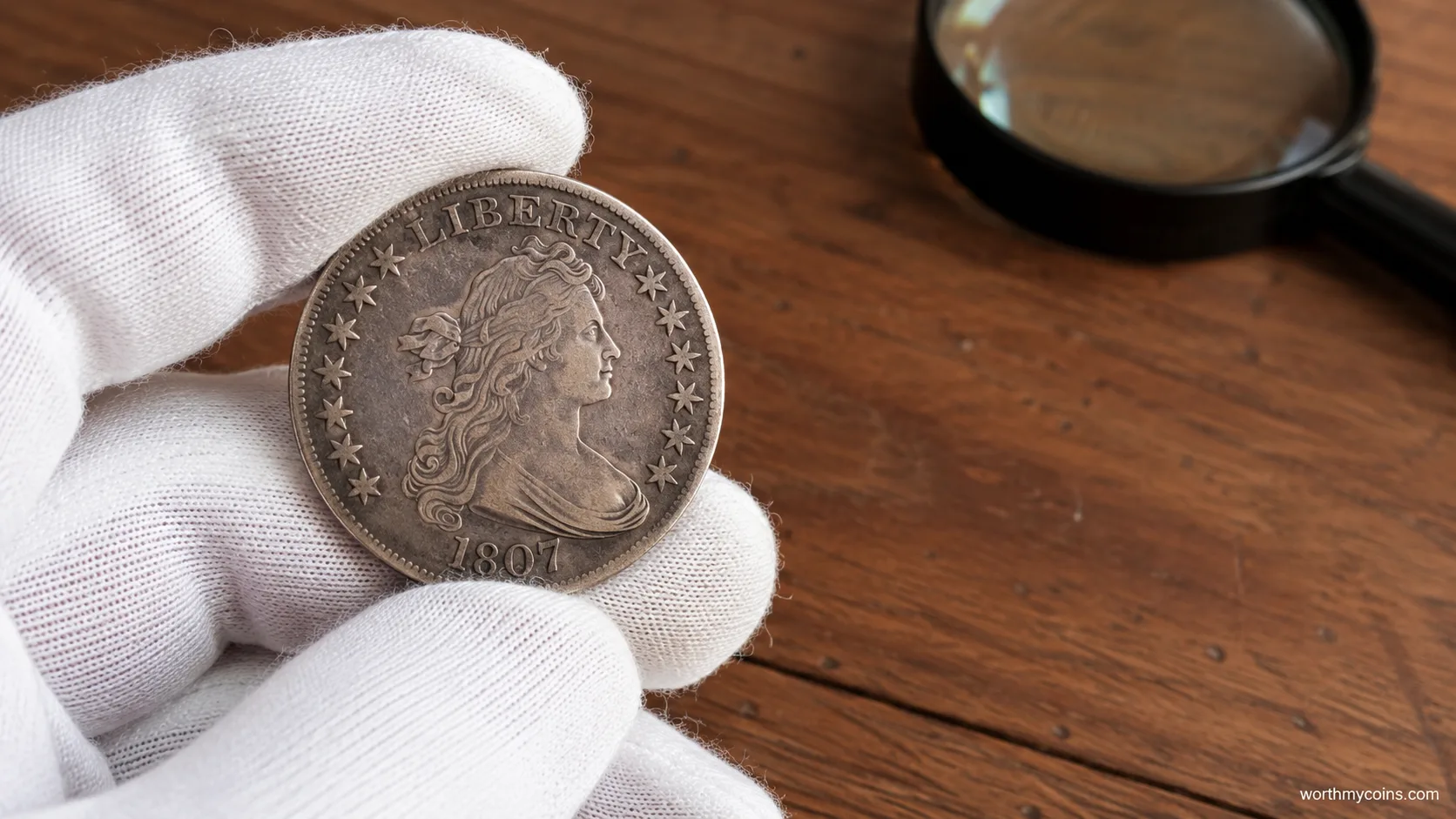
The Draped Bust Half Dollar is one of the most historically significant coins produced by the early United States Mint. Struck during the nation’s formative years, these silver half dollars reflect the craftsmanship, challenges, and economic growth of the late 18th and early 19th centuries. Although every Draped Bust Half Dollar attracts collector interest, certain dates, die varieties, and issues stand out because of their rarity, historical significance, and strong demand among numismatists.
Whether you’re just starting an early U.S. coin collection or looking to better understand this classic series, knowing which Draped Bust Half Dollars deserve special attention can help you make more informed collecting decisions.
Quick Answer
Draped Bust Half Dollars were minted from 1796 through 1807 and remain among the most sought-after early American silver coins. While all examples carry historical appeal, collectors often focus on key dates, scarce die marriages, overdates, and well-preserved certified coins. Their value depends heavily on rarity, grade, originality, eye appeal, and current market demand rather than age alone.
Why Draped Bust Half Dollars Are Important
The Draped Bust design represents one of the earliest artistic styles adopted by the United States Mint. Designed during a period when the young nation was still developing its monetary system, these coins circulated alongside foreign silver and became an essential part of everyday commerce.
Designed during a period when the young nation was still developing its monetary system, these coins circulated alongside foreign silver and became an essential part of everyday commerce.Designed during a period when the young nation was still developing its monetary system, these coins circulated alongside foreign silver and became an essential part of everyday commerce.
The series includes two major reverse designs:
| Reverse Type | Years Used | Key Characteristics |
|---|---|---|
| Small Eagle Reverse | 1796–1797 | Features a relatively small eagle surrounded by a wreath. Produced only briefly, making these coins especially desirable today. |
| Heraldic Eagle Reverse | 1801–1807 | Displays a larger eagle inspired by the Great Seal of the United States. Most surviving Draped Bust Half Dollars belong to this design. |
Because of their age, many surviving examples experienced decades of circulation before collectors began preserving early American coinage. As a result, original, problem-free pieces—especially in higher grades—are significantly scarcer than their mintages alone might suggest.
What Determines a Draped Bust Half Dollar’s Value?
Several factors influence collector demand and market value.
Date and Rarity
Some dates had relatively low mintages, while others survive in much smaller numbers because of extensive circulation, melting, and normal historical attrition.
Die Marriages
Early U.S. coin specialists often collect by die marriage rather than date alone. Different combinations of obverse and reverse dies can create distinct collectible varieties, some of which are substantially scarcer than others.
Grade
A coin’s level of preservation remains one of the primary factors influencing collector demand and market value.
Certified coins graded by respected third-party grading services generally provide buyers with greater confidence regarding authenticity and condition.
Original Surfaces
Collectors typically pay premiums for coins that retain original, undisturbed surfaces and natural toning when present.
Cleaning, polishing, scratches, corrosion, repairs, or other surface problems can significantly reduce collector interest.
Certification
Because counterfeit early U.S. silver coins exist, many collectors prefer examples authenticated and graded by recognized third-party grading services, particularly when purchasing higher-value coins.
Identifying a Genuine Draped Bust Half Dollar
Before considering rarity or value, collectors should first verify the basic characteristics of the series.
Look for:
- Liberty facing right with flowing hair and draped clothing.
- The word LIBERTY above the portrait.
- Stars surrounding Liberty.
- The date below the bust.
- Either a Small Eagle or Heraldic Eagle reverse depending on the year.
- Edge lettering rather than a reeded edge.
Collectors should remember that early U.S. coins were struck using hand-prepared dies. Minor differences in lettering placement, star spacing, and other design elements are often normal and help specialists identify individual die marriages.
Because each working die was prepared by hand, minor differences in lettering, star placement, date position, and other design details are expected. These characteristics help specialists attribute individual die marriages and distinguish one variety from another.
Top 10 Draped Bust Half Dollars Every Collector Should Know
10. 1805 Draped Bust Half Dollar
The 1805 issue is often considered one of the more approachable Heraldic Eagle dates for collectors seeking an example of the series, although originality and overall quality remain important considerations.
Although available more often than some earlier dates, attractive examples with original surfaces remain competitive because many surviving pieces circulated extensively during the early nineteenth century.
Collectors frequently study the multiple Overton die marriages associated with this date, making it popular among both beginning and advanced specialists.
Why collectors appreciate it
- Represents the mature Heraldic Eagle design.
- Multiple collectible die marriages.
- Often recommended for collectors building a complete date set.
9. 1806 Draped Bust Half Dollar
The 1806 Draped Bust Half Dollar is notable for its wide variety of die marriages and striking characteristics. Specialists often spend years assembling different Overton varieties from this single year.
For new collectors, the standard 1806 issue provides an opportunity to own a classic early American silver coin while gradually learning about variety collecting.
Collector highlights
- Numerous recognized die marriages.
- Popular among Overton variety collectors.
- Historically significant late-series issue.
8. 1807 Draped Bust Half Dollar
As the final year of the Draped Bust Half Dollar design, the 1807 issue marks the conclusion of an important chapter in early U.S. coinage before the introduction of the Capped Bust design later that year.
Collectors interested in the transition between these two classic designs may also enjoy Top 10 Capped Bust Half Dollars Worth Money Every Collector Should Know, which explores the next major half dollar series introduced immediately after the Draped Bust design.
Because it represents the end of the series, many collectors specifically seek an attractive 1807 example when assembling type sets.
Original examples displaying even wear and appealing surfaces continue to enjoy steady collector demand.
Why it’s important
- Final year of the Draped Bust Half Dollar.
- Popular type coin.
- Strong historical significance within early federal coinage.
7. 1802 Draped Bust Half Dollar
Although production resumed after a gap following 1797, the 1802 issue remains one of the more desirable Heraldic Eagle dates.
Collectors appreciate the balance between historical importance and collectability, while specialists continue researching individual die marriages documented through the Overton attribution system.
Examples with strong detail, original surfaces, and appealing eye appeal are especially attractive to experienced collectors.
What makes it notable
- Early Heraldic Eagle issue.
- Popular among both date and variety collectors.
- Frequently seen in advanced early U.S. collections.
6. 1803 Draped Bust Half Dollar
The 1803 Draped Bust Half Dollar occupies an important place within the early Heraldic Eagle series. Although examples can occasionally be found in the marketplace, original coins with pleasing eye appeal become noticeably more difficult to locate in higher certified grades.
Collectors often compare individual die marriages, strike characteristics, and preservation when evaluating examples.
Because of its historical context and collector demand, the 1803 issue remains a respected addition to virtually any early American silver collection.
Reasons collectors seek it
- Classic early federal silver issue.
- Multiple recognized Overton varieties.
- Highly collectible across a wide range of grades.
5. 1801 Draped Bust Half Dollar
The 1801 Draped Bust Half Dollar marks the return of the series after no half dollars were struck in 1798, 1799, or 1800. It was also the first year to feature the Heraldic Eagle reverse, replacing the earlier Small Eagle design used only in 1796 and 1797.
For many collectors, this coin represents an important transition in early U.S. coinage. While circulated examples are obtainable through major auctions and dealers, original coins with minimal surface issues and strong eye appeal are considerably more challenging to locate.
Early die preparation techniques resulted in multiple collectible die marriages, making the 1801 issue a favorite among specialists who enjoy attributing Overton varieties.
Why collectors seek it
- First Heraldic Eagle reverse half dollar
- Important transitional issue
- Multiple recognized Overton die marriages
- Popular in both type and date collections
4. 1797 Draped Bust Half Dollar (Small Eagle Reverse)
The 1797 Draped Bust Half Dollar belongs to one of the shortest-lived reverse designs in American coinage. Like the 1796 issue, it features the Small Eagle reverse, which was discontinued before the Heraldic Eagle design appeared.
Collectors value the 1797 issue because of its historical significance and limited surviving population. Numerous die marriages exist, and specialists often pursue complete sets of these varieties. Since these coins circulated heavily in the late eighteenth and early nineteenth centuries, examples with original surfaces are especially desirable.
Even well-worn coins remain highly collectible because they represent one of the earliest half dollars produced by the United States Mint.
Collector highlights
- Small Eagle reverse
- Historic eighteenth-century issue
- Numerous collectible die marriages
- Strong demand across all grades
3. 1804 Draped Bust Half Dollar
Although 1804 is famous among collectors because of the legendary silver dollar, the Draped Bust Half Dollar from the same year is an important collectible in its own right.
The 1804 half dollar combines historical importance with a wide range of recognized die marriages. Specialists continue studying differences in lettering, stars, date placement, and reverse details to attribute individual varieties.
Certified examples with original surfaces generally receive the strongest attention from experienced collectors, especially when accompanied by attractive natural toning.
Why it stands out
- Historic early nineteenth-century issue
- Well-known among advanced collectors
- Multiple Overton varieties
- Strong collector demand for original examples
2. 1796 Draped Bust Half Dollar (Small Eagle Reverse)
The 1796 Draped Bust Half Dollar represents the beginning of the entire series. It was the first half dollar to feature Robert Scot’s Draped Bust portrait paired with the Small Eagle reverse, making it one of the foundational coins of early United States numismatics.
Because it was produced during the nation’s earliest years, surviving examples are scarce compared with later federal silver coinage. Most saw extensive circulation before coin collecting became widespread, leaving relatively few examples in higher grades.
Collectors often view the 1796 issue as one of the essential coins for anyone interested in early American silver.
Why it’s one of the most important
- First Draped Bust Half Dollar
- First Small Eagle reverse issue
- Major historical significance
- Essential type coin for advanced collections
1. 1796 Draped Bust Half Dollar – 15 Stars Variety
Among all Draped Bust Half Dollars, the famous 1796 15 Stars variety is one of the most recognizable.
The obverse displays fifteen stars representing the number of states in the Union at that time. Shortly afterward, the Mint abandoned adding stars for each new state because the design would become increasingly crowded as additional states joined the Union.
As a result, this variety captures a brief and fascinating moment in early American coinage history. Beyond its rarity and desirability, it serves as an important reminder of how quickly the young nation’s coin designs evolved.
Why collectors consider it iconic
- Historic 15-star obverse
- Represents an early design experiment
- Highly significant within U.S. numismatics
- One of the defining coins of the Draped Bust Half Dollar series
Summary Comparison
| Rank | Coin | Reverse | Why It Matters |
|---|---|---|---|
| 1 | 1796 15 Stars Variety | Small Eagle | Historic first-year design variety |
| 2 | 1796 Draped Bust Half Dollar | Small Eagle | First issue of the series |
| 3 | 1804 Draped Bust Half Dollar | Heraldic Eagle | Popular date with numerous varieties |
| 4 | 1797 Draped Bust Half Dollar | Small Eagle | Final year of the Small Eagle design |
| 5 | 1801 Draped Bust Half Dollar | Heraldic Eagle | First Heraldic Eagle reverse |
| 6 | 1803 Draped Bust Half Dollar | Heraldic Eagle | Popular early federal issue |
| 7 | 1802 Draped Bust Half Dollar | Heraldic Eagle | Strong date and variety appeal |
| 8 | 1807 Draped Bust Half Dollar | Heraldic Eagle | Final year of the series |
| 9 | 1806 Draped Bust Half Dollar | Heraldic Eagle | Numerous Overton varieties |
| 10 | 1805 Draped Bust Half Dollar | Heraldic Eagle | Excellent introductory date |
Understanding Grades
In addition to numerical grade, experienced collectors also evaluate originality, strike quality, eye appeal, and surface preservation. Two Draped Bust Half Dollars with the same certified grade may attract different levels of collector interest based on these characteristics.
Grading has a major impact on both desirability and market value.
| Grade | Characteristics |
|---|---|
| Good (G) | Major design visible but heavily worn |
| Very Good (VG) | Portrait and eagle clearer with significant wear |
| Fine (F) | Moderate detail remains throughout the design |
| Very Fine (VF) | Most major features are distinct with moderate wear |
| Extremely Fine (XF) | Light wear on high points with strong overall detail |
| About Uncirculated (AU) | Only slight wear, much original mint luster may remain |
| Mint State (MS) | No wear from circulation; graded from MS60 to MS70 |
Because Draped Bust Half Dollars are over two centuries old, high-grade survivors are naturally much scarcer than circulated examples. Authentication and grading by reputable third-party services such as PCGS or NGC can provide additional confidence when purchasing higher-value coins.
Common Mistakes New Collectors Make
Learning from experienced collectors can help you avoid costly errors.
Assuming Every Old Coin Is Rare
Age alone does not determine rarity or value. Factors such as surviving population, condition, collector demand, and originality are often more important.
Ignoring Surface Problems
Cleaning, polishing, scratches, corrosion, repairs, and environmental damage can significantly reduce desirability, even on historically important coins.
Overlooking Die Varieties
Many Draped Bust Half Dollars are collected by Overton die marriage. Learning basic attribution skills can deepen your appreciation of the series and help identify scarcer varieties.
Buying Uncertified High-Value Coins
Because counterfeit early U.S. silver coins exist, purchasing certified examples from established dealers or reputable auction firms is often the safest approach for beginners.
Tips for Buying and Selling
When buying:
- Study genuine examples before making a purchase.
- Learn the difference between natural wear and damage.
- Compare certified coins across multiple auction archives.
- Purchase from reputable coin dealers, established auction firms, or other trusted numismatic sources.
When selling:
- Have valuable coins professionally authenticated if appropriate.
- Record certification numbers and clear photographs.
- Review recent auction results for comparable certified examples rather than relying on outdated price guides.
- Remember that realized prices vary based on grade, originality, eye appeal, rarity, certification, and current market demand.
Frequently Asked Questions
What years were Draped Bust Half Dollars minted?
The series was struck from 1796 through 1807. Coins dated 1798, 1799, and 1800 were not produced.
Why are Small Eagle reverse coins especially popular?
The Small Eagle reverse was used only in 1796 and 1797, making it a short-lived design with exceptional historical importance.
Are all Draped Bust Half Dollars valuable?
Nearly all genuine examples command collector interest because of their age and historical significance. However, market value varies widely depending on authenticity, grade, originality, rarity, certification, and collector demand.
What is an Overton variety?
An Overton variety refers to a specific die marriage identified using the attribution system developed by Al C. Overton. Many advanced collectors build collections based on these individual die pairings.
Should beginners buy certified examples?
For expensive early U.S. silver coins, certified examples graded by recognized third-party services generally provide greater confidence in authenticity and condition.
Why Overton Attribution Matters
Many advanced collectors eventually build collections based on Overton die marriages rather than dates alone. The standard reference, Early Half Dollar Die Varieties 1794–1836 by Al C. Overton, assigns a unique attribution number to each known obverse and reverse die pairing. Learning this attribution system helps collectors better understand the remarkable variety within the Draped Bust Half Dollar series.
Conclusion
The Draped Bust Half Dollar series represents one of the cornerstones of early American numismatics. From the historic 1796 first-year issues with the Small Eagle reverse to the final Heraldic Eagle coins of 1807, each date tells part of the story of the young United States Mint.
For beginners, understanding the differences between reverse designs, die marriages, grading, and originality provides a strong foundation for collecting. Experienced numismatists often go even further, studying Overton varieties and auction records to appreciate the remarkable diversity within the series.
Regardless of experience level, Draped Bust Half Dollars remain enduring symbols of America’s earliest coinage and continue to captivate collectors with their history, artistry, and lasting significance.
References
- United States Mint
- Professional Coin Grading Service (PCGS)
- Numismatic Guaranty Company (NGC)
- American Numismatic Association (ANA)
- Heritage Auctions
- Stack’s Bowers Galleries
- Newman Numismatic Portal
- Early Half Dollar Die Varieties 1794–1836 by Al C. Overton
- A Guide Book of United States Coins (The Official Red Book), Whitman Publishing

Narayan Kumar is the Founder and Author of Worth My Coins. She specializes in U.S. coin collecting, with a focus on coin identification, mint errors, grading, rare varieties, and collector education. Her goal is to publish accurate, well-researched, and easy-to-understand guides that help both new and experienced collectors make informed decisions. Every article is created using trusted numismatic references and is written with a commitment to accuracy, transparency, and long-term educational value.