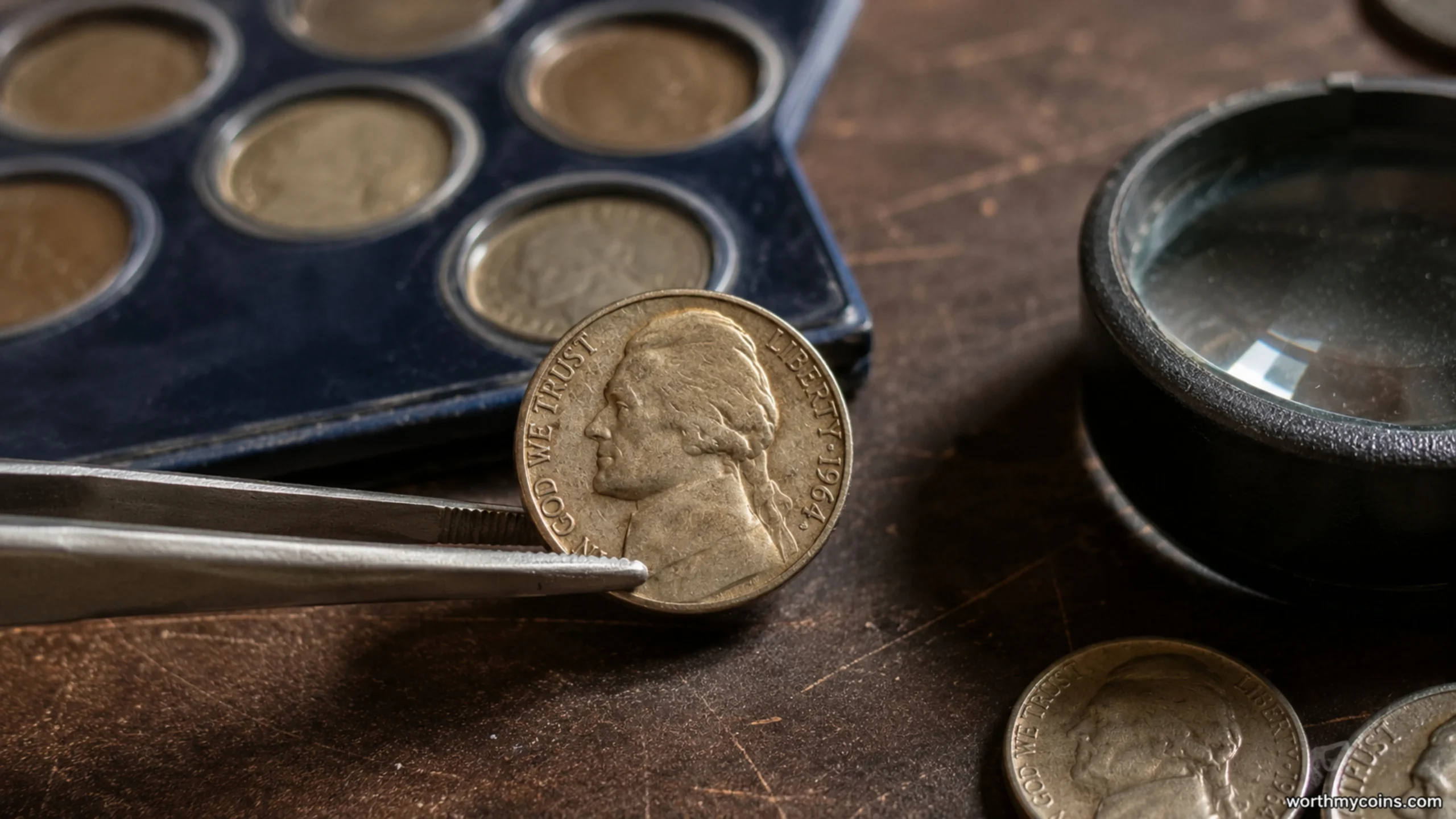
Jefferson Nickel Error Guide: Jefferson nickels have been part of everyday American pocket change since 1938, but they also offer some of the most interesting error coins and collectible varieties in modern U.S. numismatics. While most Jefferson nickels are worth only face value in circulated condition, certain verified mint errors, recognized die varieties, and well-preserved examples can attract strong collector interest.
Whether you’re checking bank rolls, sorting through an inherited collection, or looking at the nickels in your pocket, it’s helpful to know what makes one coin collectible while another is simply common change. This guide explains how to identify important varieties, recognize verified mint errors, and understand the factors collectors use when evaluating Jefferson nickels.
If you’re interested in discovering other valuable coins that still occasionally turn up in circulation, be sure to explore our Top Modern Quarters Worth Money guide, which highlights collectible quarters every coin hunter should know about.
Jefferson Nickel Specifications
| Specification | Details |
|---|---|
| First Year | 1938 |
| Designer | Felix Schlag |
| Composition (1938–1942, 1946–Present) | 75% Copper, 25% Nickel |
| Wartime Composition (1942–1945 Silver Issues) | 56% Copper, 35% Silver, 9% Manganese |
| Diameter | 21.21 mm |
| Weight | 5.00 grams (standard composition) |
| Edge | Plain |
| Obverse | Thomas Jefferson |
| Reverse (1938–2003) | Monticello |
| Reverse (2004–2005) | Westward Journey designs |
| Reverse (2006–Present) | Forward-facing Jefferson with Monticello reverse |
History of the Jefferson Nickel
The Jefferson nickel replaced the Buffalo nickel in 1938 following a design competition won by sculptor Felix Schlag. His design featured President Thomas Jefferson on the obverse and his Virginia home, Monticello, on the reverse.
Collectors who enjoy Jefferson nickels often expand into earlier five-cent coinage as well. Our Buffalo Nickel Value Guide explains the key dates, mint errors, and varieties that make this classic series so popular.
During World War II, nickel became an important strategic metal. Beginning late in 1942, the U.S. Mint temporarily changed the alloy by replacing most of the nickel with silver and manganese. These wartime nickels remain popular with collectors because of their unique composition and the large mint mark placed above Monticello on the reverse.
The Jefferson nickel series has continued through numerous design updates while remaining one of the longest-running coin series in American circulation.
How to Identify a Jefferson Nickel
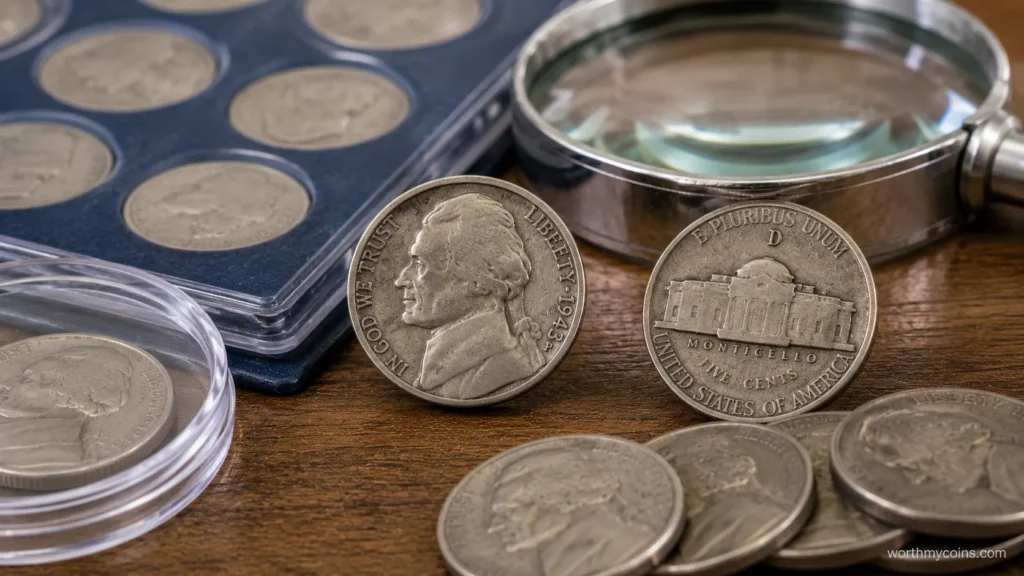
Collectors should first identify several basic characteristics before searching for possible errors.
| Feature | What to Check |
|---|---|
| Date | Look for key years and varieties |
| Mint Mark | Identify P, D, S, or no mint mark |
| Composition | Determine whether it is a wartime silver issue |
| Strike Quality | Look for weak or unusually sharp details |
| Surface | Examine for damage versus genuine mint errors |
| Weight | Compare with official Mint specifications when investigating missing-clad or planchet errors |
Good lighting and at least a 5x to 10x magnifier make identifying genuine varieties much easier.
If you’re comparing a suspected variety, examine more than one design element instead of relying on a single feature. Genuine die varieties usually show consistent characteristics in multiple locations on the coin.
Jefferson Nickel Mint Marks
Jefferson nickels have been produced at multiple U.S. Mint facilities.
| Mint | Mint Mark | Notes |
|---|---|---|
| Philadelphia | None (1938–1979 except wartime), P (1980–Present) | Wartime nickels also used a large P above Monticello |
| Denver | D | Produced throughout much of the series |
| San Francisco | S | Primarily proof coins after circulation production ended |
| Wartime Nickels | Large P, D, or S | Located above Monticello on the reverse |
The presence of a mint mark alone does not make a Jefferson nickel valuable. Collectors consider date, condition, rarity, and recognized varieties together.
Many beginning collectors mistakenly assume every older nickel with a mint mark is rare. In reality, the combination of date, variety, condition, and authentication is far more important than the mint mark by itself.
What Determines the Value of a Jefferson Nickel?
Several factors determine whether a Jefferson nickel commands collector premiums.
Condition
Coins with minimal wear generally appeal to more collectors than heavily circulated examples. Uncirculated coins that retain original mint luster often receive stronger market demand.
Full Steps Designation
One of the most important quality factors is the Full Steps designation.
Major grading services such as PCGS and NGC recognize Jefferson nickels that display a fully defined set of steps on Monticello. These coins are often scarcer because complete strikes were difficult to achieve at many mints.
Not every Jefferson nickel qualifies, even if it appears uncirculated.
Certified Grade
Professional grading helps establish authenticity and condition. Higher certified grades may significantly affect collector demand, particularly for scarce dates or recognized varieties.
Certification does not automatically make a common coin valuable, but it provides collectors with greater confidence in the coin’s authenticity, attribution, and condition.
Collector Demand
Popularity changes over time. Certain varieties receive greater attention because of new research, registry competition, or increased collector interest.
Coin Grading Overview
Professional grading follows the Sheldon Scale from Poor-1 through Mint State-70.
General grading characteristics include:
- Heavy wear with major detail missing (Good to Very Good)
- Moderate wear while major design elements remain visible (Fine to Very Fine)
- Light wear limited to the highest points (Extremely Fine to About Uncirculated)
- No circulation wear with original mint surfaces (Mint State)
Because Jefferson nickels often develop contact marks during production and circulation, grading should consider both wear and surface preservation.
Verified Jefferson Nickel Errors and Varieties
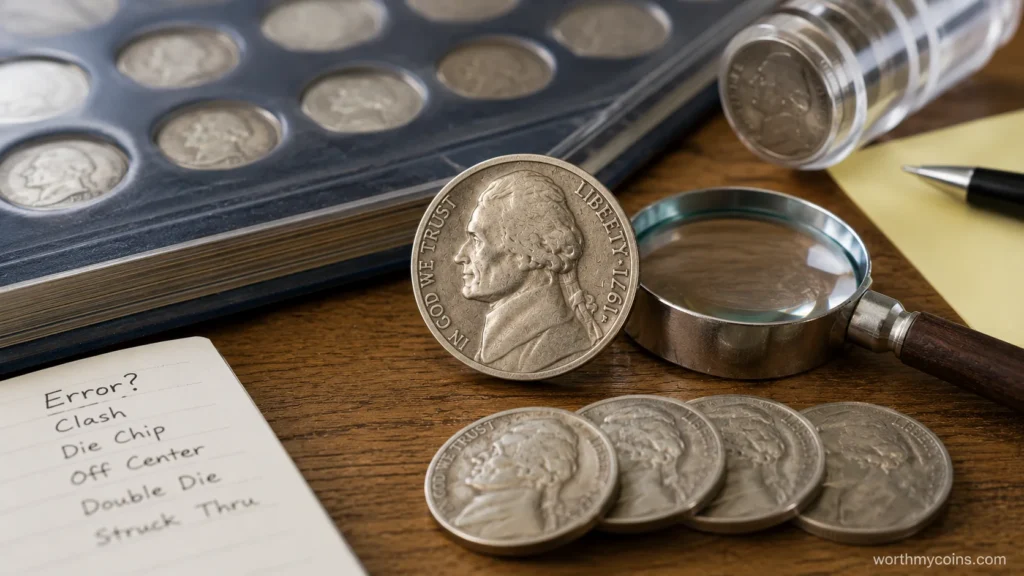
Many unusual-looking nickels are simply damaged after leaving the Mint. The following varieties and errors are among the best documented and recognized within the hobby.
Doubled Die Errors
A doubled die occurs during die creation rather than during striking.
Collectors should look for:
- Clear doubling on lettering
- Doubling in the date
- Separation visible under magnification
- Consistent doubling across multiple examples from the same die
Only recognized doubled dies listed by respected attribution organizations should be considered collectible varieties.
Repunched Mint Marks (RPMs)
Before mint marks became part of the master die, they were punched individually by hand.
On some earlier Jefferson nickels, the mint mark was punched more than once, creating visible overlapping impressions.
RPMs are especially collected on pre-1990 Jefferson nickels because later mint marks became part of the die itself.
Over Mint Marks (OMMs)
An over mint mark occurs when one mint mark was punched over another.
These are legitimate mint varieties but occur only on specific documented coins. Attribution guides should always be consulted before purchasing one.
Off-Center Strikes
An off-center strike happens when the planchet is not properly positioned during striking.
Depending on the amount of the design missing, these coins may display:
- Blank crescent-shaped areas
- Partial dates
- Misaligned designs
Coins missing the entire date generally receive less collector interest than those retaining a visible date.
Broadstrikes
Broadstruck nickels are struck without the retaining collar that normally forms the coin’s diameter.
Typical characteristics include:
- Larger diameter
- Missing rim
- Flattened appearance
- Complete design without normal edge definition
Clipped Planchets
A clipped planchet results when the metal strip is improperly fed during blank production.
Authentic clips often show:
- Curved missing section
- Blakesley Effect (weak rim opposite the clip)
- Consistent metal flow
Random cuts or damage after circulation should not be confused with genuine clips.
Die Cracks
Over time, striking dies develop cracks that appear as raised lines on finished coins.
Minor die cracks are fairly common and generally carry modest premiums, while dramatic retained or shattered die states attract greater collector attention.
Die Breaks and Cuds
A cud forms when part of the die breaks away near the edge.
Collectors may notice:
- Raised blobs of metal
- Missing rim details
- Distorted lettering near the affected area
Large cuds are among the more visually dramatic Jefferson nickel errors.
Die Chips
Small pieces of broken die steel may leave raised bumps on a coin.
Most die chips are considered minor mint errors, although unusually large or distinctive examples sometimes attract specialists.
Lamination Errors
Metal impurities or bonding problems during planchet production can create peeling or lifting metal surfaces.
These should not be confused with corrosion or environmental damage.
Wrong Planchet Errors
Occasionally a Jefferson nickel is struck on a planchet intended for another denomination.
These dramatic errors require careful authentication because incorrect weight, diameter, and composition are essential identifying characteristics.
Professional certification is strongly recommended before assuming a coin was struck on the wrong planchet.
Wrong-planchet errors are identified by evaluating the coin’s weight, diameter, composition, and striking characteristics together rather than relying on appearance alone.
Similar mint-production mistakes can also be found on classic U.S. cents. Our Lincoln Wheat Penny Value Guide (1909–1958) explains many of the major error types and key dates that continue to attract collectors.
Verified Jefferson Nickel Error Types
| Error Type | Verified by Major Grading Services | Authentication Recommended |
|---|---|---|
| Doubled Die | Yes | Yes |
| Repunched Mint Mark | Yes | Yes |
| Over Mint Mark | Yes | Yes |
| Off-Center Strike | Yes | Yes |
| Broadstrike | Yes | Yes |
| Clipped Planchet | Yes | Yes |
| Lamination Error | Yes | Yes |
| Wrong Planchet | Yes | Strongly Recommended |
| Die Crack | Yes | Helpful |
| Cud | Yes | Yes |
Tips for Collecting Jefferson Nickel Errors
Many collectors enjoy searching circulation because Jefferson nickels remain widely available.
Helpful practices include:
- Search bank rolls regularly.
- Compare suspected varieties with trusted attribution guides.
- Handle coins only by the edges.
- Store collectible coins in inert holders.
- Keep detailed records of where unusual coins were found.
- Learn the difference between genuine mint errors and post-mint damage.
Many experienced collectors focus on one specialty, such as Full Steps nickels, wartime issues, doubled dies, or major striking errors.
Common Mistakes New Collectors Make
Assuming Every Old Nickel Is Valuable
Age alone does not determine value. Millions of Jefferson nickels survive from many years.
Confusing Damage With Mint Errors
Parking lot damage, tool marks, corrosion, heat exposure, and chemical alteration are frequently mistaken for mint errors.
True mint errors occur during the manufacturing process.
Cleaning Coins
Cleaning almost always reduces collector appeal.
Even gentle polishing may leave hairlines or remove original surfaces.
Ignoring Authentication
If you believe you’ve found a rare variety or a significant mint error, professional authentication is the safest way to confirm it’s genuine before buying, selling, or assigning a premium value.
Believing Viral Social Media Claims
Online videos often exaggerate rarity or values.
Always compare claims with reputable numismatic references before assuming a coin is rare.
Should You Have Your Jefferson Nickel Professionally Graded?
Professional grading may be worthwhile if your coin appears to have:
- A recognized doubled die
- A significant striking error
- A wrong planchet
- An unusual major variety
- Exceptional uncirculated preservation
- Potential Full Steps designation
Certification can provide authentication, standardized grading, and increased buyer confidence.
Authentication has played a crucial role in confirming legendary rarities such as the 1943 Bronze Lincoln Wheat Penny, one of the most famous mint errors in American numismatics.
Conclusion
Jefferson nickels remain one of the most enjoyable U.S. coin series to collect because they combine a long history with a wide range of interesting varieties and mint errors. While most examples found in circulation are common, verified doubled dies, repunched mint marks, and major striking errors continue to attract collectors.
The best collections are built on careful research rather than exciting online claims. Learning how genuine mint errors are created, comparing your coins with trusted references, and seeking professional authentication when needed will help you make better collecting decisions.
Whether you’re searching pocket change or building a date-and-mint collection, patience and careful observation will help you recognize genuine collectible coins. Even common-looking Jefferson nickels can sometimes reveal an overlooked variety or mint error after a closer inspection.
As your collection grows, exploring other classic U.S. coin series can deepen your understanding of rarity, grading, and long-term collector demand. If you’d like to continue learning, our Morgan Dollar Value Guide explores another iconic American coin series with its own key dates, valuable varieties, and collecting history.
Frequently Asked Questions
Are Jefferson nickel errors rare?
Some are relatively common, such as minor die cracks, while major errors like wrong planchet strikes or significant off-center strikes are much scarcer. Availability varies greatly depending on the specific error.
How can I tell if my Jefferson nickel has a real error?
Examine the coin under magnification, compare it with established attribution resources, verify its weight and dimensions if necessary, and seek professional authentication for valuable-looking examples.
Are all wartime Jefferson nickels valuable?
Wartime silver nickels are popular because of their unique composition, but value depends largely on condition, collector demand, and whether the coin has notable varieties or exceptional preservation.
What is the Full Steps designation?
Full Steps is a designation used by major grading services for Jefferson nickels showing sharply defined steps on Monticello. Not every uncirculated coin qualifies.
Can I still find collectible Jefferson nickels in circulation?
Yes. Although many circulated Jefferson nickels are common, collectors still occasionally discover wartime silver nickels, recognized varieties, and genuine mint errors in pocket change or bank rolls.
Should I clean a Jefferson nickel before selling it?
No. Cleaning can permanently damage a coin’s surfaces and often reduces its appeal to collectors.
Should I weigh a Jefferson nickel if I suspect an error?
Yes, especially if you suspect a wrong-planchet or composition-related error. Use a calibrated digital scale and compare the result with official U.S. Mint specifications before drawing conclusions.
References
This guide is based on published U.S. Mint information, recognized third-party grading standards, and established numismatic references. Because every mint error is unique, collectors should rely on professional authentication before assigning rarity or significant value.
- United States Mint – Jefferson Nickel History & Specifications
- Professional Coin Grading Service (PCGS) – CoinFacts Jefferson Nickels
- Numismatic Guaranty Company (NGC) – U.S. Coin Explorer & Jefferson Nickels
- American Numismatic Association (ANA) – Coin Grading Standards & Educational Resources
- Heritage Auctions – U.S. Coin Auction Archives
- Stack’s Bowers Galleries – Jefferson Nickel Resource Center
- Newman Numismatic Portal – Digital Numismatic Library

Narayan Kumar is the Founder and Author of Worth My Coins. She specializes in U.S. coin collecting, with a focus on coin identification, mint errors, grading, rare varieties, and collector education. Her goal is to publish accurate, well-researched, and easy-to-understand guides that help both new and experienced collectors make informed decisions. Every article is created using trusted numismatic references and is written with a commitment to accuracy, transparency, and long-term educational value.