The Draped Bust Half Dollar stands among the most historically significant coins ever produced by the early United States Mint. Struck during the nation’s formative years, these silver half dollars witnessed the growth of America’s economy while showcasing the evolving craftsmanship of the young Mint. Today, collectors value them not only for their rarity but also for their connection to early American history, remarkable die varieties, and strong demand within the numismatic community.
While every Draped Bust Half Dollar deserves attention, a select group has become especially famous because of its historical importance, distinctive varieties, rarity, or lasting influence on U.S. coin collecting. Whether you’re new to early American coinage or expanding an advanced collection, understanding these landmark issues provides valuable insight into one of the most fascinating series in American numismatics.
Quick Answer
The most historically important Draped Bust Half Dollars include the 1794 first-year issue, the 1797 final Small Eagle reverse, the 1801 introduction of the Heraldic Eagle reverse, the 1807 final Draped Bust design, and several highly studied dates recognized for important Overton die marriages. Their significance comes from their role in early U.S. Mint history, limited surviving populations, historical context, and enduring collector demand. Market values vary according to authenticity, grade, originality, certification, specific die marriage, and recent auction results.
Why Draped Bust Half Dollars Matter in American Numismatic History
The Draped Bust Half Dollar was produced from 1794 through 1807 and represents one of the earliest silver denominations issued by the United States Mint. During this period, American coinage was still developing standardized manufacturing methods, resulting in numerous die varieties and distinctive production characteristics that continue to fascinate collectors today.
Designed during the nation’s early years, these coins circulated during a period when the United States was establishing its financial system. Every surviving example serves as a tangible connection to the country’s formative decades.
Several characteristics make the series especially important:
| Feature | Why It Matters |
|---|---|
| Early U.S. coinage | Represents America’s first generation of federal silver coins |
| Historical significance | Produced during the nation’s formative years |
| Hand-crafted dies | Created numerous collectible die marriages |
| Limited survivors | Many coins circulated heavily, leaving relatively few high-grade examples |
| Active collector interest | Popular among specialists and advanced U.S. coin collectors |
Understanding the Draped Bust Half Dollar Design
Before exploring the most historically important issues, it helps to understand the two major reverse designs found within the series.
Small Eagle Reverse (1794–1797)
The earliest Draped Bust Half Dollars feature a relatively simple eagle perched within a wreath. Because this design appeared for only a short period, Small Eagle coins are especially desirable among collectors.
Heraldic Eagle Reverse (1801–1807)
Beginning in 1801, the reverse adopted the Heraldic Eagle inspired by the Great Seal of the United States. This design remained in use until the series ended in 1807 before the introduction of the Capped Bust Half Dollar.
What Makes a Draped Bust Half Dollar Historically Important?
Not every coin becomes historically significant for the same reason. Specialists often evaluate several factors together.
These include:
- First-year or transitional issues
- Important die marriages identified by Overton
- Historical production context
- Scarcity of surviving examples
- Long-standing collector demand
- Exceptional preservation
- Well-documented provenance
- Appearance in major collections and public auctions
Rather than focusing solely on price, experienced collectors appreciate how each issue contributed to the development of early United States coinage.
Top 10 Draped Bust Half Dollars That Made Numismatic History
1. 1794 Draped Bust Half Dollar
The 1794 Draped Bust Half Dollar holds a special place in American numismatics as the first year of the denomination’s production. As one of the earliest silver coins struck by the United States Mint, it represents the beginning of federal half dollar coinage.
Collectors prize this issue because it reflects the experimental nature of early Mint operations. Dies were individually hand prepared, striking quality often varied, and surviving examples display the distinctive characteristics expected from America’s first generation of coin production.
Identification
- Date: 1794
- Reverse: Small Eagle
- Composition: Silver
- Edge: Lettered edge
- No mint mark (Philadelphia Mint)
Why It Made Numismatic History
- First-year Draped Bust Half Dollar
- Among the earliest federal silver denominations
- Major milestone in U.S. Mint history
- Highly respected by collectors and researchers
2. 1795 Draped Bust Half Dollar
The 1795 issue expanded production of the new half dollar denomination while introducing numerous die marriages that continue to attract specialist collectors today.
Overton’s research documents many fascinating die combinations from this year, making 1795 one of the richest dates for variety collectors. Individual die marriages often display distinctive star arrangements, date placements, or reverse details.
Identification
- Date: 1795
- Reverse: Small Eagle
- Multiple documented die marriages
- Philadelphia Mint
Historical Importance
- Demonstrates improving Mint production
- Rich variety of collectible die marriages
- Important year for Overton variety specialists
3. 1796 Draped Bust Half Dollar
Although production remained relatively modest, the 1796 Draped Bust Half Dollar represents another important step in the evolution of America’s early silver coinage.
Many surviving examples exhibit extensive circulation, reminding collectors that these coins fulfilled their intended role in everyday commerce during the nation’s earliest decades.
Why Collectors Appreciate It
- Historic Small Eagle design
- Early federal silver issue
- Strong demand among type collectors
- Important component of complete Draped Bust collections
4. 1797 Draped Bust Half Dollar
The 1797 issue marked the final appearance of the Small Eagle reverse on the Draped Bust Half Dollar.
As the last year featuring this reverse design, it serves as an important transitional issue within the series. Specialists study its numerous die marriages extensively, and collectors often seek it to complete a Small Eagle type set.
Historical Significance
- Final Small Eagle reverse
- Numerous documented Overton varieties
- Important transition within the series
- Popular among advanced early half dollar collectors
5. 1801 Draped Bust Half Dollar
Following the final Small Eagle issues of 1797 and a suspension of Draped Bust Half Dollar production in 1798–1800, the denomination returned in 1801 with the new Heraldic Eagle reverse.
The redesigned reverse dramatically changed the coin’s appearance and aligned it more closely with other contemporary federal silver denominations.
Identification
- Date: 1801
- Heraldic Eagle reverse
- Philadelphia Mint
- Lettered edge
Why It Matters
- First Heraldic Eagle Draped Bust Half Dollar
- Represents a major design transition
- Important type coin for early U.S. collections
How Condition Influences Historical and Market Significance
Although historical importance remains constant, collector value varies dramatically based on preservation.
| Grade Range | General Characteristics |
|---|---|
| Good (G) | Heavy wear but major design elements remain identifiable |
| Fine (F) | Moderate wear with stronger detail visible |
| Very Fine (VF) | Most design details remain clear |
| Extremely Fine (XF) | Light wear on high points |
| About Uncirculated (AU) | Slight friction with substantial original detail |
| Mint State (MS) | No circulation wear, though strike quality may vary |
For early Draped Bust Half Dollars, originality often matters as much as numeric grade. Collectors generally prefer coins with natural surfaces, attractive toning, and minimal cleaning, especially when certified by a respected third-party grading service.
6. 1802 Draped Bust Half Dollar
The 1802 Draped Bust Half Dollar continues the Heraldic Eagle design introduced the previous year and remains an important issue within the series. Like many early federal coins, surviving examples vary considerably in strike quality due to the minting technology of the era.
Collectors frequently study the 1802 issue for its documented die marriages, making it appealing to both type collectors and Overton variety specialists.
Identification
- Date: 1802
- Heraldic Eagle reverse
- Philadelphia Mint
- Lettered edge
Why It Made Numismatic History
- Continues the Heraldic Eagle design during the early years of the series
- Includes collectible die marriages recognized by specialists
- Represents the growing maturity of early U.S. Mint production
7. 1805 Draped Bust Half Dollar
After a gap in production during 1803 and 1804, the half dollar returned in 1805. This issue reflects renewed coinage at the Philadelphia Mint during a period of increasing commercial activity in the United States.
Many examples entered circulation immediately, making well-preserved pieces significantly less common than heavily worn survivors.
Identification
- Date: 1805
- Heraldic Eagle reverse
- Philadelphia Mint
Historical Importance
- Marks the return of half dollar production
- Popular among collectors assembling complete date sets
- Numerous recognized die marriages add collecting interest
8. 1806 Draped Bust Half Dollar
The 1806 Draped Bust Half Dollar is among the best-known issues in the series because of its multiple varieties and extensive study by early half dollar specialists.
Several Overton varieties from this year are actively pursued by advanced collectors, highlighting the craftsmanship and die preparation methods used by the early United States Mint.
Identification
- Date: 1806
- Heraldic Eagle reverse
- Multiple documented die marriages
- Philadelphia Mint
Why Collectors Value It
- Rich variety of collectible die marriages
- Well documented in early half dollar research
- Widely collected by both specialists and type collectors
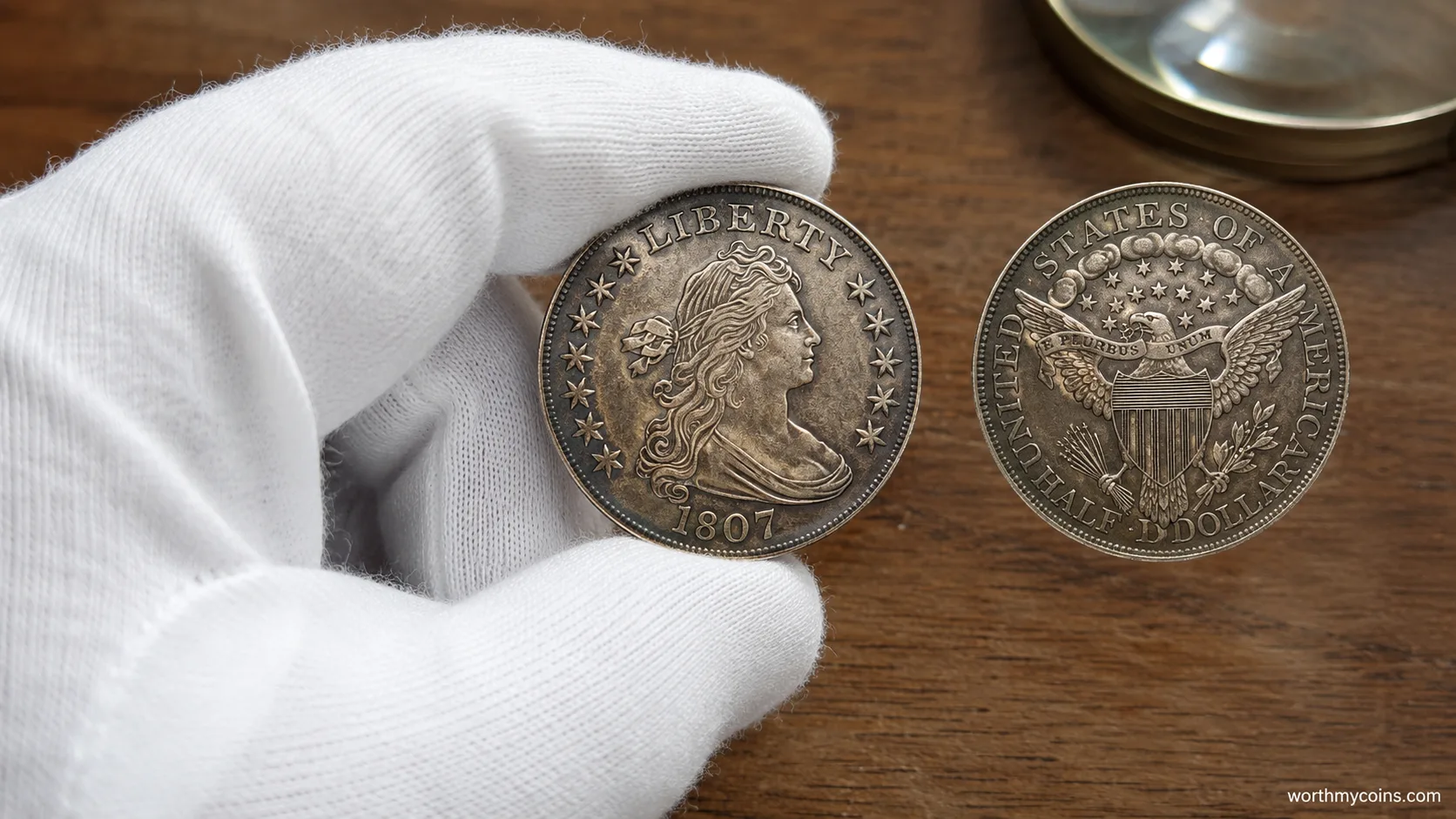
9. 1807 Draped Bust Half Dollar
The 1807 Draped Bust Half Dollar represents the final year of the Draped Bust design before the introduction of the Capped Bust Half Dollar later that year.
Collectors interested in the evolution of early U.S. half dollars can continue the story with Top 10 Capped Bust Half Dollars Worth Money Every Collector Should Know, which explores the influential series that succeeded the Draped Bust Half Dollar.
Because it marks the end of an important chapter in American coinage, it remains one of the most historically meaningful issues in the series.
Identification
- Date: 1807
- Heraldic Eagle reverse
- Final Draped Bust Half Dollar
- Philadelphia Mint
Why It Made Numismatic History
- Final year of the Draped Bust design
- Transition to the Capped Bust series
- Significant milestone in early U.S. Mint history
What Is an Overton Number?
Collectors often identify Draped Bust Half Dollars by an “Overton number,” commonly abbreviated as “O-“. Each Overton number represents a specific pairing of obverse and reverse dies used to strike a coin. Because dies were individually prepared and reused in different combinations, some marriages are considerably scarcer than others, making Overton attribution an important area of early half dollar collecting.
Although not a single coin, the documented die marriages identified in Al C. Overton’s research have become an essential part of Draped Bust Half Dollar collecting.
Each die marriage records a unique pairing of obverse and reverse dies, often distinguished by subtle differences such as star placement, date spacing, lettering, crack development, or berry arrangements on the wreath and olive branch.
Rather than collecting only one coin from each date, many specialists pursue complete sets of Overton varieties, making this one of the most advanced and respected areas of early American numismatics.
Why They Made Numismatic History
- Created a standardized system for identifying early half dollar die marriages
- Expanded research into early U.S. Mint production methods
- Form the foundation of advanced Draped Bust Half Dollar collecting today
How to Identify a Genuine Draped Bust Half Dollar
Because these coins are valuable and widely collected, proper identification is essential.
Look for the following characteristics:
- Draped Liberty portrait facing right
- Lettered edge rather than a reeded edge
- Correct Small Eagle or Heraldic Eagle reverse for the date
- Appropriate weight and silver composition for the series
- Natural wear patterns consistent with early silver coinage
- No added mint marks, as all Draped Bust Half Dollars were struck at the Philadelphia Mint and carry no mint mark
Because counterfeit early U.S. silver coins exist in the marketplace, authentication by a recognized third-party grading service is strongly recommended before purchasing higher-value examples. Certification also provides an independent assessment of authenticity and condition.
Why Certification Matters
Certification can significantly improve buyer confidence for early U.S. silver coins. Third-party grading services authenticate the coin, assign a professional grade, and encapsulate it in a tamper-evident holder. While certification does not guarantee market value, it provides a standardized opinion that many collectors and auction houses rely on when buying or selling Draped Bust Half Dollars.
No single price applies to every Draped Bust Half Dollar. Market value depends on a combination of factors, including:
| Factor | Impact on Value |
|---|---|
| Date | Some years are scarcer than others |
| Die marriage | Certain Overton varieties are more desirable |
| Grade | Better preservation generally increases collector demand |
| Original surfaces | Natural, problem-free coins are preferred |
| Certification | Professionally authenticated coins often inspire greater buyer confidence |
| Eye appeal | Attractive toning and strong detail can improve desirability |
| Recent auction results | Market demand changes over time |
Even two examples from the same year can differ significantly in value because of these characteristics.
Understanding Grades
Collectors typically evaluate Draped Bust Half Dollars using the Sheldon grading scale.
Good (G)
Heavy wear is present, but the date and major design elements remain identifiable.
Fine (F)
Moderate wear with stronger central detail and clearer lettering.
Very Fine (VF)
Most major design elements remain well defined, though moderate circulation wear is visible.
Extremely Fine (XF)
Only light wear appears on the highest points, with substantial detail preserved.
About Uncirculated (AU)
Very slight friction from handling while retaining nearly full detail.
Mint State (MS)
No evidence of circulation wear. Early Draped Bust Half Dollars in Mint State are exceptionally scarce compared with later U.S. coin series.
Common Mistakes New Collectors Make
Beginners can avoid many costly errors by understanding the series before making a purchase.
Some of the most common mistakes include:
- Assuming every old half dollar is rare.
- Ignoring condition when comparing prices.
- Overlooking die varieties.
- Buying raw coins without carefully evaluating authenticity.
- Mistaking cleaned coins for higher-grade examples.
- Focusing only on age instead of overall quality and originality.
Learning the basics of grading and authentication can help collectors make more informed decisions.
Buying and Selling Tips
Whether buying or selling Draped Bust Half Dollars, careful research is essential.
Before purchasing:
- Study certified examples to understand genuine characteristics.
- Compare multiple photographs of the same date.
- Learn the major Overton varieties if collecting by die marriage.
- Purchase from reputable coin dealers, established auction firms, or well-known numismatic marketplaces that provide clear return policies and authenticity guarantees whenever possible.
Proper Storage Tips
To help preserve originality, store Draped Bust Half Dollars in inert holders designed for long-term coin storage. Avoid PVC-containing flips, excessive humidity, abrasive cleaning, and direct handling with bare fingers, as these can permanently affect a coin’s surfaces.
- Consider professional authentication and grading before selling a higher-value example, as certified coins often attract greater buyer confidence in the marketplace.
- Review recent auction results for comparable certified examples.
- Preserve original surfaces by avoiding cleaning or polishing.
- Keep any historical documentation or provenance with the coin.
Frequently Asked Questions
What is the oldest Draped Bust Half Dollar?
The first Draped Bust Half Dollar was struck in 1794, making it the oldest coin in the series.
Do Draped Bust Half Dollars have mint marks?
No. All Draped Bust Half Dollars were struck at the Philadelphia Mint during this period and therefore carry no mint mark.
Why are Overton varieties important?
Overton varieties identify specific obverse and reverse die pairings. They allow collectors to study how individual dies were produced and used, making them an important part of early half dollar research.
Are all Draped Bust Half Dollars valuable?
Most surviving examples attract collector interest because of their age and historical importance. However, market value varies considerably depending on authenticity, date, die marriage, grade, originality, certification, eye appeal, and current collector demand.
Should beginners buy certified examples?
Certified coins graded by established third-party services can provide additional confidence regarding authenticity and condition, particularly for higher-value early U.S. silver coins.
Conclusion
The Draped Bust Half Dollar represents far more than an early piece of American silver. Each issue reflects the challenges, craftsmanship, and evolving standards of the young United States Mint during the nation’s formative years. From the groundbreaking 1794 first-year issue to the final 1807 Draped Bust design and the many celebrated Overton die marriages in between, these coins continue to inspire collectors, historians, and researchers alike.
While rarity and collector demand contribute to their appeal, their greatest importance lies in documenting the earliest years of federal coin production and the evolution of the United States Mint during the nation’s formative decades.
Understanding the history behind each issue, learning to recognize key design features, and appreciating the importance of originality and condition will help collectors make informed decisions and build a deeper appreciation for one of the most respected series in U.S. numismatics.
References
- United States Mint
- Professional Coin Grading Service (PCGS)
- Numismatic Guaranty Company (NGC)
- American Numismatic Association (ANA)
- Heritage Auctions
- Stack’s Bowers Galleries
- Newman Numismatic Portal
- A Guide Book of United States Coins (Whitman Publishing)
- Al C. Overton, Early Half Dollar Die Varieties 1794–1836

Narayan Kumar is the Founder and Author of Worth My Coins. She specializes in U.S. coin collecting, with a focus on coin identification, mint errors, grading, rare varieties, and collector education. Her goal is to publish accurate, well-researched, and easy-to-understand guides that help both new and experienced collectors make informed decisions. Every article is created using trusted numismatic references and is written with a commitment to accuracy, transparency, and long-term educational value.