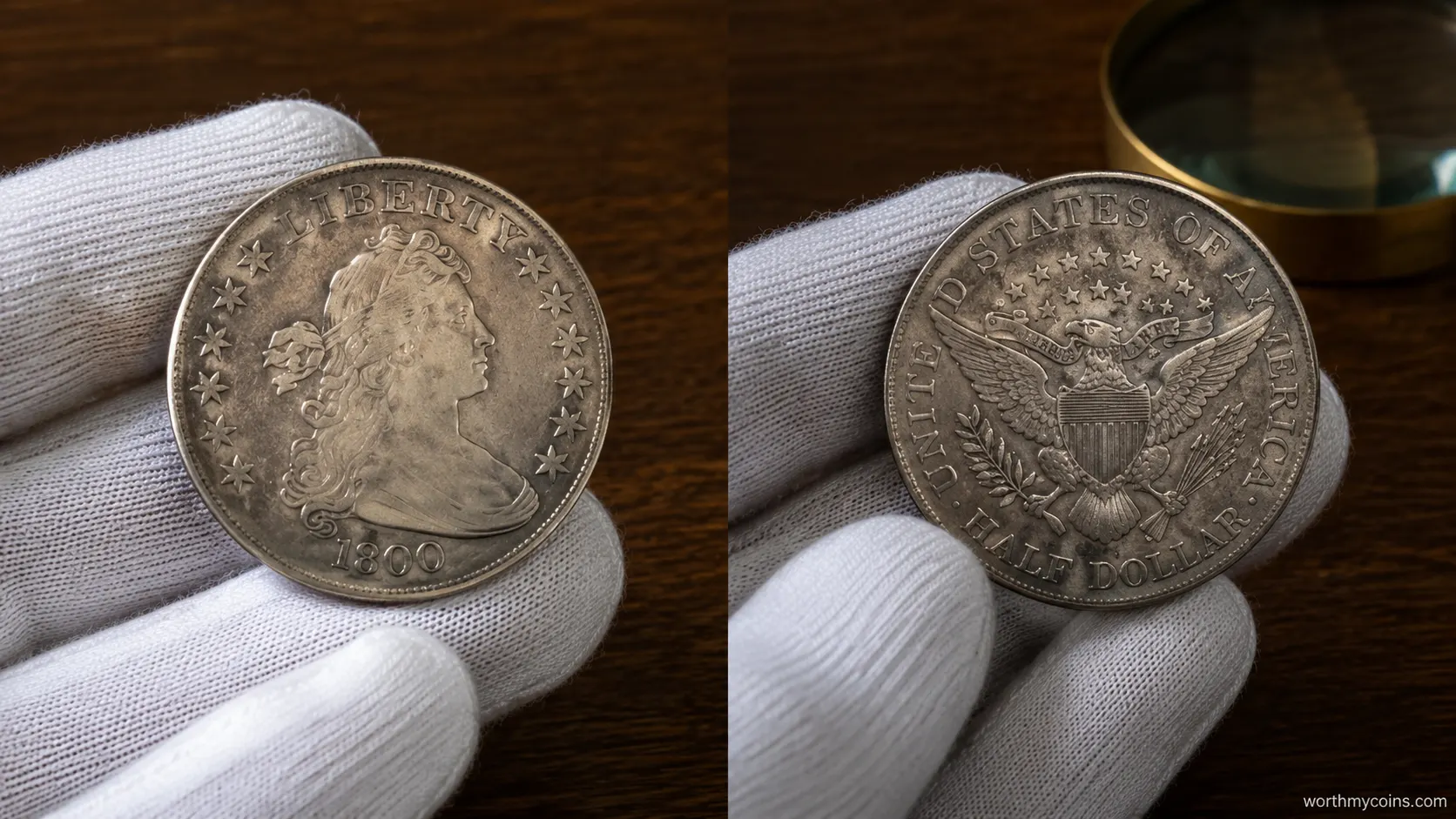
The Draped Bust Half Dollar occupies a special place in American numismatic history. PProduced during the earliest years of the United States Mint’s history these silver coins circulated when the nation was still defining its economy, commerce, and identity. More than two centuries later, they remain some of the most studied and admired U.S. coins because of their historical importance, limited surviving populations, and remarkable variety of die marriages.
While every Draped Bust Half Dollar tells part of America’s story, a handful of dates stand above the rest. Some represent key milestones in early federal coinage, others are celebrated for their rarity or famous die varieties, and several have become legendary among advanced collectors. Whether you’re new to early U.S. coins or expanding an established collection, understanding these historic half dollars helps explain why they continue to command such respect within the hobby.
Quick Answer
The most historically significant Draped Bust Half Dollars include landmark issues such as the 1794, 1795, 1796, 1797, 1801, 1802, 1805, the 1806 Pointed 6 and Knob 6 varieties, and the final-year 1807 Draped Bust Half Dollar.
Why Draped Bust Half Dollars Are So Important
The Draped Bust Half Dollar was struck from 1794 through 1807, making it one of the earliest silver denominations produced by the United States Mint. During this period, the country lacked a mature banking system, and silver coins played an essential role in everyday commerce.
Unlike modern coins manufactured with highly standardized equipment, each early half dollar was produced using hand-prepared dies and manually operated presses. As a result, every issue developed its own distinctive characteristics, creating the fascinating die varieties that collectors study today.
Another reason these coins remain highly desirable is survival. Although many coins were originally struck, centuries of circulation, melting, export, and loss have left far fewer surviving examples than their original mintages would suggest.High-grade pieces are especially scarce because most entered heavy commercial use.
Understanding Early Draped Bust Half Dollars
Before examining the most historic issues, it’s helpful to understand what makes these coins unique.
| Feature | Description |
|---|---|
| Years Produced | 1794–1807 |
| Composition | 89.24% silver, 10.76% copper |
| Weight | Approximately 13.48 grams |
| Diameter | Approximately 32.5 mm |
| Edge | Lettered edge |
| Designer | Robert Scot |
| Mint | Philadelphia (the only U.S. Mint producing half dollars during this period) |
Because all Draped Bust Half Dollars were struck in Philadelphia before branch mints existed, they do not carry mint marks.
Professional attribution often goes beyond the date alone. Many advanced collectors identify Draped Bust Half Dollars by their Overton die marriage, which documents the specific obverse and reverse die pairing used to strike the coin. This level of attribution helps collectors better understand rarity and Mint production practices, even when it does not substantially change market value.
What Makes Certain Draped Bust Half Dollars Historic?
Not every early half dollar is equally significant. Numismatists typically evaluate importance using several factors rather than age alone.
Historical Milestones
Coins associated with important events in early U.S. Mint history often receive special attention.
Die Varieties
Early half dollars are famous for their numerous die marriages, extensively documented by Al C. Overton. Some varieties are dramatically rarer than others.
Survival Rate
Original mintage figures provide useful context, but they do not fully reflect rarity because surviving populations vary significantly from one issue to another. The number of surviving examples often has a greater impact on collector demand.
Condition Rarity
Some dates may be obtainable in lower circulated grades but become exceptionally difficult in Mint State condition.
Collector Demand
Certain dates have developed legendary reputations among specialists, making them cornerstone pieces in advanced collections.
Top 10 Draped Bust Half Dollars That Made Numismatic History
1. 1794 Draped Bust Half Dollar
The 1794 Draped Bust Half Dollar represents the beginning of the denomination and one of the earliest silver half dollars ever produced by the United States Mint.
Its historical importance extends beyond its age. These coins were struck during the Mint’s formative years when production methods were still experimental, and consistency remained difficult to achieve. Surviving examples often display adjustment marks, uneven strikes, or planchet imperfections that reflect early minting technology rather than damage.
Because relatively few survive today, collectors regard the 1794 issue as one of the foundational coins of American numismatics. Even well-worn examples attract significant interest due to their connection with the earliest years of federal coinage.
Collector Highlights
- First year of Draped Bust Half Dollar production
- Major milestone in early U.S. Mint history
- Highly desirable across all grades
- Important foundation coin for early federal collections
2. 1795 Draped Bust Half Dollar
Production increased noticeably in 1795 as the Mint continued refining its operations. Although more examples were struck than the previous year, this issue remains one of the most recognizable coins from America’s earliest silver coinage.
Collectors appreciate the 1795 half dollar because it illustrates the rapid evolution of die engraving and manufacturing techniques during the young nation’s formative years. Numerous die marriages exist, providing specialists with a wide range of collectible varieties.
Many surviving examples exhibit honest circulation wear, demonstrating how extensively these coins participated in everyday commerce.
Collector Highlights
- Significant increase in production compared to 1794
- Numerous collectible die marriages
- Strong historical appeal
- Popular among both beginners and advanced specialists
3. 1796 Draped Bust Half Dollar
The 1796 Draped Bust Half Dollar occupies an important place in early American coinage because of its relatively limited production and strong collector demand.
Finding attractive examples can be challenging, particularly with original surfaces and minimal problems. Like many early federal coins, surviving pieces often show extensive circulation, making higher-grade examples considerably more elusive.
The coin also represents a transitional period when the Mint continued improving consistency while still relying on labor-intensive production methods.
Collector Highlights
- Historically important early issue
- Limited surviving population
- Strong collector demand
- Scarcer in higher certified grades
4. 1797 Draped Bust Half Dollar
Among early Draped Bust Half Dollars, the 1797 issue is especially well known for its fascinating die varieties and relative scarcity.
Specialists often study differences in stars, lettering, and other die characteristics to identify specific marriages. Some varieties are considerably more difficult to locate than others, adding another layer of interest for advanced collectors.
Because relatively few examples survive compared to later dates, the 1797 issue continues to enjoy strong demand in both circulated and Mint State grades.
Collector Highlights
- Famous for multiple die varieties
- Important year for Overton variety collectors
- Scarce across most grades
- Strong historical significance
5. 1801 Draped Bust Half Dollar
Following a short interruption in half dollar production, the 1801 Draped Bust Half Dollar marked the denomination’s return during an important period of early American commerce.
Collectors often value this issue for both its historical role and its relatively limited availability. Many examples entered circulation immediately after striking, leaving comparatively few coins with sharp detail today.
Well-preserved certified specimens are especially prized because they provide insight into the quality of early Mint production before widespread wear altered their original appearance.
Collector Highlights
- Marks the return of Draped Bust Half Dollar production
- Historically significant early federal issue
- Scarce with strong original detail
- Popular among advanced early silver collectors
How to Identify Genuine Draped Bust Half Dollars
Authenticating an early U.S. silver coin requires careful examination. Because of their value and popularity, Draped Bust Half Dollars have occasionally been counterfeited.
When examining a coin, pay close attention to:
- Correct weight and diameter
- Proper lettered edge
- Natural silver color and surface texture
- Accurate portrait and eagle details
- Die characteristics matching known genuine examples
For valuable specimens, professional authentication and grading by a recognized third-party service is generally recommended before buying or selling.
Collectors frequently compare higher-value coins with reference photographs and attribution guides published by PCGS CoinFacts, NGC VarietyPlus, and the Newman Numismatic Portal before making purchasing decisions. Using multiple trusted references can improve attribution accuracy, particularly for early die varieties.
6. 1802 Draped Bust Half Dollar
The 1802 Draped Bust Half Dollar is one of the more elusive issues in the series and has long been respected by collectors assembling complete date sets. Although it lacks the widespread recognition of the first-year 1794 issue, its combination of limited availability and historical significance makes it an important coin in early U.S. numismatics.
Most surviving examples saw extensive circulation during the early 19th century, so coins with strong detail and original surfaces are considerably more difficult to locate. As with many Draped Bust Half Dollars, specialists also study the various die marriages documented for this date.
Collector Highlights
- Scarce early-date Draped Bust Half Dollar
- Strong demand among date-set collectors
- Better-preserved examples are notably difficult to find
- Multiple recognized die marriages
7. 1805 Draped Bust Half Dollar
By 1805, the United States Mint had gained additional experience producing silver coinage, but each coin was still manufactured using hand-prepared dies and manually operated presses. These production methods created subtle differences between dies that remain an important area of study today.
The 1805 Draped Bust Half Dollar is popular with collectors because it represents the continued development of early federal coinage while remaining obtainable in a range of circulated grades. Certified Mint State examples, however, are significantly scarcer and command much greater collector attention.
Collector Highlights
- Important issue from the mature Draped Bust series
- Numerous collectible die marriages
- Readily recognized by early U.S. coin specialists
- Premium-quality examples are much less common
8. 1806 Draped Bust Half Dollar (Pointed 6)
Among all Draped Bust Half Dollars, the 1806 Pointed 6 variety is one of the best-known design varieties in the series. The distinction comes from the shape of the numeral “6” in the date, which features a pointed upper loop rather than the rounded style seen on the Knob 6 variety.
This subtle design difference has made the coin especially popular with variety collectors. While beginners may overlook the distinction, experienced numismatists recognize it as an important collectible subtype within the series.
How to Identify the Pointed 6
Look closely at the upper portion of the numeral “6” in the date:
- Narrow, pointed upper loop
- Sharper appearance than the Knob 6 variety
- Best examined with magnification
Collector Highlights
- One of the most recognized Draped Bust design varieties
- Essential for variety specialists
- Historically important subtype
- Frequently compared with the Knob 6 issue
9. 1806 Draped Bust Half Dollar (Knob 6)
The Knob 6 variety was struck during the same year but uses a different date punch, resulting in a noticeably rounded upper loop on the numeral “6.” Although the difference may appear minor, it represents an important distinction within early half dollar collecting.
Many collectors enjoy owning both 1806 varieties because together they illustrate how individual die preparation influenced early American coinage.
How to Identify the Knob 6
The numeral “6” displays:
- Rounded upper loop
- Fuller, more bulbous appearance
- Easily distinguishable from the Pointed 6 with careful comparison
Collector Highlights
- Companion variety to the Pointed 6
- Popular among Overton variety collectors
- Demonstrates hand-made die differences
- Important collectible subtype
10. 1807 Draped Bust Half Dollar
The 1807 Draped Bust Half Dollar marks the conclusion of one of the most historically important silver coin series produced by the early United States Mint. Later that year, the Capped Bust design replaced the Draped Bust motif, making this issue the final chapter of the series.
Collectors interested in what came next in the evolution of early U.S. half dollars should also read Top 10 Capped Bust Half Dollars Worth Money Every Collector Should Know, which explores the first major half dollar series introduced after the Draped Bust design.
Because it represents the end of the design type, the 1807 issue has lasting appeal among collectors building type sets as well as complete Draped Bust collections.
Many specialists also compare the final Draped Bust issues with the most desirable coins of the succeeding series in Top 10 Capped Bust Half Dollars That Became Collector Favorites, providing additional context for the transition between these two classic early American half dollar designs.
Like earlier dates, surviving examples span a wide range of conditions, but attractive certified pieces remain highly sought after.
Collector Highlights
- Final year of the Draped Bust Half Dollar series
- Historic transition to the Capped Bust design
- Popular type coin
- Important addition to early U.S. collections
Comparison of Historic Draped Bust Half Dollars
| Coin | Historical Importance | Best Known For |
|---|---|---|
| 1794 | First year of issue | Beginning of the series |
| 1795 | Expanded production | Numerous die marriages |
| 1796 | Early federal rarity | Limited surviving examples |
| 1797 | Variety-rich issue | Overton die marriages |
| 1801 | Return of production | Scarcity and historical significance |
| 1802 | Low surviving population | Collector demand |
| 1805 | Mature production era | Variety collecting |
| 1806 Pointed 6 | Major design variety | Distinct date style |
| 1806 Knob 6 | Companion variety | Rounded date punch |
| 1807 | Final Draped Bust issue | End of the design series |
Recent auction performance can also influence collector demand. While auction results should never be treated as fixed price guides, they provide useful evidence of how collectors currently value comparable certified examples in similar grades.
What Determines the Value of a Draped Bust Half Dollar?
No single price applies to every Draped Bust Half Dollar. Actual market value depends on several factors, and two coins of the same date can differ dramatically in price.
Grade
Condition remains one of the largest value drivers. Certified Mint State examples are generally much scarcer than circulated pieces, while coins with original surfaces and strong eye appeal often attract additional collector interest.
Rarity
Some dates and die marriages survive in much smaller numbers than others. Specialists often consider surviving populations in addition to original mintages when evaluating rarity.
Certification
Coins authenticated and graded by recognized third-party grading services such as PCGS and NGC generally provide buyers with greater confidence because authenticity and condition have been independently evaluated.
Eye Appeal
Natural toning, minimal surface distractions, and attractive overall appearance can significantly influence collector demand.
Collector Demand
Certain dates have become classic “must-own” coins because of their importance in early U.S. coinage, increasing competition whenever quality examples reach the market.
Grading Overview
Understanding grading helps collectors evaluate both rarity and value.
| Grade | Typical Characteristics |
|---|---|
| Good (G) | Major design visible with heavy wear |
| Very Good (VG) | More lettering and major details remain |
| Fine (F) | Moderate wear with stronger central detail |
| Very Fine (VF) | Most major design features remain distinct |
| Extremely Fine (XF) | Light overall wear with considerable detail |
| About Uncirculated (AU) | Only slight friction on high points |
| Mint State (MS) | No circulation wear; condition varies by numeric grade |
Because early silver coins often display strike weakness or planchet imperfections unrelated to circulation, grading should consider the coin as a whole rather than focusing on a single characteristic.
Common Mistakes New Collectors Make
Assuming Every Old Coin Is Rare
Age alone does not determine rarity. Historical significance, survival rate, condition, and collector demand all influence desirability.
Ignoring Die Varieties
Many Draped Bust Half Dollars have recognized die marriages that can affect collector interest. Learning basic variety identification can improve purchasing decisions.
Cleaning Early Silver Coins
Cleaning almost always reduces collector appeal. Even lightly polished surfaces may significantly affect market desirability.
Buying Without Authentication
Because early U.S. coins are valuable and frequently counterfeited, purchasing certified examples from reputable dealers or auction firms provides added confidence.
Buying and Selling Tips
Whether you’re adding a Draped Bust Half Dollar to your collection or preparing to sell one, careful research is essential.
When buying:
- Learn the key characteristics of the date you’re considering.
- Compare certified examples in similar grades and review recent public auction records to better understand current market activity.
- Purchase from established dealers or respected auction houses.
- Verify authenticity before completing expensive transactions.
When selling:
- Consider professional grading if the coin has not already been certified.
- Review recent public auction results for comparable examples.
- Provide clear photographs and accurate descriptions.
- Remember that condition, originality, and certification all influence buyer interest.
Conclusion
The Draped Bust Half Dollar series represents one of the most important chapters in the history of American coinage. Struck during the nation’s earliest years, these coins document the evolution of the United States Mint while offering collectors an extraordinary combination of history, artistry, and rarity.
From the groundbreaking 1794 issue to the final 1807 release, each coin reflects a different stage in the development of early federal silver coinage. Their numerous die varieties, limited surviving populations, and enduring collector demand have secured their place among the most respected coins in American numismatics.
Whether your goal is to build a complete date set, study Overton die marriages, or better understand the earliest years of United States coinage, Draped Bust Half Dollars remain one of the most rewarding and historically significant series in American numismatics.
Frequently Asked Questions
What years were Draped Bust Half Dollars produced?
Draped Bust Half Dollars were struck from 1794 through 1807 at the Philadelphia Mint.
Do Draped Bust Half Dollars have mint marks?
No. All Draped Bust Half Dollars were produced at the Philadelphia Mint before branch mints began striking half dollars, so they carry no mint mark.
Why are 1806 Draped Bust Half Dollars listed as Pointed 6 and Knob 6?
These names identify two different date punches used during production. The shape of the numeral “6” differs, creating two recognized collectible varieties.
Are all Draped Bust Half Dollars valuable?
Most genuine Draped Bust Half Dollars are desirable because of their age and historical importance. However, value varies significantly based on grade, rarity, die variety, originality, certification, eye appeal, and current collector demand.
Should beginners buy certified examples?
For higher-value early U.S. silver coins, certified examples graded by respected third-party services can provide greater confidence regarding authenticity and condition.
References
- United States Mint
- Professional Coin Grading Service (PCGS)
- Numismatic Guaranty Company (NGC)
- American Numismatic Association (ANA)
- Heritage Auctions
- Stack’s Bowers Galleries
- Newman Numismatic Portal
- A Guide Book of United States Coins (Whitman Publishing)
- Al C. Overton, Early Half Dollar Die Varieties 1794–1836

Narayan Kumar is the Founder and Author of Worth My Coins. She specializes in U.S. coin collecting, with a focus on coin identification, mint errors, grading, rare varieties, and collector education. Her goal is to publish accurate, well-researched, and easy-to-understand guides that help both new and experienced collectors make informed decisions. Every article is created using trusted numismatic references and is written with a commitment to accuracy, transparency, and long-term educational value.